Question:
Give step-by-step solution with explanation and final answer:
Did you like this answer?
👍 0
👎 0
Let's solve the problem step-by-step as per the given questions.
---
## **Given Data**
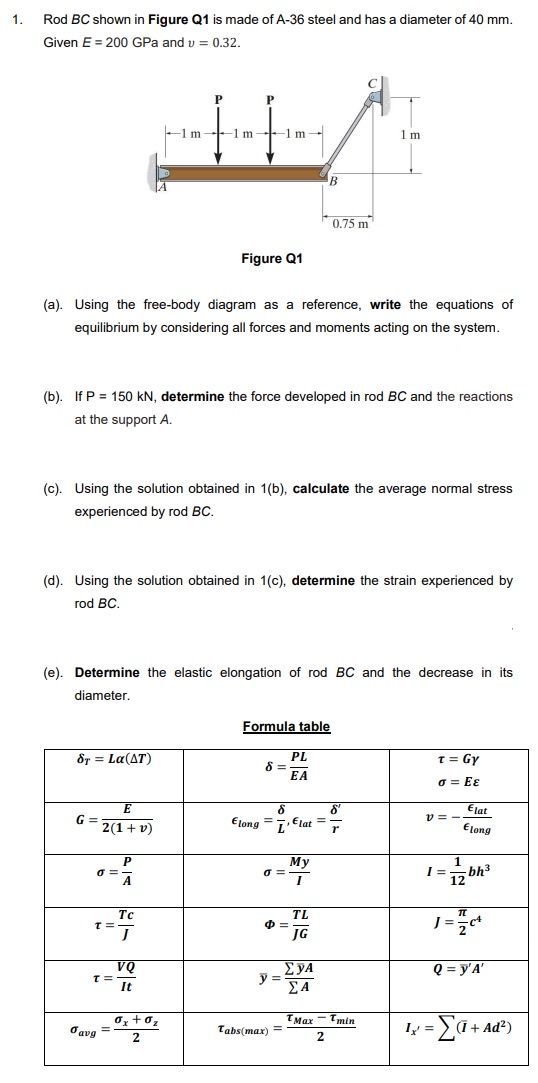
- **Diameter of rod BC, \( d \) = 40 mm = .04 m**
- **Length BC:**
\[
\text{Horizontal component} = .75~\text{m} \\
\text{Vertical component} = 1.~\text{m} \\
\text{Length } (L) = \sqrt{(.75^2 + 1^2)} = 1.25~\text{m}
\]
- **\( E = 200 \) GPa = \( 200 \times 10^9 \) Pa**
- **\( \nu = .32 \)**
- **Load \( P = 150 \) kN = \( 150,000 \) N**
---
## **(a) Write Equations of Equilibrium**
Let:
- \( A_x \) and \( A_y \) = reactions at A (horizontal and vertical)
- \( F_{BC} \) = force in rod BC (direction along BC)
- Point B has no vertical/horizontal support, only internal force from BC.
### **Free-Body Diagram Analysis**
**Sum of Forces:**
\[
\sum F_x = : \quad A_x - F_{BC} \cdot \cos\theta =
\]
\[
\sum F_y = : \quad A_y - 2P + F_{BC} \cdot \sin\theta =
\]
Where \( \theta \) is the angle of rod BC from the horizontal:
\[
\theta = \tan^{-1}\left(\frac{1.}{.75}\right) = 53.13^\circ
\]
**Sum of Moments about A:**
- The forces P act at 1 m and 2 m from A.
- The vertical component of BC acts at B (2.75 m from A).
\[
\sum M_A = : \quad -P \cdot 1 - P \cdot 2 + (F_{BC} \cdot \sin\theta) \cdot 2.75 =
\]
---
## **(b) Determine Force in BC and Reactions at A**
### **Step 1: Calculate \( F_{BC} \)**
From moment equilibrium:
\[
-150,000 \cdot 1 - 150,000 \cdot 2 + (F_{BC} \cdot \sin 53.13^\circ) \cdot 2.75 =
\]
\[
-150,000 - 300,000 + (F_{BC} \cdot .8) \cdot 2.75 =
\]
\[
-450,000 + 2.2 F_{BC} =
\]
\[
2.2 F_{BC} = 450,000
\]
\[
F_{BC} = \frac{450,000}{2.2} = 204,545.45~\text{N}
\]
### **Step 2: Reactions at A**
\[
A_x = F_{BC} \cdot \cos\theta = 204,545.45 \times .6 = 122,727.27~\text{N}
\]
\[
A_y = 2P - F_{BC} \cdot \sin\theta = 300,000 - 204,545.45 \times .8 = 135,454.55~\text{N}
\]
---
## **(c) Average Normal Stress in BC**
\[
\sigma = \frac{P}{A}
\]
Where \( A = \frac{\pi}{4} d^2 = \frac{\pi}{4} (.04)^2 = .001257~\text{m}^2 \)
\[
\sigma = \frac{204,545.45}{.001257} = 162,767,998~\text{Pa} = 162.77~\text{MPa}
\]
---
## **(d) Strain in BC**
\[
\epsilon = \frac{\sigma}{E}
\]
\[
\epsilon = \frac{162,767,998}{200 \times 10^9}
\]
\[
\epsilon = .000814
\]
---
## **(e) Elastic Elongation and Decrease in Diameter**
### **Elastic Elongation**
\[
\delta = \frac{PL}{EA}
\]
\[
\delta = \frac{204,545.45 \times 1.25}{200 \times 10^9 \times .001257}
= \frac{255,681.81}{251,400,000}
= .001017~\text{m} = 1.02~\text{mm}
\]
### **Decrease in Diameter**
\[
\text{Lateral strain:} \quad \epsilon_{lat} = -\nu \epsilon_{long}
\]
\[
\Delta d = d \cdot \epsilon_{lat} = .04 \times (-.32 \times .000814) = .04 \times -.00026048 = -.00001042~\text{m} = -.0104~\text{mm}
\]
---
## **Summary Table**
| Step | Quantity | Value |
|------|---------------------------------------|--------------:|
| (b) | Force in BC, \( F_{BC} \) | 204,545 N |
| | \( A_x \) | 122,727 N |
| | \( A_y \) | 135,455 N |
| (c) | Normal stress, \( \sigma \) | 162.77 MPa |
| (d) | Strain, \( \epsilon \) | .000814 |
| (e) | Elongation, \( \delta \) | 1.02 mm |
| | Decrease in diameter, \( \Delta d \) | .0104 mm |
---
**Let me know if you'd like the step-by-step calculations typed differently or want explanations for specific steps!**
 VIPSolutions
 1. Rod BC shown in Figure Q1 is made of A-36 steel and has a diameter of 40 mm.
Given E =200 GPa and u = 0.32.
é
[I :
A :
Fozsm
Figure Q1
(@). Using the free-body diagram as a reference, write the equations of
equilibrium by considering all forces and moments acting on the system
(6). 1fP = 150 kN, determine the force developed in rod BC and the reactions
atthe support A
(©). Using the solution obtained in 1(b), calculate the average normal stress
experienced by rod BC.
(d). Using the solution obtained in 1(c), determine the strain experienced by
rod BC.
(¢). Determine the elastic elongation of rod BC and the decrease in its
diameter.
Formula table
7 = La(aT) PL =r
all
EA o=Ee
ER 5,5 P—
“3a long = 70 tat =5 ag
~My = Lops
EE on ed
Tc 13 1d
Te NL =5c
i ik
.) _IvA Q=ya’
aT Y=3a
[ALA Tw = Tam ;
Tapsiman = ET p= Grad?)