 VIPSolutions
Give step-by-step solution with explanation and final answer: (Give me answer without using bullet points)Gasphase reactions: AB (exothermic) B+ C (endothermic) In’ long tubuiar reactor with radial and axil gradients. Governing equations: Cy, 80s PCs 10 ( ac, SE tu=t =Du—= + D, (= (r=2)) - ki, a "os Fra rd ied or ar Cy ( 5 + uz ) = kn VT + (— a+ (— ka Cy we (5+ 7) WV + (~AHKCa + (~AH)kiCr Tasks: 1. Nondmensionalize ful model 2. Identify key dimensionless groups 3. Determine steady-state profes 4. Perform linear stabilty analysis 5. Predict onset of thermal runaway 6. Effect of increasing Peclet number
Question:
Give step-by-step solution with explanation and final answer:
(Give me answer without using bullet points)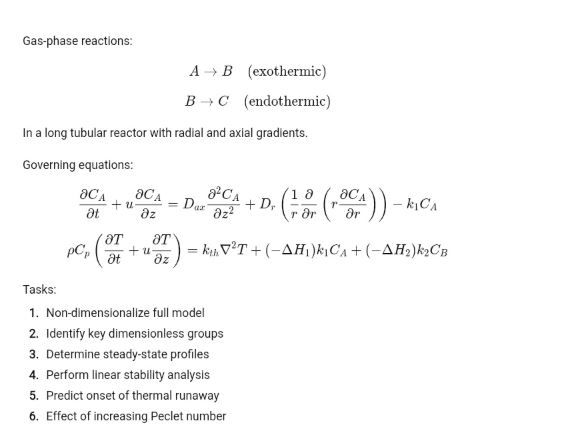 Gasphase reactions:
AB (exothermic)
B+ C (endothermic)
In’ long tubuiar reactor with radial and axil gradients.
Governing equations:
Cy, 80s PCs 10 ( ac,
SE tu=t =Du—= + D, (= (r=2)) - ki,
a "os Fra rd ied
or ar
Cy ( 5 + uz ) = kn VT + (— a+ (— ka Cy
we (5+ 7) WV + (~AHKCa + (~AH)kiCr
Tasks:
1. Nondmensionalize ful model
2. Identify key dimensionless groups
3. Determine steady-state profes
4. Perform linear stabilty analysis
5. Predict onset of thermal runaway
6. Effect of increasing Peclet number
This is AI generated Response.
Asked by: Francis
Created at: 2026-01-24 07:29:43
Asked by: Francis
Created at: 2026-01-24 07:29:43
Final Answer:
Rendered
Raw Text
Did you like this answer?
# Step-by-Step Solution
Let's address each task in sequence for the tubular reactor problem with two gas-phase reactions radial and axial gradients, and the given governing equations.
---
## 1. **Non-dimensionalize the Full Model**
Let’s introduce non-dimensional variables:
Let \( z = L \hat{z} \), \( r = R \hat{r} \), \( t = \tau \hat{t} \), \( C_A = C_{A} \hat{C}_A \), \( C_B = C_{A} \hat{C}_B \), \( T = T_ + \Delta T \hat{T} \)
Substitute these into the original equations:
First, for species A:
\[
\frac{\partial C_A}{\partial t} + u\frac{\partial C_A}{\partial z} = D_{az} \frac{\partial^2 C_A}{\partial z^2} + D_{r} \left( \frac{1}{r}\frac{\partial}{\partial r}\left( r \frac{\partial C_A}{\partial r} \right) \right) - k_1 C_A
\]
Non-dimensionalizing, divide through by \( C_{A}/\tau \):
\[
\frac{\partial \hat{C}_A}{\partial \hat{t}} + \text{Pe}_z \frac{\partial \hat{C}_A}{\partial \hat{z}} = \frac{\partial^2 \hat{C}_A}{\partial \hat{z}^2} + \frac{D_r L^2}{D_{az} R^2} \frac{1}{\hat{r}} \frac{\partial}{\partial \hat{r}} \left( \hat{r} \frac{\partial \hat{C}_A}{\partial \hat{r}} \right) - Da_1 \hat{C}_A
\]
Where:
- Axial Peclet number: \( \text{Pe}_z = \frac{u L}{D_{az}} \)
- Damkohler number: \( Da_1 = \frac{k_1 L^2}{D_{az}} \)
- Radial-to-axial diffusion ratio: \( \Lambda = \frac{D_r L^2}{D_{az} R^2} \)
For energy:
\[
\rho C_p \left( \frac{\partial T}{\partial t} + u \frac{\partial T}{\partial z} \right) = k_h \nabla^2 T + ( -\Delta H_1 ) k_1 C_A + ( -\Delta H_2 ) k_2 C_B
\]
Non-dimensionalizing, divide through by \( \rho C_p \Delta T/\tau \):
\[
\frac{\partial \hat{T}}{\partial \hat{t}} + \text{Pe}_z \frac{\partial \hat{T}}{\partial \hat{z}} = \frac{\alpha L^2}{D_{az} \tau} \nabla^2_{\hat{r},\hat{z}} \hat{T} + \beta_1 \hat{C}_A + \beta_2 \hat{C}_B
\]
Where:
- \( \beta_1 = \frac{(-\Delta H_1) k_1 C_{A} \tau}{\rho C_p \Delta T} \)
- \( \beta_2 = \frac{(-\Delta H_2) k_2 C_{A} \tau}{\rho C_p \Delta T} \)
- \( \alpha = \frac{k_h}{\rho C_p} \) is thermal diffusivity.
---
## 2. **Key Dimensionless Groups**
The main dimensionless groups are:
- **Peclet number (\(\text{Pe}_z\))**: Ratio of convective to diffusive transport in the axial direction.
- **Damkohler number (\(Da_1, Da_2\))**: Ratio of reaction rate to diffusion rate.
- **Radial-to-axial diffusion ratio (\(\Lambda\))**: Importance of radial diffusion.
- **Heat release/absorption parameters (\(\beta_1, \beta_2\))**
---
## 3. **Determine Steady-State Profiles**
At steady state, time derivatives are zero:
For A:
\[
\text{Pe}_z \frac{\partial \hat{C}_A}{\partial \hat{z}} = \frac{\partial^2 \hat{C}_A}{\partial \hat{z}^2} + \Lambda \frac{1}{\hat{r}} \frac{\partial}{\partial \hat{r}} \left( \hat{r} \frac{\partial \hat{C}_A}{\partial \hat{r}} \right) - Da_1 \hat{C}_A
\]
For T:
\[
\text{Pe}_z \frac{\partial \hat{T}}{\partial \hat{z}} = \alpha' \nabla^2_{\hat{r},\hat{z}} \hat{T} + \beta_1 \hat{C}_A + \beta_2 \hat{C}_B
\]
Where \( \alpha' = \alpha L^2 / D_{az} \).
Profiles are found by solving these coupled PDEs, often with boundary conditions:
- Inlet (\(\hat{z}=\)): known concentrations and temperature.
- Wall (\(\hat{r}=1\)): e.g., no-flux or fixed temperature.
- Centerline (\(\hat{r}=\)): symmetry.
---
## 4. **Linear Stability Analysis**
To analyze thermal or concentration runaway, perturb the steady state:
Let \( \hat{C}_A = \hat{C}_{A,ss} + \epsilon c' \exp(\lambda t) \), \( \hat{T} = \hat{T}_{ss} + \epsilon t' \exp(\lambda t) \). Linearize the PDEs around the steady state and look for the sign of \( \lambda \). If \( \text{Re}(\lambda) > \), the system is unstable (runaway possible).
---
## 5. **Predict Onset of Thermal Runaway**
Thermal runaway occurs when heat generated by the reaction exceeds heat removed (by conduction/convection). Use the stability criterion from above. Typically, critical conditions are found by setting \( \text{Re}(\lambda) = \), solving for critical values of Damkohler or Peclet numbers, or the heat release parameter (\( \beta_1 \)). Increasing exothermicity or decreasing heat removal favors runaway.
---
## 6. **Effect of Increasing Peclet Number**
A high Peclet number (\(\text{Pe}_z \gg 1\)) means convection dominates over diffusion. This leads to sharper axial gradients (plug-flow-like behavior), reduces axial mixing, and can increase the risk of thermal and concentration hot spots (and thus, thermal runaway) since heat and mass have less chance to diffuse away from the reaction zone.
---
## **Final Answer Summary**
The model is non-dimensionalized using length, time, concentration, and temperature scales, resulting in equations with key groups: Peclet number, Damkohler number, diffusion ratios, and heat release terms. Steady-state profiles require solving the coupled PDEs. Linear stability (via eigenvalue analysis) predicts runaway. Thermal runaway is favored by higher exothermicity and poor heat removal. Increasing Peclet number intensifies gradients and can promote instability and hot spots.
📢 Instructions:
- Ask anything relatd to above question only.
- For new Question goto :