 VIPSolutions
Give step-by-step solution with explanation and final answer:(12 pts) All of the carbon atoms of the products must come from the starting materials for this one! ? : PY
Question:
Give step-by-step solution with explanation and final answer: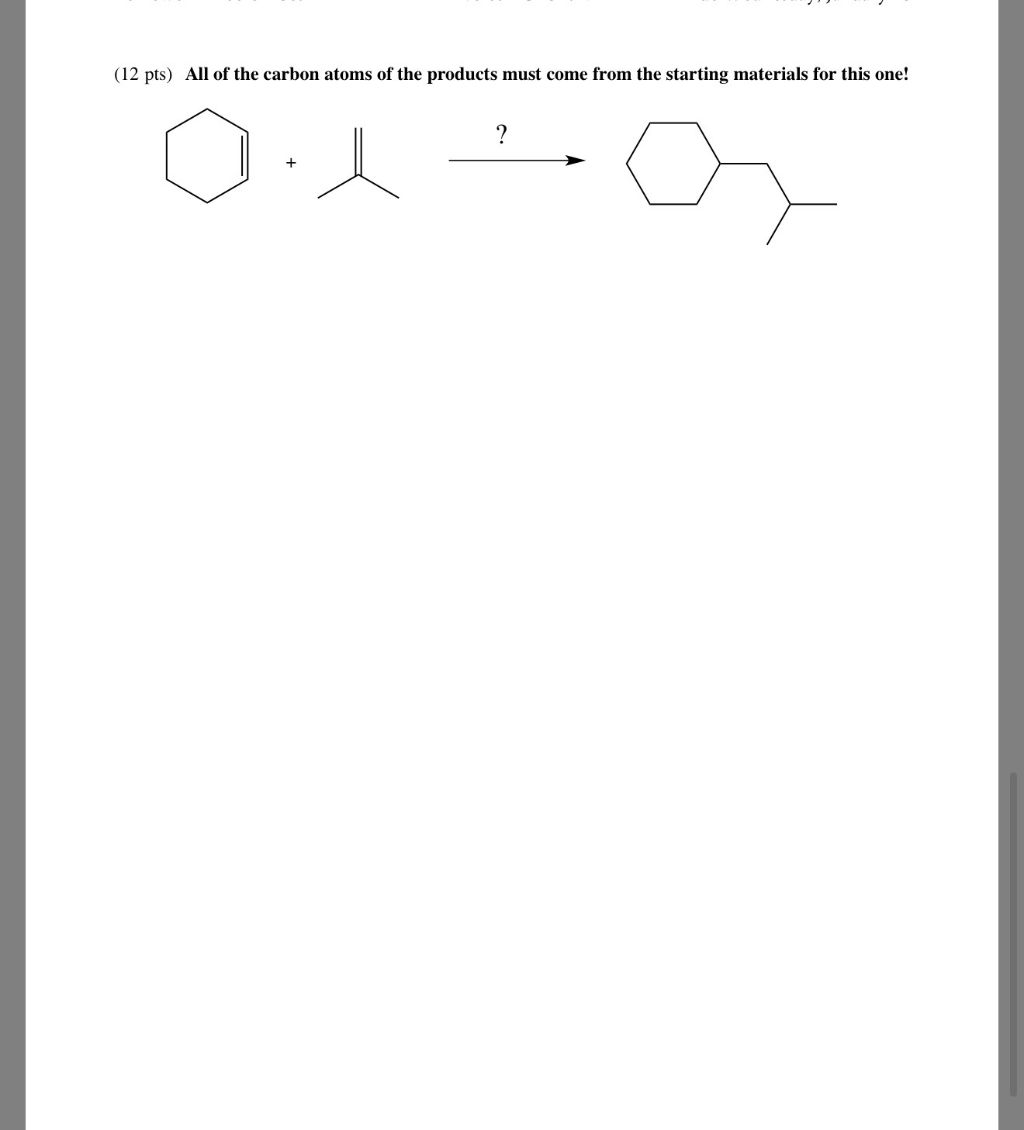 (12 pts) All of the carbon atoms of the products must come from the starting materials for this one!
?
: PY
This is AI generated Response.
Asked by: Rahul
Created at: 2026-01-24 05:43:14
Asked by: Rahul
Created at: 2026-01-24 05:43:14
Final Answer:
Rendered
Raw Text
Did you like this answer?
Let's break down the problem step by step.
### Step 1: Identify the Reactants and Product
- **Reactants:** Cyclohexane (C₆H₁₂) and isopropyl bromide (or isopropyl chloride, C₃H₇X)
- **Product:** sec-Butylcyclohexane
### Step 2: Compare the Structures
Product: The product is cyclohexane with a sec-butyl (–CH(CH₃)CH₂CH₃) group attached.
### Step 3: Analyze Carbon Sources
- Cyclohexane provides the cyclohexyl ring (6 carbons).
- Isopropyl group (from isopropyl halide) has 3 carbons.
- The sec-butyl group has 4 carbons: CH(CH₃)CH₂CH₃.
Thus, we need to combine the isopropyl group and one more carbon to get sec-butyl.
### Step 4: Reaction Mechanism
The most logical reaction is a **Friedel–Crafts alkylation**.
#### Friedel–Crafts Alkylation Steps:
1. **Preparation of sec-butyl cation:**
Isopropyl halide (e.g., isopropyl chloride, (CH₃)₂CHCl) cannot directly give a sec-butyl group.
But if isopropyl halide reacts with an **alkene** in the presence of acid, it can form a sec-butyl group.
However, with only the given reactants, another step is needed.
2. **Convert isopropyl halide to propene:**
Isopropyl halide can undergo elimination (E2) to form propene (CH₂=CH–CH₃).
**Reagent:** Strong base (e.g., KOH/EtOH)
3. **Friedel–Crafts Alkylation with Propene:**
Cyclohexane + propene + acid (e.g., H₂SO₄ or AlCl₃)
The propene forms a secondary carbocation (CH₃–CH⁺–CH₃) which adds to cyclohexane to give sec-butylcyclohexane.
---
## **Step-by-Step Solution**
### **Step 1: Convert isopropyl halide to propene**
- Isopropyl halide + strong base → propene + halide ion
### **Step 2: Friedel–Crafts Alkylation**
- Cyclohexane + propene + acid → sec-butylcyclohexane
---
## **Final Reaction Sequence**
1. **Elimination:**
Isopropyl halide \(\xrightarrow{\text{KOH/EtOH}}\) propene
2. **Friedel–Crafts Alkylation:**
Cyclohexane + propene \(\xrightarrow{\text{H}^+}\) sec-butylcyclohexane
---
## **Final Answer**
**Reagents Needed:**
1. Strong base (KOH/EtOH)
2. Acid catalyst (H₂SO₄ or AlCl₃)
**Steps:**
1. Isopropyl halide → propene (via elimination)
2. Cyclohexane + propene + acid → sec-butylcyclohexane
---
### **Summary Table**
| Step | Reactant(s) | Reagent/Condition | Product |
|------|-------------------------|-------------------|---------------------------|
| 1 | Isopropyl halide | KOH/EtOH | Propene |
| 2 | Cyclohexane + Propene | Acid (H₂SO₄/AlCl₃)| sec-Butylcyclohexane |
---
### **Explanation**
- **All carbons** in the product come from the starting materials.
- You use elimination followed by Friedel–Crafts alkylation to achieve the transformation.
---
Let me know if you need the mechanism details or structures!
📢 Instructions:
- Ask anything relatd to above question only.
- For new Question goto :