 VIPSolutions
Give step-by-step solution with explanation and final answer:Propose a logical, step-by-step mechanism for the reaction. Fi 8 Me We ‘ x Ne ty Hi Ver, be 1 — EN dP
Question:
Give step-by-step solution with explanation and final answer: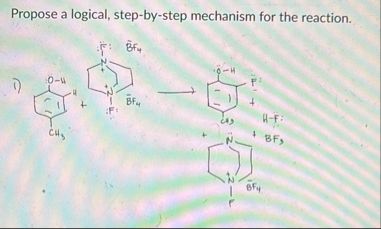 Propose a logical, step-by-step mechanism for the reaction.
Fi 8
Me
We ‘
x Ne
ty Hi Ver,
be 1
—
EN dP
This is AI generated Response.
Asked by: Rahul
Created at: 2026-01-24 05:01:55
Asked by: Rahul
Created at: 2026-01-24 05:01:55
Final Answer:
Rendered
Raw Text
Did you like this answer?
Certainly! Let’s break down the step-by-step mechanism for the reaction shown in the image.
---
## **Step-by-Step Mechanism**
### **Step 1: Formation of the Oxonium Ion**
- The starting material is a methyl-substituted **phenol** (with a methyl group at the para position).
- The reaction is in the presence of **BF₄⁻** (tetrafluoroborate) and **F₂** (fluorine gas).
- **F₂** is a strong electrophile and reacts with the lone pair of electrons on the oxygen atom of the phenol group.
- The oxygen donates electrons to the fluorine, forming an **oxonium ion** and generating a **fluoride ion (F⁻)**.
**Intermediate:**
```
O⁺-F
|
/-----\
/ \
| |
\ /
\-----/
|
CH3
```
### **Step 2: Nucleophilic Attack by Amine**
- The nitrogen atom from the **pyridine ring** (shown in the mechanism) acts as a nucleophile.
- The lone pair on the nitrogen attacks the positively charged carbon (electrophilic center) in the oxonium intermediate.
### **Step 3: Rearrangement and Leaving Group Departure**
- The bond between the oxygen and the aromatic ring breaks, forming a new C-N bond (between the aromatic ring and the nitrogen atom from the pyridine ring).
- The **BF₄⁻** acts as a counterion for the newly formed cation.
- At the same time, **HF** is eliminated.
### **Step 4: Final Product**
- The final product is a **heterocycle** formed by the fusion of the aromatic ring and the nitrogen-containing ring, with **BF₄⁻** as the counterion.
---
## **Detailed Stepwise Mechanism**
1. **Activation of Phenol:**
- Phenol reacts with **F₂** and **BF₄⁻** to form an oxonium ion intermediate.
\[
\text{Ar-OH} + F_2 + BF_4^- \rightarrow \text{Ar-O-F}^+ + HF + BF_4^-
\]
2. **Nucleophilic Attack:**
- Pyridine nitrogen attacks the activated aromatic ring at the ortho or para position (relative to the OH group).
3. **Cyclization:**
- Intramolecular nucleophilic aromatic substitution occurs, forming the fused ring system.
4. **Loss of HF and Rearrangement:**
- HF is eliminated as a leaving group, and the aromaticity is restored.
5. **Final Product:**
- The product is a fused nitrogen heterocycle with **BF₄⁻** as the counterion.
---
## **Final Answer:**
**The reaction mechanism involves:**
1. Formation of an oxonium ion (via reaction with F₂ and BF₄⁻).
2. Nucleophilic attack by a pyridine nitrogen.
3. Cyclization and loss of HF.
4. Formation of a fused heterocycle with BF₄⁻ as the counterion.
---
### **Summary Table**
| Step | Reaction |
|-------------|-----------------------------------------------------------------------------------------------------|
| 1 | Phenol + F₂ + BF₄⁻ → Oxonium ion + F⁻ |
| 2 | Nucleophilic attack by pyridine N on oxonium intermediate |
| 3 | Cyclization and elimination of HF |
| 4 | Formation of fused N-heterocycle with BF₄⁻ |
---
If you need the detailed arrow-pushing mechanism, let me know!
📢 Instructions:
- Ask anything relatd to above question only.
- For new Question goto :