 VIPSolutions
Give step-by-step solution with explanation and final answer:a Write in the missing reactants, reaction conditions, or products in the multi-s ynthesis. Lo ~ » Fe Fan | — | ) — ~~ ~ ~ | 1591 ig 0 s Un N Dal .co inl A 0s og Beryl TD Sm an Ta) Lx; Eo, or Lr he ? rh on why ey
Question:
Give step-by-step solution with explanation and final answer: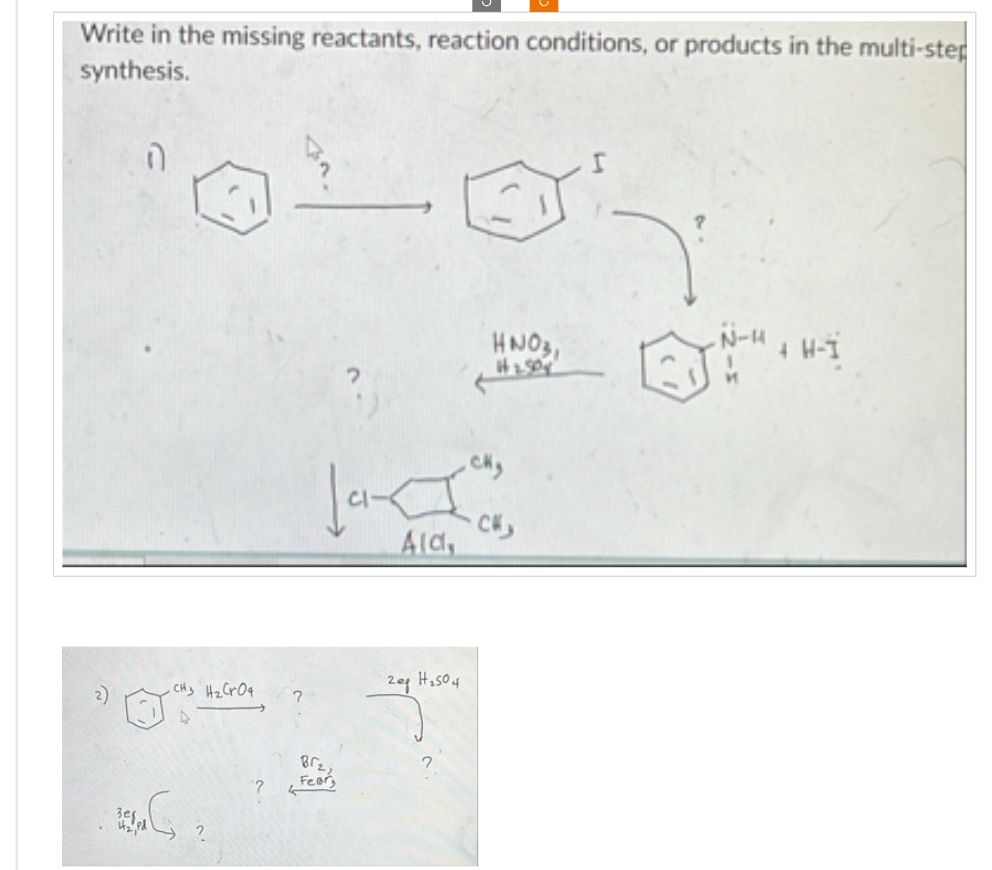 a
Write in the missing reactants, reaction conditions, or products in the multi-s
ynthesis. Lo
~ »
Fe Fan
| — | ) —
~~ ~ ~
|
1591 ig 0 s
Un
N Dal .co inl
A 0s og Beryl
TD Sm an Ta)
Lx; Eo,
or Lr he
? rh on
why ey
This is AI generated Response.
Asked by: Rahul
Created at: 2026-01-24 04:59:19
Asked by: Rahul
Created at: 2026-01-24 04:59:19
Final Answer:
Rendered
Raw Text
Did you like this answer?
Let's break down each multi-step synthesis problem and fill in the missing reactants, conditions, or products.
---
## **Problem 1**
### **Step-by-step Solution**
#### **Step 1: Benzene to Iodobenzene**
- **Starting Material:** Benzene
- **Reagent/Reaction:** To introduce an iodine atom onto benzene, we typically use **I₂** and an **oxidizing agent** (such as HNO₃ or H₂O₂) to generate the electrophile.
- **Product:** Iodobenzene
**Equation:**
C₆H₆ + I₂ / HNO₃ → C₆H₅I
---
#### **Step 2: Iodobenzene to Phenylhydrazine**
- **Reagent/Reaction:** Iodobenzene reacts with **hydrazine (NH₂NH₂)** to substitute the iodine with a hydrazine group.
- **Product:** Phenylhydrazine (C₆H₅NHNH₂) + HI
**Equation:**
C₆H₅I + NH₂NH₂ → C₆H₅NHNH₂ + HI
---
#### **Step 3: Phenylhydrazine to p-Nitrophenylhydrazine**
- **Reagent/Reaction:** Nitration (HNO₃, H₂SO₄) introduces a nitro group, mainly para to the NHNH₂ group due to its activating nature.
- **Product:** p-Nitrophenylhydrazine
**Equation:**
C₆H₅NHNH₂ + HNO₃/H₂SO₄ → p-Nitrophenylhydrazine
---
#### **Step 4: Friedel-Crafts Alkylation**
- **Reagent/Reaction:** The compound reacts with **CH₃CCl₃ (tert-butyl chloride)** and **AlCl₃** to introduce a tert-butyl group via Friedel-Crafts alkylation.
- **Product:** para- or ortho-tert-butyl-p-nitrophenylhydrazine (depending on substituent positions).
---
### **Summary Table**
| Step | Starting Material | Reagent/Condition | Product |
|------|----------------------|------------------------|------------------------------|
| 1 | Benzene | I₂/HNO₃ | Iodobenzene |
| 2 | Iodobenzene | NH₂NH₂ | Phenylhydrazine |
| 3 | Phenylhydrazine | HNO₃, H₂SO₄ | p-Nitrophenylhydrazine |
| 4 | p-Nitrophenylhydrazine | (CH₃)₃CCl, AlCl₃ | tert-butyl-p-nitrophenylhydrazine |
---
## **Problem 2**
### **Step-by-step Solution**
#### **Step 1: Toluene to Benzoic Acid**
- **Starting Material:** Toluene (C₆H₅CH₃)
- **Reagent/Reaction:** Oxidation using **H₂CrO₄** converts methyl to carboxylic acid.
- **Product:** Benzoic acid (C₆H₅COOH)
---
#### **Step 2: Benzoic Acid to Benzenesulfonic Acid**
- **Reagent/Reaction:** Sulfonation using **conc. H₂SO₄ (2 eq)** introduces SO₃H.
- **Product:** Benzenesulfonic acid (C₆H₅SO₃H)
---
#### **Step 3: Toluene to Tribromotoluene**
- **Reagent/Reaction:** **Br₂/FeBr₃** (excess) brominates methylbenzene on all ortho and para positions.
- **Product:** 2,4,6-Tribromotoluene
---
### **Summary Table**
| Step | Starting Material | Reagent/Condition | Product |
|------|------------------|---------------------|------------------------|
| 1 | Toluene | H₂CrO₄ | Benzoic acid |
| 2 | Benzoic acid | 2 eq H₂SO₄ | Benzenesulfonic acid |
| 3 | Toluene | 3 eq Br₂/FeBr₃ | 2,4,6-Tribromotoluene |
---
## **Final Answers (Filled-in):**
### **Problem 1:**
1. **I₂, HNO₃** (or I₂, H₂O₂)
2. **NH₂NH₂** (hydrazine)
3. **p-Nitrophenylhydrazine**
4. **(CH₃)₃CCl, AlCl₃**
### **Problem 2:**
1. **Benzoic acid (C₆H₅COOH)**
2. **Benzenesulfonic acid (C₆H₅SO₃H)**
3. **2,4,6-Tribromotoluene**
---
If you need the structures or more detailed explanations, let me know!
📢 Instructions:
- Ask anything relatd to above question only.
- For new Question goto :