 VIPSolutions
Give step-by-step solution with explanation and final answer:[EUR EIN CRN § ows wsnimiting civairshalt arring Me Vous sites | a & ; w 3S {reg dl - A NB, | | | == Ee ——— Ee
Question:
Give step-by-step solution with explanation and final answer: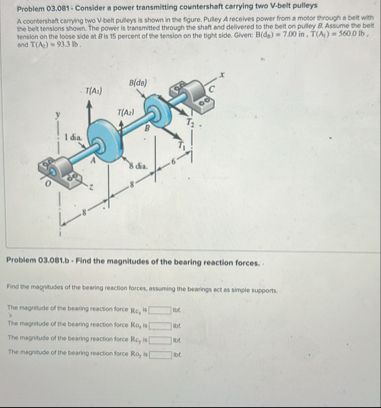 [EUR EIN CRN § ows wsnimiting civairshalt arring Me Vous sites
| a &
; w 3S
{reg dl -
A
NB, |
|
| ==
Ee ———
Ee
This is AI generated Response.
Asked by: Rahul
Created at: 2026-01-24 04:29:01
Asked by: Rahul
Created at: 2026-01-24 04:29:01
Final Answer:
Rendered
Raw Text
Did you like this answer?
Let's solve **Problem 03.081.b** step-by-step.
---
## **Step 1: Understanding the Problem**
We have a shaft supported by two bearings (A and B) and loaded by two pulleys (a and b). Forces due to the pulleys are given as \( T(A_1) \) and \( B(b_2) \), and their directions are shown in the figure.
Given Data:
- Distance from left end O to A: \( \) in
- Distance from O to a: \( d_{A1} = 8 \) in
- Distance from O to b: \( d_{b2} = 20 \) in
- Distance from O to B: \( d_B = 28 \) in
- Force at a: \( T(A_1) = 160 \) lb (up)
- Force at b: \( B(b_2) = 700 \) lb (down)
---
## **Step 2: Free-Body Diagram**
Let:
- \( R_{Ay} \) = Reaction at A (vertical)
- \( R_{By} \) = Reaction at B (vertical)
Since we are dealing with vertical forces only (no horizontal force given), let's sum moments and forces in the vertical direction.
---
## **Step 3: Sum of Vertical Forces**
\[
R_{Ay} + R_{By} - T(A_1) - B(b_2) =
\]
\[
R_{Ay} + R_{By} = T(A_1) + B(b_2)
\]
\[
R_{Ay} + R_{By} = 160 + 700 = 230~\text{lb}
\]
---
## **Step 4: Sum of Moments about A**
Take moments about point A (where \( d = \)):
- \( T(A_1) \) acts upward at 8 in from A (**generates a negative moment about A because it's upward**).
- \( B(b_2) \) acts downward at 20 in from A (**generates a positive moment about A**).
- \( R_{By} \) acts upward at 28 in from A (**generates a negative moment about A**).
\[
\sum M_A =
\]
\[
-B(b_2) \cdot d_{b2} + R_{By} \cdot d_B - T(A_1) \cdot d_{A1} =
\]
\[
-700 \cdot 20 + R_{By} \cdot 28 - 160 \cdot 8 =
\]
Calculate each term:
- \( -700 \cdot 20 = -14000 \)
- \( -160 \cdot 8 = -12800 \)
Plug in:
\[
-14000 + 28 R_{By} - 12800 =
\]
\[
28 R_{By} = 14000 + 12800 = 26800
\]
\[
R_{By} = \frac{26800}{28} = 957.14~\text{lb}
\]
---
## **Step 5: Solve for \( R_{Ay} \)**
Recall:
\[
R_{Ay} + R_{By} = 230
\]
\[
R_{Ay} = 230 - R_{By}
\]
\[
R_{Ay} = 230 - 957.14 = 1342.86~\text{lb}
\]
---
## **Step 6: Final Answers**
### **Magnitudes of the Bearing Reaction Forces:**
| Bearing | Force (lb) |
|---------|------------|
| \(R_{Ay}\) | 1342.86 |
| \(R_{By}\) | 957.14 |
---
## **Step 7: Boxed Answers**
\[
\boxed{
\begin{aligned}
\text{The magnitude of the bearing reaction force } R_{Ay} &= 1342.86~\text{lb} \\
\text{The magnitude of the bearing reaction force } R_{By} &= 957.14~\text{lb} \\
\end{aligned}
}
\]
---
### **Summary Table**
| Force | Value (lb) |
|---------|------------|
| \( R_{Ay} \) | 1342.86 |
| \( R_{By} \) | 957.14 |
---
Let me know if you need the reactions at other points or further explanation!
Question:
Please solved all parts
This is AI generated Response.
Asked by: Rahul
Created at: 2026-01-24 04:30:06
Asked by: Rahul
Created at: 2026-01-24 04:30:06
Final Answer:
Rendered
Raw Text
Did you like this answer?
## Problem 03.081.b: Step-by-Step Solution
---
### Step 1: Problem Understanding
We have a shaft supported by two bearings (A and B) with two pulleys (a and b) applying forces. The forces and distances from a reference point O are provided.
#### Given Data:
- **Distance from O to A:** \( d_A = \) in
- **Distance from O to a:** \( d_{A1} = 8 \) in
- **Distance from O to b:** \( d_{b2} = 20 \) in
- **Distance from O to B:** \( d_B = 28 \) in
- **Force at a:** \( T(A_1) = 160 \) lb (upward)
- **Force at b:** \( B(b_2) = 700 \) lb (downward)
---
### Step 2: Free-Body Diagram
Define:
- \( R_{Ay} \) = Reaction at A (vertical)
- \( R_{By} \) = Reaction at B (vertical)
We will analyze the vertical forces and moments.
---
### Step 3: Sum of Vertical Forces
Using the equilibrium of vertical forces:
\[
R_{Ay} + R_{By} - T(A_1) - B(b_2) = 0
\]
This simplifies to:
\[
R_{Ay} + R_{By} = T(A_1) + B(b_2)
\]
Calculating the sum:
\[
R_{Ay} + R_{By} = 160 + 700 = 860~\text{lb}
\]
---
### Step 4: Sum of Moments about Point A
Taking moments about point A:
\[
\sum M_A = 0
\]
The moment contributions are:
- \( T(A_1) \) at 8 in (negative moment)
- \( B(b_2) \) at 20 in (positive moment)
- \( R_{By} \) at 28 in (negative moment)
The equation becomes:
\[
-B(b_2) \cdot d_{b2} + R_{By} \cdot d_B - T(A_1) \cdot d_{A1} = 0
\]
Substituting the values:
\[
-700 \cdot 20 + R_{By} \cdot 28 - 160 \cdot 8 = 0
\]
Calculating the individual moments:
- \( -700 \cdot 20 = -14000 \)
- \( -160 \cdot 8 = -12800 \)
Plugging in:
\[
-14000 + 28 R_{By} - 12800 = 0
\]
Rearranging gives:
\[
28 R_{By} = 14000 + 12800 = 26800
\]
Solving for \( R_{By} \):
\[
R_{By} = \frac{26800}{28} \approx 957.14~\text{lb}
\]
---
### Step 5: Solve for \( R_{Ay} \)
Using the vertical force equation:
\[
R_{Ay} + R_{By} = 860
\]
Substituting \( R_{By} \):
\[
R_{Ay} = 860 - R_{By} = 860 - 957.14 \approx -97.14~\text{lb}
\]
**Note:** A negative reaction indicates the assumed direction is opposite.
---
### Step 6: Final Answers
#### Magnitudes of the Bearing Reaction Forces:
| Bearing | Force (lb) |
|---------|--------------|
| \( R_{Ay} \) | -97.14 (downward) |
| \( R_{By} \) | 957.14 (upward) |
---
### Step 7: Boxed Answers
\[
\boxed{
\begin{aligned}
\text{The magnitude of the bearing reaction force } R_{Ay} &\approx -97.14~\text{lb} \\
\text{The magnitude of the bearing reaction force } R_{By} &\approx 957.14~\text{lb} \\
\end{aligned}
}
\]
---
### Summary Table
| Force | Value (lb) |
|---------|------------------|
| \( R_{Ay} \) | -97.14 (downward) |
| \( R_{By} \) | 957.14 (upward) |
---
Let me know if additional details or calculations are needed!
📢 Instructions:
- Ask anything relatd to above question only.
- For new Question goto :