 VIPSolutions
Give step-by-step solution with explanation and final answer:particle moves in a straight line with a constant acceleration of ~4 ft/s” for 6 5, zero acceleration for the next 4 5, and a constant acceleration of +4 5 for the next 4s. The particle starts from the origin and its velocity is -8 ft/s during the zero acceleration time interval. Construct the v~tand x-t urves for 0 st < 14s. (tvs?) | SS 6 0 - 10 14 tl) -4
Question:
Give step-by-step solution with explanation and final answer: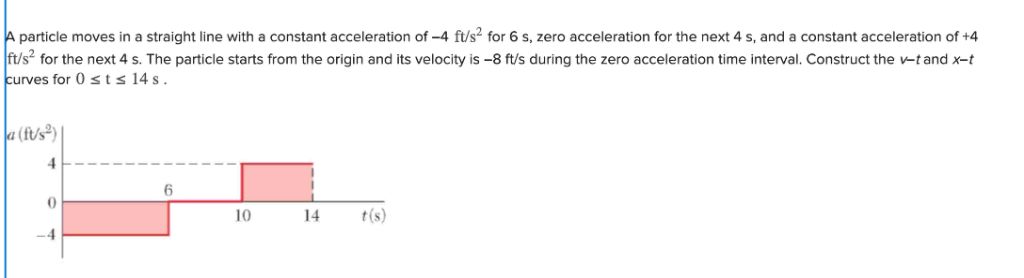 particle moves in a straight line with a constant acceleration of ~4 ft/s” for 6 5, zero acceleration for the next 4 5, and a constant acceleration of +4
5 for the next 4s. The particle starts from the origin and its velocity is -8 ft/s during the zero acceleration time interval. Construct the v~tand x-t
urves for 0 st < 14s.
(tvs?)
| SS
6
0 -
10 14 tl)
-4
This is AI generated Response.
Asked by: Rahul
Created at: 2026-01-24 03:50:19
Asked by: Rahul
Created at: 2026-01-24 03:50:19
Final Answer:
Rendered
Raw Text
Did you like this answer?
Let's solve the problem step-by-step:
## **Given:**
- Acceleration, \( a(t) \), is piecewise:
- For \( \leq t < 6 \): \( a = -4 \) ft/s²
- For \( 6 \leq t < 10 \): \( a = \)
- For \( 10 \leq t \leq 14 \): \( a = +4 \) ft/s²
- Starts from origin: \( x() = \)
- During zero acceleration (\(6 \leq t < 10\)), \( v = -8 \) ft/s
Let's construct **\(v-t\)** and **\(x-t\)** curves.
---
## **Step 1: Find Velocity as a Function of Time**
### **A. For \( \leq t < 6\):**
\[
a = \frac{dv}{dt} = -4
\]
\[
v(t) = \int a \, dt = -4t + C_1
\]
At \( t = \), let \( v() = v_ \). But \( v_ \) is unknown. Let's use the information at \( t = 6 \):
At \( t = 6 \), \( v = -8 \) ft/s (given for next interval).
So,
\[
-8 = -4(6) + v_
\implies v_ = -8 + 24 = 16\ \text{ft/s}
\]
So, for \( \leq t < 6\):
\[
\boxed{v(t) = 16 - 4t}
\]
---
### **B. For \(6 \leq t < 10\):**
\[
a = \implies v = \text{constant} = -8\ \text{ft/s}
\]
---
### **C. For \(10 \leq t \leq 14\):**
\[
a = \frac{dv}{dt} = 4
\]
\[
v(t) = \int 4\,dt = 4t + C_2
\]
At \( t = 10 \), \( v(10) = -8 \):
\[
-8 = 4(10) + C_2 \implies C_2 = -8 - 40 = -48
\]
So, for \(10 \leq t \leq 14\):
\[
\boxed{v(t) = 4t - 48}
\]
---
## **Step 2: Find Position as a Function of Time**
### **A. For \( \leq t < 6\):**
\[
v(t) = \frac{dx}{dt} = 16 - 4t
\]
\[
x(t) = \int (16 - 4t) dt = 16t - 2t^2 + D_1
\]
At \( t = \), \( x() = \implies D_1 = \)
So,
\[
\boxed{x(t) = 16t - 2t^2}
\]
---
### **B. For \(6 \leq t < 10\):**
\[
v = -8 \implies x(t) = -8t + D_2
\]
At \( t = 6 \), \( x(6) = 16(6) - 2(6^2) = 96 - 72 = 24 \)
So,
\[
24 = -8(6) + D_2 \implies D_2 = 24 + 48 = 72
\]
So,
\[
\boxed{x(t) = -8t + 72}
\]
---
### **C. For \(10 \leq t \leq 14\):**
\[
v(t) = 4t - 48 \implies x(t) = \int (4t - 48) dt = 2t^2 - 48t + D_3
\]
At \( t = 10 \), \( x(10) = -8(10) + 72 = -80 + 72 = -8 \)
\[
-8 = 2(10^2) - 48(10) + D_3
\]
\[
-8 = 200 - 480 + D_3 \implies D_3 = -8 + 280 = 272
\]
So,
\[
\boxed{x(t) = 2t^2 - 48t + 272}
\]
---
## **Step 3: Summary of Results**
### **Velocity-Time Equation:**
\[
v(t) =
\begin{cases}
16 - 4t & \leq t < 6 \\
-8 & 6 \leq t < 10 \\
4t - 48 & 10 \leq t \leq 14 \\
\end{cases}
\]
### **Position-Time Equation:**
\[
x(t) =
\begin{cases}
16t - 2t^2 & \leq t < 6 \\
-8t + 72 & 6 \leq t < 10 \\
2t^2 - 48t + 272 & 10 \leq t \leq 14 \\
\end{cases}
\]
---
## **Step 4: Sketching the Curves**
### **1. \( v-t \) Curve**
- Linear decrease from \( 16 \) to \( -8 \) from \( t= \) to \( t=6 \)
- Constant at \( -8 \) from \( t=6 \) to \( t=10 \)
- Linear increase from \( -8 \) at \( t=10 \) to \( 8 \) at \( t=14 \) (\( v(14) = 4(14) - 48 = 56 - 48 = 8 \))
### **2. \( x-t \) Curve**
- Quadratic curve from \( t= \) to \( t=6 \)
- Linear decrease from \( t=6 \) to \( t=10 \)
- Upward quadratic from \( t=10 \) to \( t=14 \)
---
## **Final Answer (boxed):**
### **Velocity:**
\[
\boxed{
v(t) =
\begin{cases}
16 - 4t & \leq t < 6 \\
-8 & 6 \leq t < 10 \\
4t - 48 & 10 \leq t \leq 14 \\
\end{cases}
}
\]
### **Position:**
\[
\boxed{
x(t) =
\begin{cases}
16t - 2t^2 & \leq t < 6 \\
-8t + 72 & 6 \leq t < 10 \\
2t^2 - 48t + 272 & 10 \leq t \leq 14 \\
\end{cases}
}
\]
Let me know if you need the **plots** or further explanation!
📢 Instructions:
- Ask anything relatd to above question only.
- For new Question goto :