 VIPSolutions
Give step-by-step solution with explanation and final answer:3 Table 2: Resonance Structures . ENSURE YOU DRAWALL, RESONANCE STRUCTURES AND THE MOVEMENT OF ELEC
Question:
Give step-by-step solution with explanation and final answer: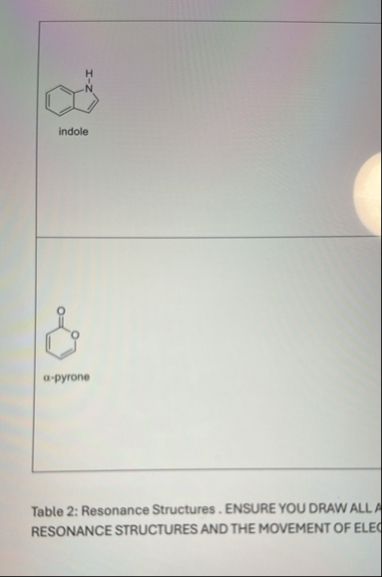 3
Table 2: Resonance Structures . ENSURE YOU DRAWALL,
RESONANCE STRUCTURES AND THE MOVEMENT OF ELEC
This is AI generated Response.
Asked by: Rahul
Created at: 2026-01-24 03:45:05
Asked by: Rahul
Created at: 2026-01-24 03:45:05
Final Answer:
Rendered
Raw Text
Did you like this answer?
Let's **draw the resonance structures** for both **indole** and **α-pyrone** and explain the movement of electrons step by step.
---
## 1. Indole
**Structure:**
Indole is a bicyclic compound: a benzene ring fused to a five-membered nitrogen-containing pyrrole ring.
### Resonance in Indole
The nitrogen in indole has a lone pair, but this lone pair is part of the aromatic sextet of the five-membered ring, making it less available for resonance outside of the ring. Most resonance involves the movement of π electrons within the ring system:
#### Step-by-Step Resonance
1. **Movement of π electrons in the pyrrole ring:**
- The double bond between C2–C3 can move to C3–C4.
- The double bond between C4–C5 can move to C5–N.
- The lone pair on nitrogen forms a double bond with C2.
- This causes the aromaticity to be preserved.
**Major Resonance Structure:**
```plaintext
N-H N-H
/ \ / \
| | | |
| | | |
/ \ / \
| | | |
\ / \ /
\ / \ /
----- -----
```
_The actual Lewis structures would show the delocalization of electrons with curved arrows._
#### Key Points:
- The lone pair on nitrogen participates in the aromatic sextet.
- The resonance stabilizes the system.
- The benzene ring also retains its aromaticity.
---
## 2. α-Pyrone
**Structure:**
α-Pyrone is a six-membered heterocyclic compound with one oxygen atom and a carbonyl group.
### Resonance in α-Pyrone
Here, resonance occurs due to the electron-withdrawing carbonyl group and the conjugated double bonds.
#### Step-by-Step Resonance
1. **Lone pair on the oxygen atom at position 2:**
- The lone pair can form a double bond with the adjacent carbon, pushing the double bond at C3–C4 to C4–C5, and the double bond at C5–C6 to C6–O (carbonyl oxygen).
- The π electrons from the C=O bond move up to the oxygen, creating a negative charge on the carbonyl oxygen and a positive charge on the ring oxygen.
2. **Movement of π electrons:**
- Each double bond moves one position over, and the charges distribute accordingly.
**Major Resonance Structures:**
**Structure 1 (Normal form):**
```
O
/ \
/ \
| |
| |
\___/
||
O
```
**Structure 2 (Negative charge on carbonyl oxygen):**
```
O
/ \
/ \
| |
| |
\___/
| \
[O]^- +
```
_Arrows would show the movement of electrons._
#### Key Points:
- Resonance delocalizes the negative charge onto the carbonyl oxygen.
- The ring and carbonyl group are involved in electron delocalization.
- The structure maintains aromaticity due to electron delocalization.
---
## **Summary Table**
| Compound | Resonance Movement | Main Effects |
|-------------|-------------------------------------------------------------------------------|-----------------------------------------------|
| **Indole** | Lone pair on N forms double bond, π bonds shift around the five-membered ring | Maintains aromaticity, delocalized electrons |
| **α-Pyrone**| Lone pair from ring oxygen forms double bond, π bonds shift, C=O electrons move up | Negative charge on carbonyl O, aromaticity |
---
## **Final Notes**
- **Draw all resonance structures** using arrows to show the movement of electrons for full credit.
- Resonance increases **stability** and influences **reactivity** and **aromaticity**.
If you need the actual Lewis structures with arrows, let me know and I can sketch them out as well!
📢 Instructions:
- Ask anything relatd to above question only.
- For new Question goto :