 VIPSolutions
Give step-by-step solution with explanation and final answer:2.1 Modeling a two degree of freedom mass-spring-damper system ‘The system in Figure 1 consists of two masses (m1 and 712) connected by linear springs (hr. /» and. 3) and viscous dampers (c1. ¢2 and ¢3). Two external forces fi and f are applied to m1 and mn. respectively. 0(0./iC) 00.5) h kB ks EN == a 0 0 O_O = Figure 1. Two degrees of freedom system: two masses with springs and dampers. Drarw the free body diagram. derive the equations of motion and write the equations in the following format: i= =
Question:
Give step-by-step solution with explanation and final answer: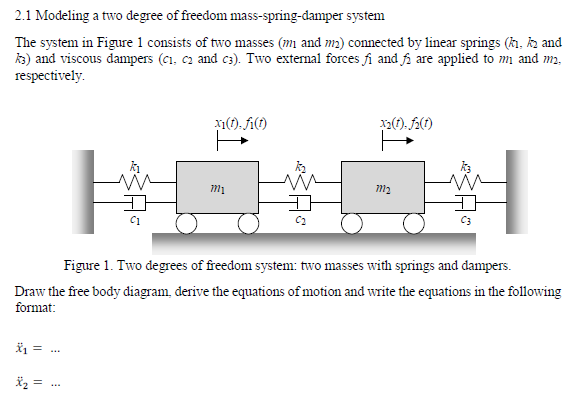 2.1 Modeling a two degree of freedom mass-spring-damper system
‘The system in Figure 1 consists of two masses (m1 and 712) connected by linear springs (hr. /» and.
3) and viscous dampers (c1. ¢2 and ¢3). Two external forces fi and f are applied to m1 and mn.
respectively.
0(0./iC) 00.5)
h kB ks
EN ==
a 0 0 O_O =
Figure 1. Two degrees of freedom system: two masses with springs and dampers.
Drarw the free body diagram. derive the equations of motion and write the equations in the following
format:
i=
=
This is AI generated Response.
Asked by: Rahul
Created at: 2026-01-24 03:30:08
Asked by: Rahul
Created at: 2026-01-24 03:30:08
Final Answer:
Rendered
Raw Text
Did you like this answer?
Let's solve the problem **step by step**:
---
# **Step 1: Free Body Diagram**
- **Mass \( m_1 \)** is acted upon by:
- Spring \( k_1 \) and damper \( c_1 \) (to the left, connected to ground)
- Spring \( k_2 \) and damper \( c_2 \) (to the right, connecting \( m_1 \) and \( m_2 \))
- External force \( f_1(t) \)
- **Mass \( m_2 \)** is acted upon by:
- Spring \( k_3 \) and damper \( c_3 \) (to the right, connected to ground)
- Spring \( k_2 \) and damper \( c_2 \) (to the left, connecting \( m_1 \) and \( m_2 \))
- External force \( f_2(t) \)
Let:
- \( x_1(t) \): displacement of \( m_1 \)
- \( x_2(t) \): displacement of \( m_2 \)
---
# **Step 2: Write the Equations of Motion**
## **For Mass \( m_1 \):**
Sum forces acting on \( m_1 \):
- Left spring and damper (to ground):
- Spring: \( -k_1 x_1 \)
- Damper: \( -c_1 \dot{x}_1 \)
- Right spring and damper (to \( m_2 \)):
- Spring: \( -k_2 (x_1 - x_2) \)
- Damper: \( -c_2 (\dot{x}_1 - \dot{x}_2) \)
- External force: \( +f_1(t) \)
Apply Newton's second law:
\[
m_1 \ddot{x}_1 = -k_1 x_1 - c_1 \dot{x}_1 - k_2 (x_1 - x_2) - c_2 (\dot{x}_1 - \dot{x}_2) + f_1(t)
\]
---
## **For Mass \( m_2 \):**
Sum forces acting on \( m_2 \):
- Right spring and damper (to ground):
- Spring: \( -k_3 x_2 \)
- Damper: \( -c_3 \dot{x}_2 \)
- Left spring and damper (to \( m_1 \)):
- Spring: \( -k_2 (x_2 - x_1) \)
- Damper: \( -c_2 (\dot{x}_2 - \dot{x}_1) \)
- External force: \( +f_2(t) \)
Apply Newton's second law:
\[
m_2 \ddot{x}_2 = -k_3 x_2 - c_3 \dot{x}_2 - k_2 (x_2 - x_1) - c_2 (\dot{x}_2 - \dot{x}_1) + f_2(t)
\]
---
# **Step 3: Rearranging and Writing State-Space Form**
Let’s write the equations as:
\[
\begin{align*}
m_1 \ddot{x}_1 + (c_1 + c_2)\dot{x}_1 - c_2\dot{x}_2 + (k_1 + k_2)x_1 - k_2 x_2 &= f_1(t) \\
m_2 \ddot{x}_2 + (c_2 + c_3)\dot{x}_2 - c_2\dot{x}_1 + (k_2 + k_3)x_2 - k_2 x_1 &= f_2(t)
\end{align*}
\]
---
# **Step 4: Write in Given Format**
Let:
- \(\dot{x}_1 = v_1\)
- \(\dot{x}_2 = v_2\)
Then, the equations for \(\dot{v}_1\) and \(\dot{v}_2\) (i.e., \(\ddot{x}_1\) and \(\ddot{x}_2\)) are:
\[
\boxed{
\begin{aligned}
\ddot{x}_1 &= \frac{1}{m_1} \left[ - (c_1 + c_2)\dot{x}_1 + c_2\dot{x}_2 - (k_1 + k_2)x_1 + k_2 x_2 + f_1(t) \right] \\
\ddot{x}_2 &= \frac{1}{m_2} \left[ - (c_2 + c_3)\dot{x}_2 + c_2\dot{x}_1 - (k_2 + k_3)x_2 + k_2 x_1 + f_2(t) \right]
\end{aligned}
}
\]
Or, in the requested format:
\[
\boxed{
\begin{aligned}
\dot{x}_1 &= v_1 \\
\dot{x}_2 &= v_2 \\
\dot{v}_1 &= \frac{1}{m_1} \left[ - (c_1 + c_2)v_1 + c_2v_2 - (k_1 + k_2)x_1 + k_2 x_2 + f_1(t) \right] \\
\dot{v}_2 &= \frac{1}{m_2} \left[ - (c_2 + c_3)v_2 + c_2v_1 - (k_2 + k_3)x_2 + k_2 x_1 + f_2(t) \right]
\end{aligned}
}
\]
---
## **Summary**
- **Free body diagrams** are drawn for each mass.
- **Equations of motion** are derived using Newton's second law.
- **Final answer** is written in state-space (first-order ODE) format.
If you need the free body diagram sketch, let me know!
📢 Instructions:
- Ask anything relatd to above question only.
- For new Question goto :