VIPSolutions logo ✨ VIPSolutions

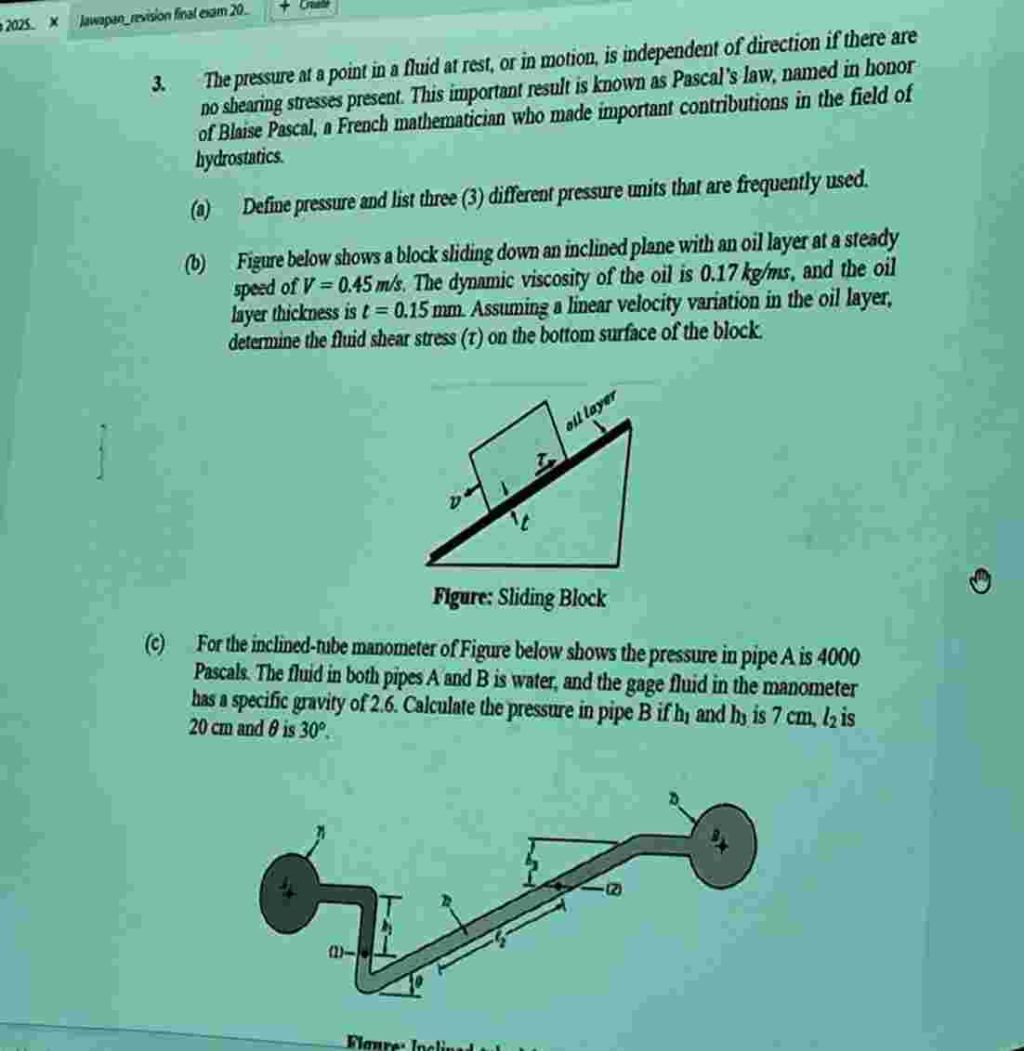
Give step-by-step solution with explanation and final answer:0s. x owmpen ison al eam 20. || 7 EC i tion, i independent of direction if tere are 3 The preset a point a a uid at 5, OF BREE F000 gy, in 20 shearing sireses preseat. This important - fet tai ot Oe Peach mnbemtician who made portant conibuions hydrostatics. (a) pine pressure nd tre) diffe pressure unit at re frequently ed ®) igre below shows block sldig down anuclined plane wi an oi layer a steady peed of = 045 mi, The dynamic viscosity of the il is 0.17 kgf, and the ol Jaye thickness is £ = 0.15 mm. Assuming a linear velocity variation in the ol ayer, determine the fluid shear stress (7) on the bottom surface of the block. v Figure: Sliding Block (v) (©) Forthe inclined-tube manometer of Figure below shows 22s Pascal. The hid in both pipes A sad B the pressure in pipe A is 4000 Doe pei gravity of 2.5. Calcul, th i §Age fluid in the soometer 20cm and Bis 30°, pressure in pipe B if by and hy is 7 cm, lyis 2, » Ld > 2 (i

Question:

Give step-by-step solution with explanation and final answer:Uploaded Image0s. x owmpen ison al eam 20. || 7 EC i tion, i independent of direction if tere are 3 The preset a point a a uid at 5, OF BREE F000 gy, in 20 shearing sireses preseat. This important - fet tai ot Oe Peach mnbemtician who made portant conibuions hydrostatics. (a) pine pressure nd tre) diffe pressure unit at re frequently ed ®) igre below shows block sldig down anuclined plane wi an oi layer a steady peed of = 045 mi, The dynamic viscosity of the il is 0.17 kgf, and the ol Jaye thickness is £ = 0.15 mm. Assuming a linear velocity variation in the ol ayer, determine the fluid shear stress (7) on the bottom surface of the block. v Figure: Sliding Block (v) (©) Forthe inclined-tube manometer of Figure below shows 22s Pascal. The hid in both pipes A sad B the pressure in pipe A is 4000 Doe pei gravity of 2.5. Calcul, th i §Age fluid in the soometer 20cm and Bis 30°, pressure in pipe B if by and hy is 7 cm, lyis 2, » Ld > 2 (i
This is AI generated Response.
Asked by: Rahul
Created at: 2026-01-24 03:26:52

Final Answer:

Rendered Raw Text
Did you like this answer?
Let's solve each part step by step: --- ## (a) **Define pressure and list three different pressure units that are frequently used.** ### **Definition of** **Pressure** is defined as the amount of force exerted per unit area. \[ P = \frac{F}{A} \] Where: - \( P \) = Pressure - \( F \) = Force - \( A \) = Area ### **Common Units of Pressure** 1. **Pascal (Pa)**: 1 Pa = 1 N/m² (SI unit) 2. **Bar**: 1 bar = 100,000 Pa 3. **Atmosphere (atm)**: 1 atm = 101,325 Pa --- ## (b) **Sliding Block Problem** Given: - Speed, \( V = .45\, \text{m/s} \) - Dynamic viscosity, \( \mu = .17\, \text{kg/(m·s)} \) - Oil layer thickness, \( t = .15\, \text{mm} = .00015\, \text{m} \) We are to find **fluid shear stress (\(\tau\))** on the bottom surface. ### **Shear Stress Formula** For a linear velocity profile: \[ \tau = \mu \frac{V}{t} \] #### **Substitute the Values** \[ \tau = .17 \times \frac{.45}{.00015} \] \[ \tau = .17 \times 300 \] \[ \tau = 510\, \text{N/m}^2 \] **Final Answer for (b):** > The fluid shear stress on the bottom surface of the block is **510 N/m²**. --- ## (c) **Inclined-tube Manometer Problem** Given: - Pressure in pipe A, \( P_A = 400\, \text{Pa} \) - Fluid in A & B = water (\( \rho_{water} = 100\, \text{kg/m}^3 \)) - Manometer fluid specific gravity (\( S_g \)) = 2.6 - \( h_1 = 7\, \text{cm} = .07\, \text{m} \) - \( l_2 = 20\, \text{cm} = .20\, \text{m} \) - \( \theta = 30^\circ \) #### **Step 1: Calculate \( h_2 \)** \[ h_2 = l_2 \sin \theta = .20 \times \sin 30^\circ = .20 \times .5 = .10\, \text{m} \] #### **Step 2: Write Pressure Equation** Starting from left (Pipe A) to right (Pipe B): \[ P_A + \rho_{water} g h_1 + \rho_{man} g h_2 = P_B \] where - \(\rho_{man} = S_g \times \rho_{water} = 2.6 \times 100 = 260\, \text{kg/m}^3\) So, \[ P_B = P_A + \rho_{water} g h_1 + (\rho_{man} - \rho_{water}) g h_2 \] #### **Step 3: Substitute Values** \[ P_B = 400 + (100 \times 9.81 \times .07) + (260 - 100) \times 9.81 \times .10 \] \[ P_B = 400 + (100 \times .687) + (160 \times .981) \] \[ P_B = 400 + 687 + 1569.6 \] \[ P_B = 6256.6\, \text{Pa} \] --- ### **Final Answers** **(a)** - **Pressure** is force per unit area. - **Units:** Pascal (Pa), Bar, Atmosphere (atm) **(b)** - Shear stress, \( \tau = \boxed{510\, \text{N/m}^2} \) **(c)** - Pressure in pipe B, \( P_B = \boxed{6256.6\, \text{Pa}} \) --- Let me know if you need clarification or further explanation on any part!

📢 Instructions:

  • Ask anything relatd to above question only.
  • For new Question goto :

Study Help, Fast Answers

VIPSolutions focuses on clear, step‑by‑step explanations so you can learn quickly. Whether you need an AI‑generated walkthrough or a short hint to get unstuck, each solution is organized for fast reading and easy review later.

Search similar questions, compare approaches, and bookmark the best answers for revision. Our goal is simple: quick, reliable study help that feels natural—not noisy.