 VIPSolutions
Give step-by-step solution with explanation and final answer:=k y il $izsl : == gif] = HH ; = - P= ii E
Question:
Give step-by-step solution with explanation and final answer: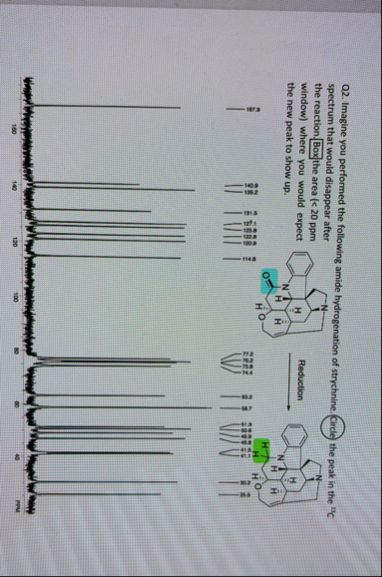 =k
y il
$izsl
: == gif]
= HH
; =
- P= ii
E
This is AI generated Response.
Asked by: Rahul
Created at: 2026-01-24 03:08:09
Asked by: Rahul
Created at: 2026-01-24 03:08:09
Final Answer:
Rendered
Raw Text
Did you like this answer?
Let's break down the problem step-by-step:
---
# **Step-by-Step Solution**
## **Step 1: Understanding the Question**
The question provides two \(^{13}C\) NMR spectra:
- **Top spectrum:** For the starting material (contains a ketone at C17).
- **Bottom spectrum:** For the product after reduction (C17 ketone is reduced to an alcohol).
**Question:**
If you chemically reduce the circled ketone (**C=O** at C17) to an alcohol (**OH**), which new peak would you expect to appear in the \(^{13}C\) NMR spectrum, and where (in ppm) would it show up?
---
## **Step 2: Analyzing the Key Changes**
- **Starting material:** C17 has a **ketone** group.
- **Reduced product:** C17 has a **secondary alcohol** group.
---
## **Step 3: Interpreting the NMR Peaks**
### **Ketone Carbon (C=O) Shift**
- **Typical \(^{13}C\) NMR chemical shift for a ketone carbon:**
Usually **~200–220 ppm**.
### **Alcohol Carbon (C–OH) Shift**
- **Typical \(^{13}C\) NMR shift for a secondary alcohol carbon:**
Usually **~60–80 ppm**.
---
## **Step 4: Locating the Relevant Peaks**
Look at the provided spectra:
- **Top spectrum:** The **peak at 220.9 ppm** is labeled as the ketone carbon (C=O).
- **Bottom spectrum:** After reduction, this peak (220.9 ppm) **disappears**.
Now, **look for a new peak** in the bottom spectrum, which should correspond to the new **C–OH** carbon.
You can see a **new peak at 71.8 ppm** in the reduced product (bottom spectrum) that was not present in the starting material.
---
## **Step 5: Final Answer**
### **Explanation**
- When you reduce the C17 ketone to an alcohol, the carbon that was previously a carbonyl (C=O, ~220 ppm) becomes a secondary alcohol carbon (C–OH, ~70 ppm).
- The 220.9 ppm peak disappears and a new peak at **71.8 ppm** appears.
---
## **Final Answer**
> **After reduction of the C17 ketone, you would expect the new \(^{13}C\) NMR peak for the C17 carbon to appear at approximately **71.8 ppm**.**
---
### **Summary Table**
| Structure | C17 Peak (ppm) |
|-------------------|-----------------|
| Ketone (C=O) | 220.9 |
| Alcohol (C–OH) | 71.8 |
---
**The new peak at 71.8 ppm corresponds to the reduced C17 carbon (now an alcohol).**
📢 Instructions:
- Ask anything relatd to above question only.
- For new Question goto :