This is AI generated Response.
Asked by: Alok Kumar
Created at: 2026-01-24 03:03:57
Final Answer:
RenderedRaw Text
Did you like this answer?
Let's break down and solve each part step by step:
---
## **8(a) Mass of Air Entered the Tank**
### **Given:**
- Initial tank volume, \( V = .75 \, m^3 \)
- Initial air density, \( \rho_1 = 1.18 \, kg/m^3 \)
- Final air density, \( \rho_2 = 4.95 \, kg/m^3 \)
- The tank is rigid (volume does not change).
### **Required:**
Determine the mass of air that has entered the tank.
---
### **Step 1: Calculate Initial Mass of Air**
\[
m_1 = \rho_1 \cdot V
\]
\[
m_1 = 1.18 \times .75 = .885 \, kg
\]
---
### **Step 2: Calculate Final Mass of Air**
\[
m_2 = \rho_2 \cdot V
\]
\[
m_2 = 4.95 \times .75 = 3.7125 \, kg
\]
---
### **Step 3: Mass of Air Entered**
\[
\Delta m = m_2 - m_1
\]
\[
\Delta m = 3.7125 - .885 = 2.8275 \, kg
\]
---
### **Final Answer for 8(a):**
\[
\boxed{2.83 \, \text{kg}}
\]
of air has entered the tank (rounded to two decimal places).
---
## **8(b) Force on the Elbow Flanges**
### **Given:**
- Water flow rate, \( Q = .16 \, m^3/s \)
- Area, \( A = .015 \, m^2 \)
- \( D = 30 \, cm = .3 \, m \)
- \( d = 10 \, cm = .1 \, m \)
- \( h = 50 \, cm = .5 \, m \)
- Volume = \( .03 \, m^3 \)
- Angle = \( 60^\circ \)
- Ignore weight of elbow material, water in elbow, and friction.
### **Required:**
Determine the force acting on the flanges of the elbow.
---
### **Step 1: Find Water Velocity**
\[
Q = A \cdot v \implies v = \frac{Q}{A}
\]
\[
v = \frac{.16}{.015} = 10.67 \, m/s
\]
---
### **Step 2: Calculate the Force Using Momentum Equation**
The force exerted by the fluid on the elbow is based on the change in momentum (linear momentum equation):
\[
\vec{F} = \dot{m} (\vec{v}_{out} - \vec{v}_{in})
\]
Where:
- \(\dot{m} = \rho Q\)
- Water density \(\rho \approx 100 \, kg/m^3\)
#### **Inlet and Outlet Velocities:**
Let’s assume:
- Inlet is horizontal (x-direction)
- Outlet is downward at \(60^\circ\) to the horizontal
#### **Velocity Components:**
- Inlet: \( \vec{v}_{in} = v \hat{i} \)
- Outlet: \( \vec{v}_{out} = v (\cos 60^\circ \hat{i} - \sin 60^\circ \hat{j}) \)
\[
\cos 60^\circ = .5,\ \sin 60^\circ = .866
\]
So:
- \( \vec{v}_{out} = v (.5 \hat{i} - .866 \hat{j}) \)
#### **Change in Velocity:**
\[
\vec{v}_{out} - \vec{v}_{in} = v (.5 \hat{i} - .866 \hat{j}) - v \hat{i} = v(-.5 \hat{i} - .866 \hat{j})
\]
#### **Calculate Mass Flow Rate:**
\[
\dot{m} = \rho Q = 100 \times .16 = 160 \, kg/s
\]
---
### **Step 3: Calculate Force Components**
\[
\vec{F} = \dot{m} \times [(-.5 v) \hat{i} + (-.866 v) \hat{j}]
\]
Plug in values:
- \( v = 10.67 \, m/s \)
- \( \dot{m} = 160 \, kg/s \)
\[
F_x = 160 \times (-.5) \times 10.67 = -853.6 \, N
\]
\[
F_y = 160 \times (-.866) \times 10.67 = -1,478.5 \, N
\]
---
### **Step 4: Magnitude of Total Force**
\[
F = \sqrt{F_x^2 + F_y^2}
\]
\[
F = \sqrt{(-853.6)^2 + (-1,478.5)^2}
\]
\[
F = \sqrt{728,636.96 + 2,186,003.25} = \sqrt{2,914,640.21}
\]
\[
F \approx 1,707 \, N
\]
---
### **Final Answer for 8(b):**
- **Horizontal force (\(x\)):** \(\boxed{-854 \, N}\) (to the left)
- **Vertical force (\(y\)):** \(\boxed{-1,479 \, N}\) (downward)
- **Magnitude:** \(\boxed{1,707 \, N}\)
---
### **Summary Table**
| Part | Step | Expression | Value/Answer |
|---|---|---|---|
| 8(a) | Mass entered | \(m_2 - m_1\) | \(2.83 \, kg\) |
| 8(b) | Force (\(x\)) | \(-.5 \dot{m} v\) | \(-854 \, N\) |
| 8(b) | Force (\(y\)) | \(-.866 \dot{m} v\) | \(-1,479 \, N\) |
| 8(b) | Magnitude | \( \sqrt{F_x^2 + F_y^2} \) | \(1,707 \, N\) |
---
Let me know if you'd like a detailed diagram or further clarification on any step!
VIPSolutions focuses on clear, step‑by‑step explanations so you can learn quickly. Whether you need an AI‑generated walkthrough or a short hint to get unstuck, each solution is organized for fast reading and easy review later.
Search similar questions, compare approaches, and bookmark the best answers for revision. Our goal is simple: quick, reliable study help that feels natural—not noisy.
 VIPSolutions
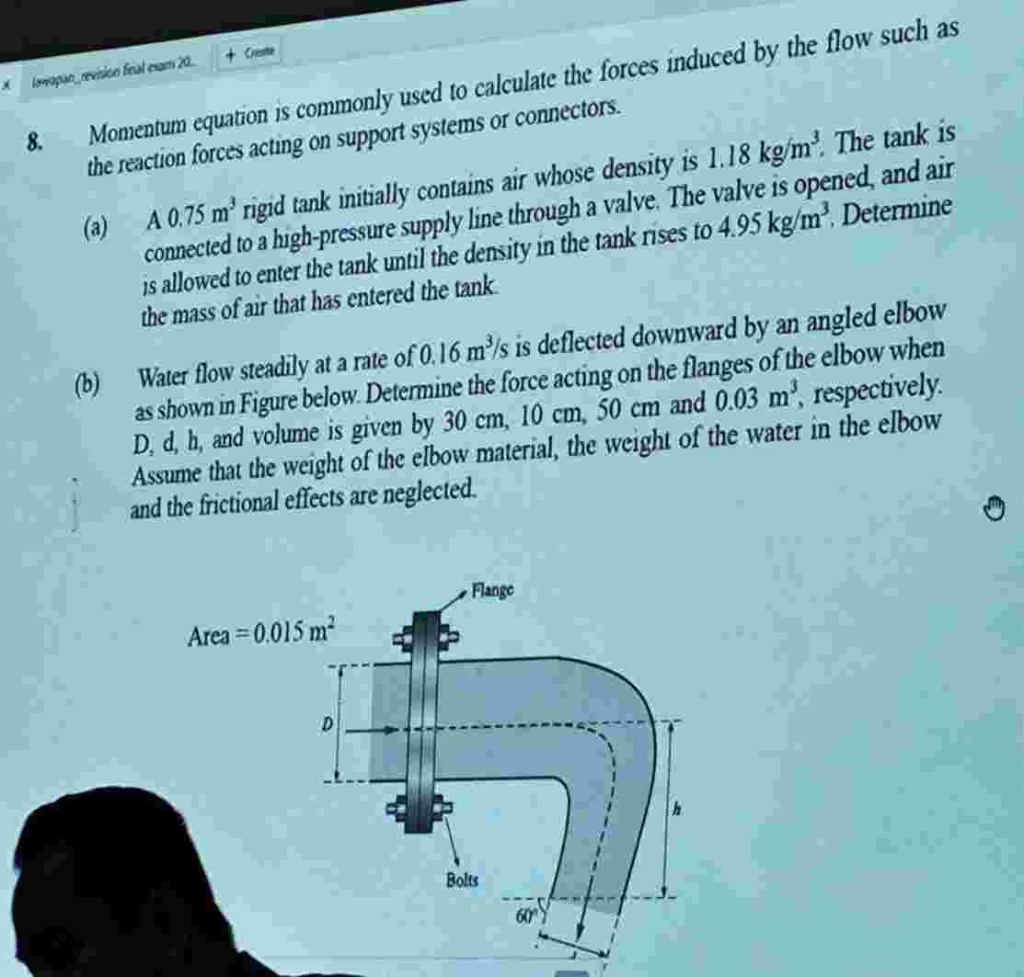 Pa; econ fool en 4 Cm
> w such as
g, Momentum equation 18 commonly used © calculate the forces induced by the flo¥
the reaction forces acting on support systems OF connectors:
@ AOT om’ rigid tank initially contains air whose density 15 1.18 kg/m”. The tank 15
connected 02 Jugh-pressure supply line through a valve: The valve 1s opened. and air
1s allowed to enter the tank until the density in the tank rises [0 4.95 kg/m”, Determine
the mass of air that has entered the tank
(b) Water flow steadily at a rate of 0. 16 m/s 18 deflected downward by an angled elbow
as shown in Figure below. Determine the force acing on the flanges of the elbow when
D, d, b, and volume is given by 30 cm, 10 cm, 50 cm and 0.03 m’, respectively:
h Assume that the weight of the elbow material, the weight of the water In the elbow
and the frictional effects are neglected.
LY)
Flange
Area=0015m’*
om
»|_ BEIT
In oN aT
1
5
\ |
Bolts /
ai = os
— itr)