 VIPSolutions
Give step-by-step solution with explanation and final answer:a nN JE paision firs! £5 2 See 9, The pressure at a point in a fluid at rest, Of in motion, 1S independent of direction 45 long as {here are po shearing stresses present This important result is known a5 Pascal's law. named in honor of Blaise Pascal, French mathematician who made important contributions 10 the field of hydrostatics (a) Define pressure and list 3 different pressure its that are ff equently used (b) Figure bio shows a differential manometer connected to Wo points AandB AtA the air pressure IS 100 kN/m?. Find the absolute pressure af B MN Pr Ns he Ol(50 + 0.85) ] SAAN om = 7) 4 Er Tom | 2 or _¥. 8 QU FER | 10mm) Tg ¢ Mercury S0~ 116) Figure: U-manometer
Question:
Give step-by-step solution with explanation and final answer: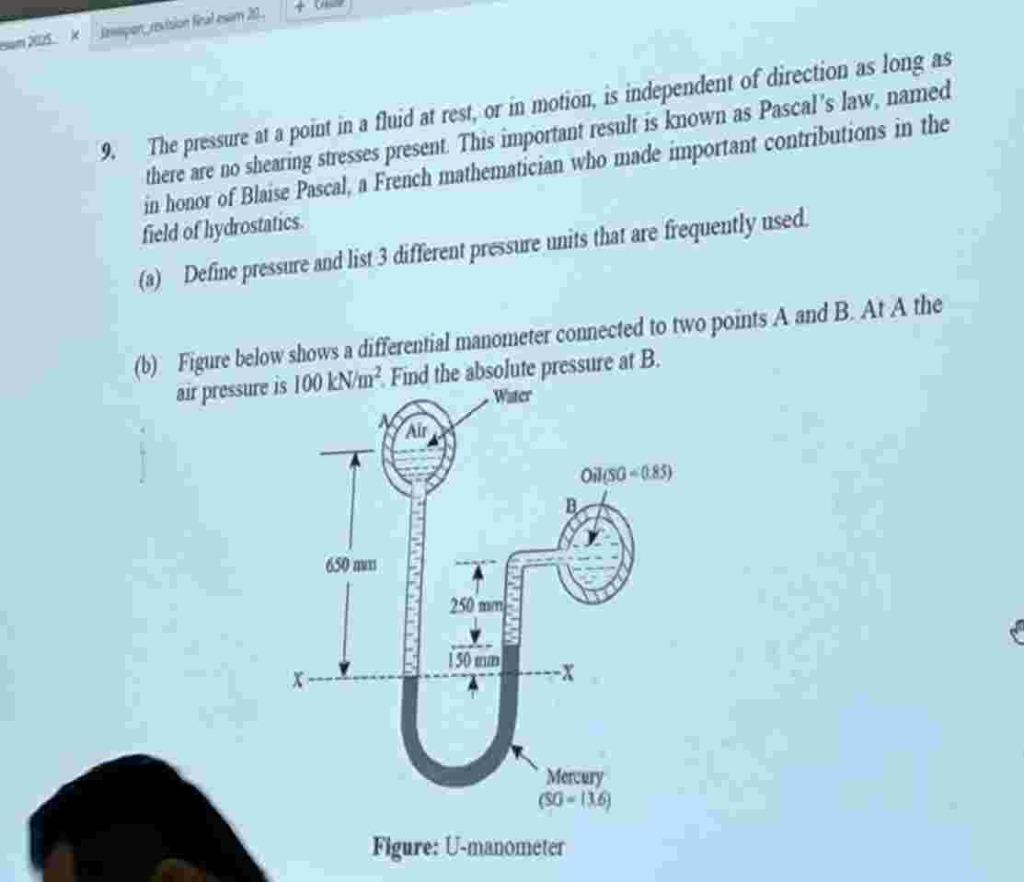 a
nN JE paision firs! £5 2 See
9, The pressure at a point in a fluid at rest, Of in motion, 1S independent of direction 45 long as
{here are po shearing stresses present This important result is known a5 Pascal's law. named
in honor of Blaise Pascal, French mathematician who made important contributions 10 the
field of hydrostatics
(a) Define pressure and list 3 different pressure its that are ff equently used
(b) Figure bio shows a differential manometer connected to Wo points AandB AtA the
air pressure IS 100 kN/m?. Find the absolute pressure af B
MN Pr
Ns
he Ol(50 + 0.85)
] SAAN
om = 7)
4 Er Tom |
2 or
_¥. 8
QU FER | 10mm)
Tg ¢
Mercury
S0~ 116)
Figure: U-manometer
This is AI generated Response.
Asked by: Alok Kumar
Created at: 2026-01-24 03:00:16
Asked by: Alok Kumar
Created at: 2026-01-24 03:00:16
Final Answer:
Rendered
Raw Text
Did you like this answer?
Let's solve the questions step by step:
---
## (a) **Define pressure and list 3 different pressure units that are frequently used.**
### **Definition of Pressure:**
Pressure is defined as the amount of force exerted per unit area of a surface.
\[
\text{Pressure} = \frac{\text{Force}}{\text{Area}}
\]
### **Three Common Pressure Units:**
1. **Pascal (Pa)** — SI unit, \(1 \text{ Pa} = 1 \text{ N/m}^2\)
2. **Bar** — \(1 \text{ bar} = 100,000 \text{ Pa}\)
3. **Atmosphere (atm)** — \(1 \text{ atm} = 101,325 \text{ Pa}\)
---
## (b) **Absolute Pressure at B Calculation**
### **Given Data:**
- Pressure at A, \(P_A = 100\, \text{kN/m}^2 = 100,000\, \text{N/m}^2\)
- Water column: \(h_1 = 650\, \text{mm} = .65\, \text{m}\)
- Oil column (\(\text{SG}=.85\)): \(h_2 = 250\, \text{mm} = .25\, \text{m}\)
- Mercury (\(\text{SG}=13.6\)): \(h_3 = 150\, \text{mm} = .15\, \text{m}\)
- Gravitational acceleration, \(g = 9.81\, \text{m/s}^2\)
- Densities:
- Water, \(\rho_{water} = 100\, \text{kg/m}^3\)
- Oil, \(\rho_{oil} = .85 \times 100 = 850\, \text{kg/m}^3\)
- Mercury, \(\rho_{Hg} = 13.6 \times 100 = 13600\, \text{kg/m}^3\)
---
### **Step-by-Step Solution:**
#### **1. Pressure at point X from A's side:**
Starting from A and moving down:
- Down .65 m of water, **pressure increases**:
\[
P_X (\text{left}) = P_A + \rho_{water} g h_1
\]
#### **2. Pressure at point X from B's side:**
From B, move:
- Down .25 m of oil (**increase**)
- Down .15 m of mercury (**increase**)
- Up .15 m of water (**decrease**; since the water column is above the X datum on left side)
So,
\[
P_X (\text{right}) = P_B + \rho_{oil} g h_2 + \rho_{Hg} g h_3 - \rho_{water} g h_3
\]
---
#### **3. Equate Pressures at X:**
\[
P_X (\text{left}) = P_X (\text{right})
\]
\[
P_A + \rho_{water} g h_1 = P_B + \rho_{oil} g h_2 + \rho_{Hg} g h_3 - \rho_{water} g h_3
\]
---
#### **4. Solve for \( P_B \):**
\[
P_B = P_A + \rho_{water} g h_1 - \rho_{oil} g h_2 - (\rho_{Hg} - \rho_{water}) g h_3
\]
---
#### **5. Plug in the values:**
##### Constants:
- \(P_A = 100,000\, \text{N/m}^2\)
- \(\rho_{water} = 100\, \text{kg/m}^3\)
- \(h_1 = .65\, \text{m}\)
- \(\rho_{oil} = 850\, \text{kg/m}^3\)
- \(h_2 = .25\, \text{m}\)
- \(\rho_{Hg} = 13,600\, \text{kg/m}^3\)
- \(h_3 = .15\, \text{m}\)
- \(g = 9.81\, \text{m/s}^2\)
##### Now calculate each term:
- \(\rho_{water} g h_1 = 100 \times 9.81 \times .65 = 6,376.5\, \text{N/m}^2\)
- \(\rho_{oil} g h_2 = 850 \times 9.81 \times .25 = 2,085.6\, \text{N/m}^2\)
- \((\rho_{Hg} - \rho_{water}) g h_3 = (13,600 - 1,000) \times 9.81 \times .15 = 12,600 \times 9.81 \times .15 = 18,540.9\, \text{N/m}^2\)
##### Substitute into the equation:
\[
P_B = 100,000 + 6,376.5 - 2,085.6 - 18,540.9
\]
\[
P_B = 100,000 + 6,376.5 - 2,085.6 - 18,540.9 = 100,000 + 6,376.5 - 20,626.5
\]
\[
P_B = 106,376.5 - 20,626.5 = 85,750\, \text{N/m}^2
\]
---
## **Final Answers**
### (a)
- **Definition:** Pressure is force per unit area.
- **Three units:** Pascal (Pa), bar, atmosphere (atm).
### (b)
- **Absolute pressure at B:**
\[
\boxed{85,750\, \text{N/m}^2\ (\text{or}\ 85.75\, \text{kPa})}
\]
📢 Instructions:
- Ask anything relatd to above question only.
- For new Question goto :