 VIPSolutions
Give step-by-step solution with explanation and final answer:= F3 ® > ES o o Q i | ES a in § 3S $< I: 23 a o o SE = 2 = ° o S | 0 = | 3 3 3 2 om = £3 5 3 “ 5 $3 3 5 = 85 2 30 83
Question:
Give step-by-step solution with explanation and final answer: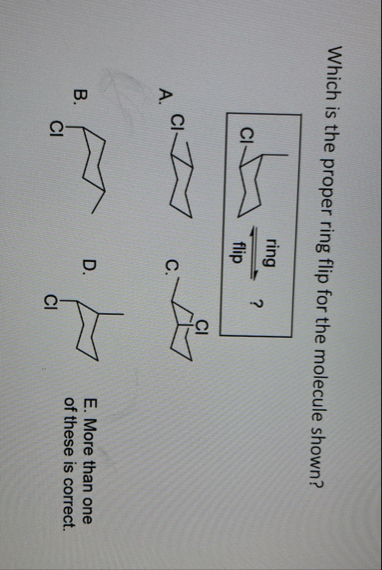 =
F3
® > ES
o o
Q i | ES
a
in §
3S
$<
I:
23 a
o o SE =
2 = °
o S |
0 =
| 3
3
3
2
om =
£3 5
3 “
5
$3 3
5 =
85 2
30
83
This is AI generated Response.
Asked by: Alok Kumar
Created at: 2026-01-24 02:35:52
Asked by: Alok Kumar
Created at: 2026-01-24 02:35:52
Final Answer:
Rendered
Raw Text
Did you like this answer?
Let's solve the problem step-by-step:
---
## Step 1: **Understanding the Question**
We are given a chair conformation of cyclohexane with a chlorine substituent. The question asks which of the options (A, B, C, D) represents the correct **ring flip** for the molecule shown.
---
## Step 2: **Identifying Axial and Equatorial Positions**
In the starting conformation (on the right in the box):
- The chlorine is **axial down**.
---
## Step 3: **Effect of a Ring Flip**
A ring flip **interchanges all axial and equatorial positions**:
- Axial → Equatorial
- Equatorial → Axial
The carbon positions are preserved, but the orientation (up/down) is also preserved:
- Axial down → Equatorial down
- Axial up → Equatorial up
So, **after the ring flip**, the chlorine will be in the **equatorial down** position.
---
## Step 4: **Analyzing the Choices**
Let’s look for a chair conformation where the Cl is in the **equatorial down** position.
- **A:** Cl is axial up (incorrect)
- **B:** Cl is axial down (incorrect)
- **C:** Cl is equatorial down (**correct**)
- **D:** Cl is equatorial up (incorrect)
---
## Step 5: **Final Answer**
**The correct answer is C.**
---
### **Summary Table**
| Option | Cl Position | Correct? |
|--------|---------------------|-----------|
| A | Axial up | No |
| B | Axial down | No |
| C | Equatorial down | **Yes** |
| D | Equatorial up | No |
---
## **Final Answer**
### **C is the proper ring flip for the molecule shown.**
Question:
Question 2 : Union ProbabilityDevice fails if component A ( P = 0 . 0 1 ) , B ( 0 . 0 3 ) , or C ( 0 . 0 4 ) fails independently. Probability device works?
This is AI generated Response.
Asked by: Alok Kumar
Created at: 2026-01-26 03:57:17
Asked by: Alok Kumar
Created at: 2026-01-26 03:57:17
Final Answer:
Rendered
Raw Text
Did you like this answer?
# Solution to Union Probability Problem
## Step 1: **Understanding the Problem**
We need to determine the probability that a device works given the failure probabilities of its components \( A \), \( B \), and \( C \).
- **Failure Probabilities:**
- \( P(A) = 0.01 \)
- \( P(B) = 0.03 \)
- \( P(C) = 0.04 \)
The device fails if **any one of its components fails**.
## Step 2: **Calculating the Probability of Failure**
To find the probability that the device fails, we first calculate the probability that each component works:
- \( P(A \text{ works}) = 1 - P(A) = 1 - 0.01 = 0.99 \)
- \( P(B \text{ works}) = 1 - P(B) = 1 - 0.03 = 0.97 \)
- \( P(C \text{ works}) = 1 - P(C) = 1 - 0.04 = 0.96 \)
The device will work if all components work, so we calculate the joint probability that all components work:
## Step 3: **Calculating the Probability of the Device Working**
The probability that the device works, \( P(\text{Device works}) \), is given by:
\[
P(\text{Device works}) = P(A \text{ works}) \times P(B \text{ works}) \times P(C \text{ works})
\]
Substituting the values we computed:
\[
P(\text{Device works}) = 0.99 \times 0.97 \times 0.96
\]
## Step 4: **Performing the Calculation**
Calculating the product:
\[
P(\text{Device works}) = 0.99 \times 0.97 = 0.9603
\]
Next, multiply \( 0.9603 \) by \( 0.96 \):
\[
P(\text{Device works}) = 0.9603 \times 0.96 \approx 0.921696
\]
## Step 5: **Final Answer**
Thus, the probability that the device works is approximately:
\[
\boxed{0.9217}
\]
This means that there is about a **92.17%** chance that the device will work.
📢 Instructions:
- Ask anything relatd to above question only.
- For new Question goto :