 VIPSolutions
Give step-by-step solution with explanation and final answer:Problem 03.091 - Find the principal stresses and maximum shear stress on a cantilevered bar. The cantilevered bar in the figure is made from a ductile material and is statically loaded with F,, = 420.0 Ibf and F; = F. = 0. The diameter Dis 2.000 in and the height his 2.500 in. Lengths AB and BC are 9.00 in. and 6.00 in., respectively. pe D , NY tin A b 2 Gr, re iN F X 1 I> ~~.
Question:
Give step-by-step solution with explanation and final answer: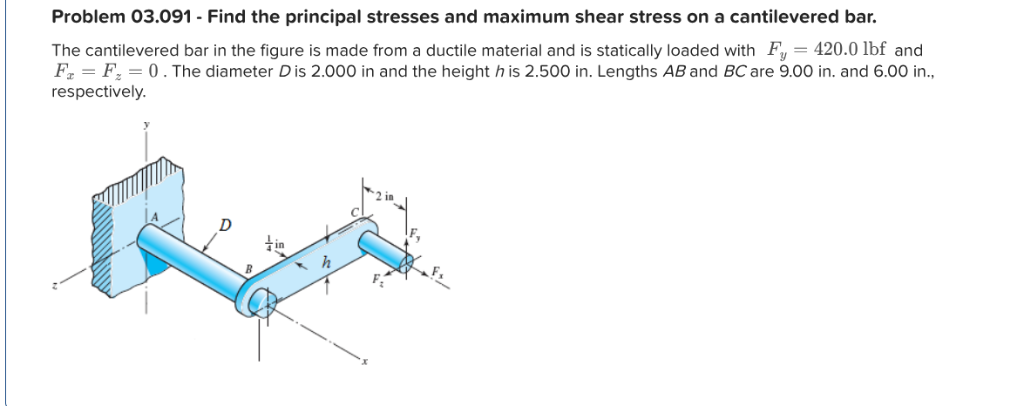 Problem 03.091 - Find the principal stresses and maximum shear stress on a cantilevered bar.
The cantilevered bar in the figure is made from a ductile material and is statically loaded with F,, = 420.0 Ibf and
F; = F. = 0. The diameter Dis 2.000 in and the height his 2.500 in. Lengths AB and BC are 9.00 in. and 6.00 in.,
respectively.
pe
D ,
NY tin A
b 2 Gr,
re iN F X
1
I>
~~.
This is AI generated Response.
Asked by: Alok Kumar
Created at: 2026-01-24 01:57:53
Asked by: Alok Kumar
Created at: 2026-01-24 01:57:53
Final Answer:
Rendered
Raw Text
Did you like this answer?
Let's break down the solution step by:
---
## **Step 1: List Given Data**
- \( F_y = 420. \) lbf
- \( F_x = F_z = \)
- Diameter \( D = 2.000 \) in
- Height \( h = 2.500 \) in
- Length \( AB = 9.00 \) in
- Length \( BC = 6.00 \) in
---
## **Step 2: Identify Critical Section**
The highest stresses will occur at the fixed support, **point A**.
---
## **Step 3: Calculate Resulting Moments**
The force \( F_y \) acts at a distance from A:
- **Total length from A to F application:**
\( L = AB + BC + \frac{h}{4} \)
\( L = 9.00 + 6.00 + \frac{2.5}{4} = 15.625 \) in
- **Moment about A:**
\( M = F_y \times L = 420. \times 15.625 = 6562.5 \) in-lbf
---
## **Step 4: Calculate Sectional Properties**
- **Area, \( A \):**
\( A = \frac{\pi}{4} D^2 = \frac{\pi}{4} (2.000)^2 = 3.142 \) in²
- **Moment of inertia, \( I \):**
\( I = \frac{\pi}{64} D^4 = \frac{\pi}{64} (2.000)^4 = 1.571 \) in⁴
---
## **Step 5: Calculate Stresses**
### **A. Bending Stress (\( \sigma_b \))**
\[
\sigma_b = \frac{Mc}{I}
\]
where \( c = \frac{D}{2} = 1.000 \) in
\[
\sigma_b = \frac{6562.5 \times 1.000}{1.571} = 418 \text{ psi}
\]
---
### **B. Direct (Axial) Stress**
Since \( F_x = \), there is **no direct axial stress**.
---
### **C. Shear Stress**
Shear is negligible in bending-dominated cases for circular bars, but let's check:
- **Transverse Shear Stress (\( \tau \)):**
\[
\tau = \frac{4F_y}{3A} = \frac{4 \times 420}{3 \times 3.142} = \frac{168}{9.426} = 178.3 \text{ psi}
\]
---
## **Step 6: Principal Stresses**
At the **surface** (outer fiber at top or bottom), the stress state is:
- Normal: \( \sigma_b \) (tension or compression)
- Shear: \( \tau \) (from above)
Principal stresses:
\[
\sigma_{1,2} = \frac{\sigma_b}{2} \pm \sqrt{\left(\frac{\sigma_b}{2}\right)^2 + \tau^2}
\]
Plug the values:
\[
\sigma_{1,2} = \frac{418}{2} \pm \sqrt{\left(\frac{418}{2}\right)^2 + (178.3)^2}
\]
\[
= 209 \pm \sqrt{209^2 + 178.3^2}
\]
\[
= 209 \pm \sqrt{4,368,100 + 31,801}
\]
\[
= 209 \pm \sqrt{4,399,901}
\]
\[
= 209 \pm 2098.8
\]
So,
- \( \sigma_1 = 209 + 2098.8 = 4188.8 \) psi
- \( \sigma_2 = 209 - 2098.8 = -8.8 \) psi
---
## **Step 7: Maximum Shear Stress**
\[
\tau_{max} = \frac{\sigma_1 - \sigma_2}{2} = \frac{4188.8 - (-8.8)}{2} = \frac{4197.6}{2} = 2098.8 \text{ psi}
\]
---
## **Final Answers**
### **Principal Stresses:**
- **Maximum:** \( \boxed{4188.8~\text{psi}} \)
- **Minimum:** \( \boxed{-8.8~\text{psi}} \)
### **Maximum Shear Stress:**
- \( \boxed{2098.8~\text{psi}} \)
---
**Summary Table:**
| Stress Type | Value (psi) |
|---------------------|:-----------:|
| Principal (max) | 4188.8 |
| Principal (min) | -8.8 |
| Max Shear | 2098.8 |
---
**If you need further breakdown or explanation for any step, please let me know!**
📢 Instructions:
- Ask anything relatd to above question only.
- For new Question goto :