 VIPSolutions
Give step-by-step solution with explanation and final answer:3) Calculate th, © the degree of unsaturation for the following molecule: NL LA | A)2 3 ) B)4 PE) i | 6 Which of the following alkenes arc terminal alkenes? ES Pe ANN SAN 4 n " ww 6) 2 sh pan B) Land IV Oliand II D)land It 7) Predict the major product(s) of the following reaction. fa fe ey 1 : Br - 3 Br Br 1 " " wv JY aethe. A) Only [and II B) Only [ll and IV C) Only Iand IV D) Only [1 and III 8) Provide the reagents necessary to complete the following transformation. 9 oH { Yo, F & —-— Te i ¥ a ae : E TER ; ale i hs 4 +, HO he . A)1.CHgCO3H 2-H" Ha hE : 0504, re B)0sOy H2O2 eles a OBO HO Lr dhs CRO SEE RR TNR ST
Question:
Give step-by-step solution with explanation and final answer: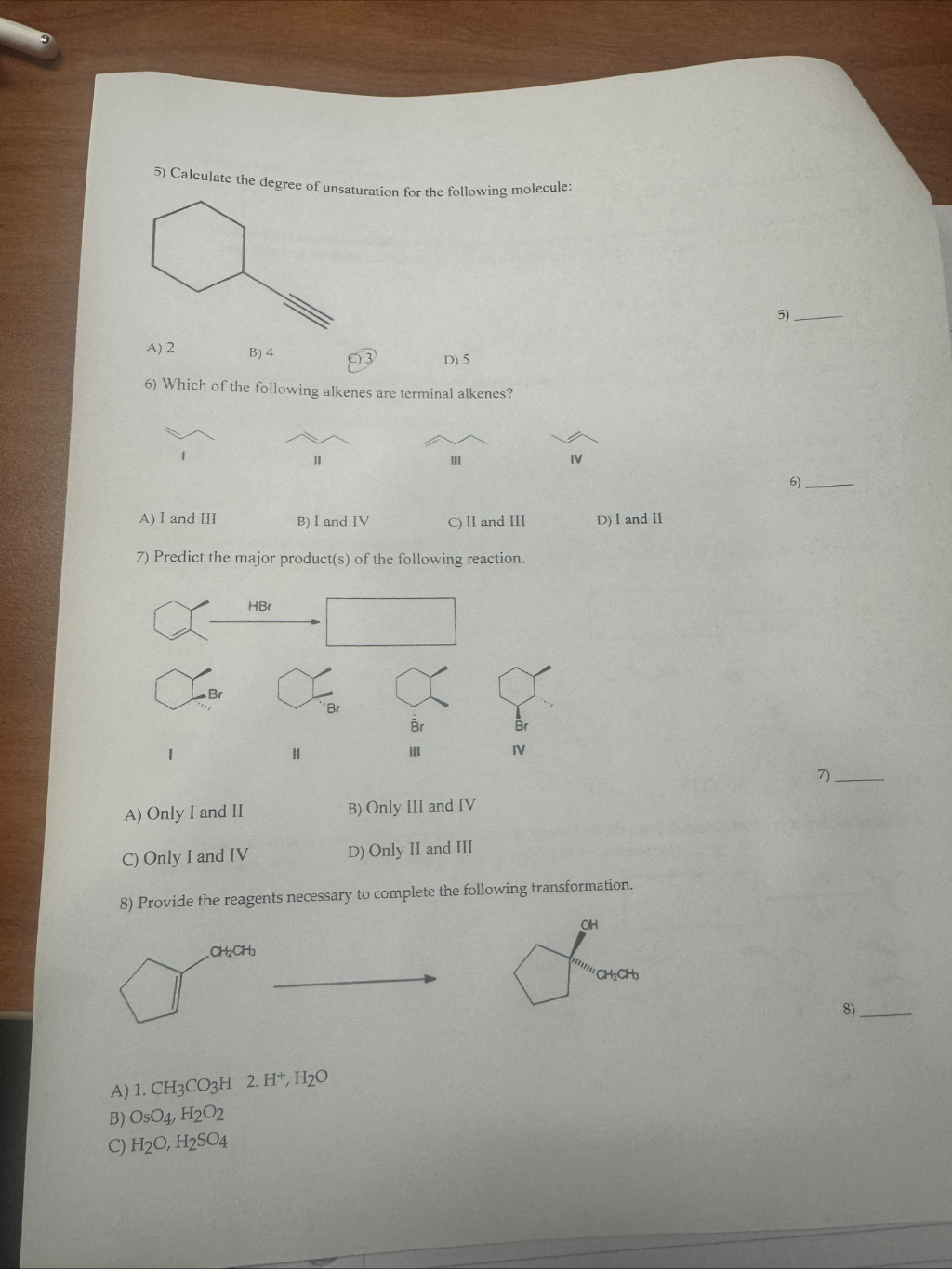 3) Calculate th,
© the degree of unsaturation for the following molecule:
NL LA |
A)2 3
) B)4 PE) i |
6 Which of the following alkenes arc terminal alkenes?
ES Pe ANN SAN
4 n " ww
6) 2 sh
pan B) Land IV Oliand II D)land It
7) Predict the major product(s) of the following reaction.
fa
fe
ey 1
: Br - 3
Br Br
1 " " wv
JY aethe.
A) Only [and II B) Only [ll and IV
C) Only Iand IV D) Only [1 and III
8) Provide the reagents necessary to complete the following transformation. 9
oH {
Yo,
F & —-— Te
i ¥ a ae :
E TER
; ale
i hs
4 +, HO he
. A)1.CHgCO3H 2-H" Ha hE
: 0504, re
B)0sOy H2O2 eles a
OBO HO Lr dhs
CRO SEE
RR TNR ST
This is AI generated Response.
Asked by: Alok Kumar
Created at: 2026-01-24 00:36:31
Asked by: Alok Kumar
Created at: 2026-01-24 00:36:31
Final Answer:
Rendered
Raw Text
Did you like this answer?
Let's solve each question step by step:
---
## **Question 5: Calculate the degree of unsaturation**
**Structure:** Cyclohexane ring with an ethynyl group.
### **Degree of Unsaturation Formula**
\[
\text{Degree of Unsaturation} = \frac{2C + 2 - H}{2}
\]
**Count the atoms:**
- Carbons (\(C\)): 8 (6 in ring + 2 in ethynyl)
- Hydrogens (\(H\)): Draw the structure or count:
- Cyclohexane ring (6C, each with 2H except where the ethynyl group is attached, which loses 1H).
- Ethynyl group (\(\ce{C#CH}\)): 1 H.
In total:
- Ring: 6C × 2H = 12H, but 1 position replaced by ethynyl, so 11H.
- Ethynyl: 1H.
- Total H = 11 + 1 = 12H.
But let's check with the structure:
- Cyclohexane: C6H12 (if fully saturated)
- Remove 1 H from one carbon for the ethynyl group: C6H11
- Ethynyl group: C2H
So total: C8H12.
Plug into the formula:
\[
\text{Degree of Unsaturation} = \frac{2(8) + 2 - 12}{2} = \frac{16 + 2 - 12}{2} = \frac{6}{2} = 3
\]
**Final Answer:**
\[
\boxed{3}
\]
---
## **Question 6: Which of the following alkenes are terminal alkenes?**
**Terminal alkene:** Double bond at the end of the chain (one carbon of the double bond is at the end).
- **I**: Yes, terminal.
- **II**: Yes, terminal.
- **III**: No, internal.
- **IV**: No, internal.
**Final Answer:**
\[
\boxed{\text{D) I and II}}
\]
---
## **Question 7: Predict the major product(s) of the following reaction.**
**Reaction:** Cyclohexene + HBr
**Mechanism:**
- Alkene undergoes electrophilic addition.
- Markovnikov addition: Br adds to more substituted carbon.
**Look at the products:**
- **I:** Br at more substituted carbon (Markovnikov)
- **II:** Br at less substituted carbon (anti-Markovnikov)
- **III:** Same as II, just different drawing.
- **IV:** Br at more substituted carbon (same as I, different drawing).
So, **I and IV** are Markovnikov (major), **II and III** are anti-Markovnikov (minor).
**Final Answer:**
\[
\boxed{\text{C) Only I and IV}}
\]
---
## **Question 8: Reagents necessary for the transformation.**
**Transformation:**
- Cyclohexene with an ethyl group → trans-1,2-diol (syn addition of two OH groups).
**This is syn dihydroxylation.**
- **A:** Epoxidation (MCPBA) + acid workup: gives trans-diol (anti).
- **B:** OsO4, H2O2: syn addition of two OH groups.
- **C:** Hydration (not correct).
**Final Answer:**
\[
\boxed{\text{B) OsO}_4, \text{H}_2\text{O}_2}
\]
---
## **Summary Table**
| Q# | Answer |
|--- |---------------------|
| 5 | 3 |
| 6 | D) I and II |
| 7 | C) Only I and IV |
| 8 | B) OsO4, H2O2 |
📢 Instructions:
- Ask anything relatd to above question only.
- For new Question goto :