Give step-by-step solution with explanation and final answer:
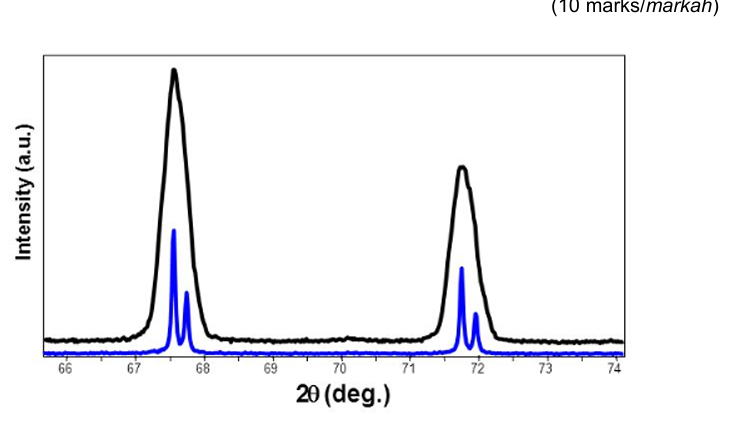
{give the answer without using bullet-points} Figure 1 shows diffraction patterns from the same sample on two different diffractometers set up. The observed peak broadening results solely from instrumentation differences, highlighting the need to consider instrumental effects in XRD data interpretation. In a different setup, explain how crystallite size influences peak broadening in powder XRD patterns. Using the Scherrer equation, calculate the crystallite size for a sample if the full width at half maximum (FWHM) of a selected peak at 20 = 30° is 0.3° (in 20 scale). Assume a wavelength A = 0.154 nm and a shape factor K = 0.9. Discuss the limitations of the Scherrer equation in accurately determining crystallite size.(TU marks/markan)
3
sg
2
7]
e
Ss
E
CRG ® ee 0 on 1 nn
20 (deg.)
Question:
Give step-by-step solution with explanation and final answer:
{give the answer without using bullet-points} Figure 1 shows diffraction patterns from the same sample on two different diffractometers set up. The observed peak broadening results solely from instrumentation differences, highlighting the need to consider instrumental effects in XRD data interpretation. In a different setup, explain how crystallite size influences peak broadening in powder XRD patterns. Using the Scherrer equation, calculate the crystallite size for a sample if the full width at half maximum (FWHM) of a selected peak at 20 = 30° is 0.3° (in 20 scale). Assume a wavelength A = 0.154 nm and a shape factor K = 0.9. Discuss the limitations of the Scherrer equation in accurately determining crystallite size.(TU marks/markan)
3
sg
2
7]
e
Ss
E
CRG ® ee 0 on 1 nn
20 (deg.)
This is AI generated Response.
Asked by: Francis
Created at: 2026-01-23 22:58:34
Final Answer:
RenderedRaw Text
Did you like this answer?
# Step-by-Step Solution
## Explanation of Crystallite Size and Peak Broadening
Crystallite size affects the width of diffraction peaks in powder X-ray diffraction (XRD) patterns. Smaller crystallites cause broader peaks due to the uncertainty principle: as the number of diffracting planes decreases, the precision in their orientation decreases, broadening the diffraction peak. This phenomenon is known as size broadening.
## Calculation Using the Scherrer Equation
The Scherrer equation relates the crystallite size (\( D \)) to the broadening of a specific XRD peak:
\[
D = \frac{K \lambda}{\beta \cos\theta}
\]
Where:
- \( D \): Crystallite size
- \( K \): Shape factor (usually .9)
- \( \lambda \): X-ray wavelength (given as .154 nm)
- \( \beta \): Full width at half maximum (FWHM) in radians
- \( \theta \): Bragg angle (half of \( 2\theta \))
### Step 1: Convert FWHM to Radians
Given FWHM (\( \beta \)) in \( 2\theta \) scale is .3°.
Convert degrees to radians:
\[
\beta (\text{radians}) = .3^\circ \times \frac{\pi}{180} = .00524 \text{ radians}
\]
### Step 2: Calculate \( \theta \)
Given \( 2\theta = 30^\circ \), so
\[
\theta = \frac{30^\circ}{2} = 15^\circ
\]
### Step 3: Calculate \( \cos\theta \)
\[
\cos 15^\circ = .9659
\]
### Step 4: Substitute into the Scherrer Equation
\[
D = \frac{.9 \times .154}{.00524 \times .9659}
\]
Calculate the denominator:
\[
.00524 \times .9659 = .00506
\]
Then:
\[
D = \frac{.1386}{.00506} = 27.4~\text{nm}
\]
**Final Answer:**
The calculated crystallite size is **27.4 nm**.
---
## Limitations of the Scherrer Equation
The Scherrer equation provides only an estimate for crystallite size and has several limitations:
- It assumes that peak broadening is due only to small crystallite size, whereas other factors, such as lattice strain or instrumental broadening, can also contribute.
- It is most accurate for crystallite sizes below about 100 nm; for larger sizes, the peaks become too sharp for reliable measurement.
- The shape factor (\( K \)) depends on the crystallite shape and may not always be exactly .9.
- The equation assumes that the crystallites are free of strain and that the sample is free of defects, which is rarely the case in real materials.
- Instrumental broadening must be subtracted from the observed FWHM to avoid overestimating broadening due to small size.
In summary, while the Scherrer equation is a useful tool for estimating crystallite size from XRD data, its results should be interpreted with caution and supplemented with other characterization techniques for more accurate size determination.
VIPSolutions focuses on clear, step‑by‑step explanations so you can learn quickly. Whether you need an AI‑generated walkthrough or a short hint to get unstuck, each solution is organized for fast reading and easy review later.
Search similar questions, compare approaches, and bookmark the best answers for revision. Our goal is simple: quick, reliable study help that feels natural—not noisy.
 VIPSolutions
 (TU marks/markan)
3
sg
2
7]
e
Ss
E
CRG ® ee 0 on 1 nn
20 (deg.)