This is AI generated Response.
Asked by: Francis
Created at: 2026-01-23 12:37:37
Final Answer:
RenderedRaw Text
Did you like this answer?
Let's solve the **step by step using the given data:
**Given:**
- Reversible reaction: \( \rightlefarpoons B \)
Isothermal at500 K
Equilibrium constant (\(K_c\)) at 500 K = **4**
- Initial concentration: \( [A]_ = 2 \) mol/L, \( [B]_ = \)
- Constant volume, ideal behavior
---
### (a) **Expression for the equilibrium constant in terms of concentration**
For the reaction \( A \rightleftharpoons B \):
\[
K_c = \frac{[B]_{eq}}{[A]_{eq}}
\]
---
### (b) **Equilibrium concentration of A (\([A]_{eq}\))**
Let \( x \) be the amount of A that reacts at equilibrium:
- Initial: \( [A]_ = 2 \), \( [B]_ = \)
- Change: \( -x \) for A, \( +x \) for B
- At equilibrium: \( [A]_{eq} = 2 - x \), \( [B]_{eq} = x \)
Substitute into the equilibrium expression:
\[
K_c = \frac{[B]_{eq}}{[A]_{eq}} = \frac{x}{2-x} = 4
\]
Solve for \( x \):
\[
x = 4(2-x)
\]
\[
x = 8 - 4x
\]
\[
x + 4x = 8
\]
\[
5x = 8
\]
\[
x = \frac{8}{5} = 1.6
\]
Thus,
\[
[A]_{eq} = 2 - x = 2 - 1.6 = .4 \text{ mol/L}
\]
---
### (c) **Equilibrium concentration of B (\([B]_{eq}\))**
\[
[B]_{eq} = x = 1.6 \text{ mol/L}
\]
---
### (d) **Equilibrium conversion of A**
Conversion of A, \( X \):
\[
X = \frac{\text{moles of A reacted}}{\text{initial moles of A}} = \frac{x}{2} = \frac{1.6}{2} = .8 \text{ or } 80\%
\]
---
### (e) **Total concentration of the system at equilibrium**
Total concentration = \( [A]_{eq} + [B]_{eq} = .4 + 1.6 = 2. \) mol/L
---
### (f) **Effect of increasing temperature if the reaction is exothermic**
For an **exothermic reaction**, increasing temperature **shifts equilibrium toward the reactant (A)**, thus favoring formation of A (less B formed). This is due to Le Chatelier’s principle: system tries to absorb added heat by favoring the endothermic (reverse) reaction.
---
### **Final Answers Summary**
(a) \( K_c = \frac{[B]_{eq}}{[A]_{eq}} \)
(b) \( [A]_{eq} = .4 \) mol/L
(c) \( [B]_{eq} = 1.6 \) mol/L
(d) Conversion of A = .8 (or 80%)
(e) Total concentration at equilibrium = 2. mol/L
(f) Increasing temperature favors formation of **A** (reactant) if the reaction is exothermic.
VIPSolutions focuses on clear, step‑by‑step explanations so you can learn quickly. Whether you need an AI‑generated walkthrough or a short hint to get unstuck, each solution is organized for fast reading and easy review later.
Search similar questions, compare approaches, and bookmark the best answers for revision. Our goal is simple: quick, reliable study help that feels natural—not noisy.
 VIPSolutions
 HE RE {! IRE TRIN ERE
i ra chasing ms has reactor operating at steady sate th reverse reactor
{ia ChelTicel BngESANEIBRE eactor operating at steady state, the reversible reaction
TTR Te i
Him i i iii if ihe Hi Wa
ify fi Hii Hil Hitt didi i ih
I mi LG ee
me I de
| Ach occurs sothermally at 500 K. The equilibrium constant ~~ il Hi igi
IGT I
IA fli / Jy a
i pH a i
ie Hit ili i
i | fa, Ee
i bid; TT
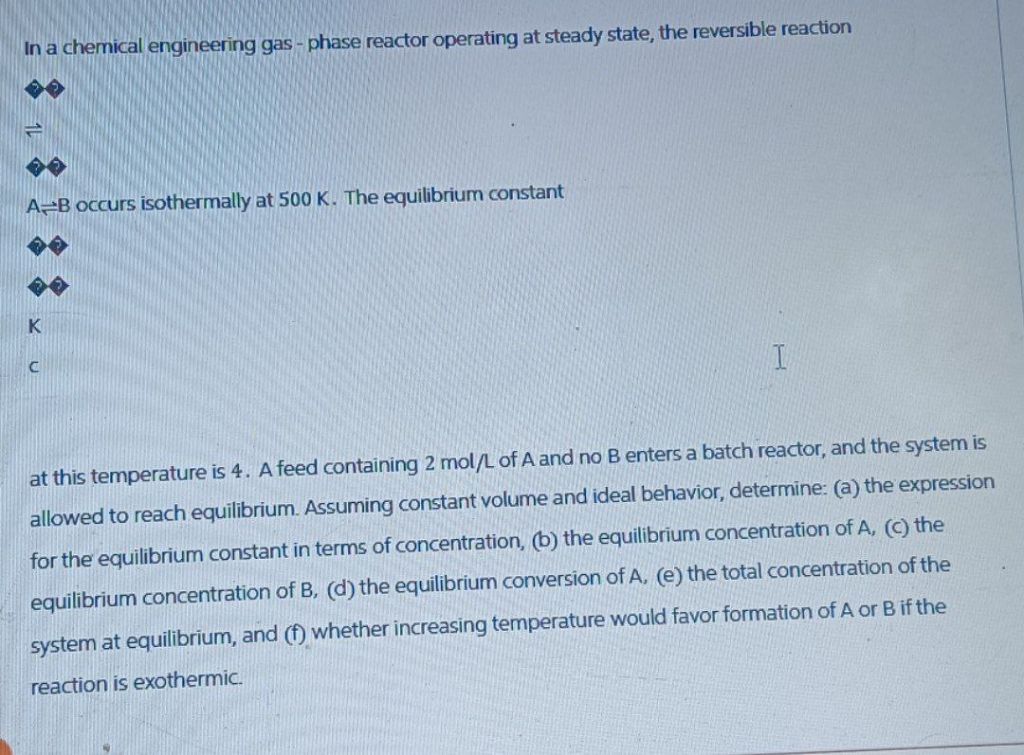
| at this temperature is 4. A feed containing 2 mol/L of Aand no B enters a patch reactor, and the systems
allowed to reach equilibrium. Assuming constant volume and ideal behavior, determine: (a) the! expression i
ATH the expreciogl
for the equilibrium constant in terms of concentration, (b) the equilibrium concentration of A, ©the 0
He
ll equilibrium concentration of B, (d) the equilibrium conversion of A, (e) the total concentration ofthe [ii
if system at equilibrium, and (f) whether increasing temperature would favor formation of Aor Bifthe ih ji
reaction is exothermic. ; 1
i i 4
LE i :
i