 VIPSolutions
Give step-by-step solution with explanation and final answer:ee, [Ze aein ; GR NH Sy A ( 2 7 2) ] ATP ea) Eu RD & Iz; ) Jeenebtd 3 SI Ae Bs { > Ky Ch y= Kyla Prank 2 : Erpeen egal A Meat 9 anther ASCH ex dennal Casdart T an - ns pent ef of ODE’ = (efe ehvER props 7 gpl nea of COMP u- Fo? ini an ie {i Affe oF v robe ey paste 0
Question:
Give step-by-step solution with explanation and final answer: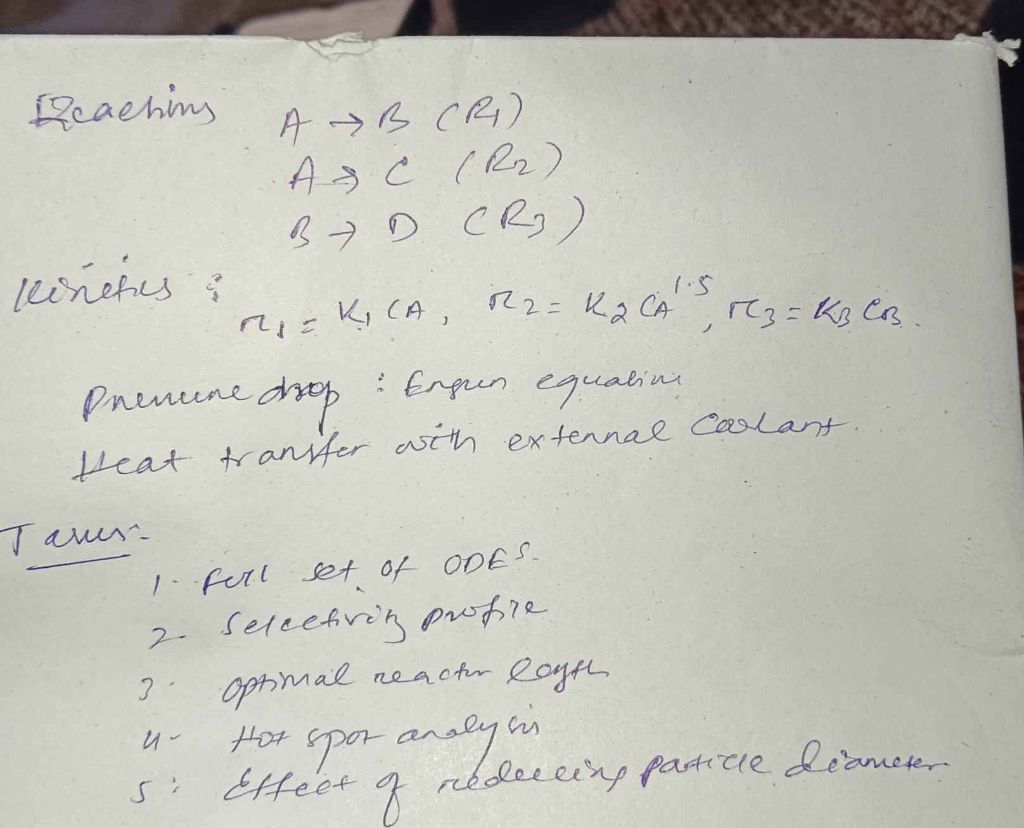 ee,
[Ze aein ;
GR NH Sy A ( 2 7 2) ]
ATP ea)
Eu RD & Iz; )
Jeenebtd 3
SI Ae Bs
{ > Ky Ch y= Kyla
Prank 2 : Erpeen egal A
Meat 9 anther ASCH ex dennal Casdart
T an -
ns
pent ef of ODE’
= (efe ehvER props
7 gpl nea of COMP
u- Fo? ini an ie
{i Affe oF v robe ey paste 0
This is AI generated Response.
Asked by: Francis
Created at: 2026-01-23 09:51:35
Asked by: Francis
Created at: 2026-01-23 09:51:35
Final Answer:
Rendered
Raw Text
Did you like this answer?
Let's break down and address the first task: **writing the full set of ODEs (Ordinary Differential Equations)** for the given reactions and kinetics.
---
## **Step 1: Write the Reactions**
Given:
1. \( \mathbf{A \rightarrow B} \) (R1)
2. \( \mathbf{A \rightarrow C} \) (R2)
3. \( \mathbf{B \rightarrow D} \) (R3)
---
## **Step 2: Write the Rate Expressions**
Given kinetics:
- \( r_1 = k_1 C_A \)
- \( r_2 = k_2 C_A^{1.5} \)
- \( r_3 = k_3 C_B \)
Where:
- \(C_A, C_B, C_C, C_D\) are the concentrations of A, B, C, D.
- \(k_1, k_2, k_3\) are rate constants.
---
## **Step 3: Write the Mole Balances (ODEs)**
Assuming a plug flow reactor (PFR) or batch reactor (no spatial variation):
### **For A:**
A is consumed in both R1 and R2.
\[
\frac{dC_A}{dt} = -r_1 - r_2 = -k_1 C_A - k_2 C_A^{1.5}
\]
---
### **For B:**
B is formed from R1 and consumed in R3.
\[
\frac{dC_B}{dt} = r_1 - r_3 = k_1 C_A - k_3 C_B
\]
---
### **For C:**
C is formed from R2.
\[
\frac{dC_C}{dt} = r_2 = k_2 C_A^{1.5}
\]
---
### **For D:**
D is formed from R3.
\[
\frac{dC_D}{dt} = r_3 = k_3 C_B
\]
---
## **Step 4: Final Set of ODEs**
\[
\boxed{
\begin{aligned}
\frac{dC_A}{dt} &= -k_1 C_A - k_2 C_A^{1.5} \\
\frac{dC_B}{dt} &= k_1 C_A - k_3 C_B \\
\frac{dC_C}{dt} &= k_2 C_A^{1.5} \\
\frac{dC_D}{dt} &= k_3 C_B \\
\end{aligned}
}
\]
---
## **Explanation**
- Each equation represents the rate of change of concentration for each species.
- The negative signs indicate consumption, while positive signs indicate formation.
- The rates are substituted from the given kinetics.
---
### **Next Steps**
You can use these ODEs for further tasks:
1. **Selectivity profile** (e.g., C vs. B)
2. **Optimal reactor length/time**
3. **Hot spot analysis** (add energy balance)
4. **Effect of reducing particle diameter** (affects heat/mass transfer)
---
**Let me know which subtask you'd like to solve next, or if you need explanations for the rest!**
📢 Instructions:
- Ask anything relatd to above question only.
- For new Question goto :