 VIPSolutions
Give step-by-step solution with explanation and final answer:ra 145-5 mechanism fr the (oloing suSsttion reaction. Be sur 00d fone pairs and charges where rear Cin cic on — |
Question:
Give step-by-step solution with explanation and final answer: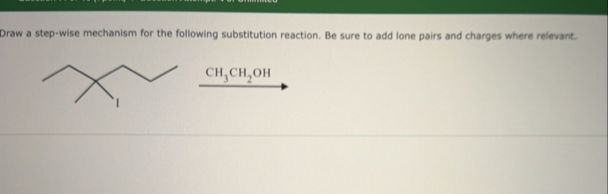 ra 145-5 mechanism fr the (oloing suSsttion reaction. Be sur 00d fone pairs and charges where rear
Cin cic on
—
|
This is AI generated Response.
Asked by: Rahul
Created at: 2026-01-23 09:12:35
Asked by: Rahul
Created at: 2026-01-23 09:12:35
Final Answer:
Rendered
Raw Text
Did you like this answer?
Let's analyze and solve the given problem **step-by-step**.
---
## **Step 1: Identify the Reaction Type**
- The substrate is a **tertiary alkyl iodide**:
(2-iodo-2,3-dimethylbutane)
- The nucleophile is **ethanol** (\(\mathrm{CH_3CH_2OH}\)), a weak nucleophile and weak base.
- This setup favors an **SN1 substitution reaction** mechanism.
---
## **Step 2: Draw the SN1 Mechanism**
### **Step 2.1: Formation of Carbocation (Rate-determining Step)**
- The **iodide** (\(\mathrm{I^-}\)) leaves, generating a **tertiary carbocation**.
\[
\begin{align*}
\text{(CH}_3)_2C(I)CH_2CH_3 &\longrightarrow (\text{CH}_3)_2C^+CH_2CH_3 + \mathrm{I}^-
\end{align*}
\]
#### **Explanation:**
- Iodide is a good leaving group.
- The tertiary carbocation is stabilized by inductive and hyperconjugation effects.
---
### **Step 2.2: Nucleophilic Attack by Ethanol**
- Ethanol (\(\mathrm{CH_3CH_2OH}\)) attacks the carbocation.
\[
\begin{align*}
(\text{CH}_3)_2C^+CH_2CH_3 + \mathrm{CH_3CH_2OH} &\longrightarrow (\text{CH}_3)_2C(OCH_2CH_3)CH_2CH_3^+ \\
\end{align*}
\]
- The oxygen in ethanol donates a lone pair to the carbocation, forming an **oxonium ion** (protonated ether).
---
### **Step 2.3: Deprotonation**
- Another ethanol molecule (or solvent) removes a proton from the oxonium ion.
\[
\begin{align*}
(\text{CH}_3)_2C(O^+HCH_2CH_3)CH_2CH_3 + \mathrm{CH_3CH_2OH} &\longrightarrow (\text{CH}_3)_2C(OCH_2CH_3)CH_2CH_3 + \mathrm{CH_3CH_2OH_2}^+
\end{align*}
\]
---
## **Step 3: Final Answer**
### **Overall Reaction:**
\[
\text{Tert-alkyl iodide} + \mathrm{CH_3CH_2OH} \rightarrow \text{Tert-alkyl ethyl ether} + \mathrm{HI}
\]
### **Stepwise Mechanism (Summary):**
1. **Leaving group leaves:**
- Tertiary alkyl iodide → Tertiary carbocation + I⁻
2. **Nucleophilic attack:**
- Ethanol attacks carbocation, forming a protonated ether (oxonium ion).
3. **Deprotonation:**
- Ethanol (solvent) removes the proton, yielding the final ether.
---
## **Product Structure**
- The **ethoxy group** (\(-OCH_2CH_3\)) replaces the iodine at the tertiary carbon.
**Product:**
2-ethoxy-2,3-dimethylbutane
---
### **Mechanism Diagram**
```markdown
Step 1: Formation of carbocation
(CH3)2C(I)CH2CH3 → (CH3)2C^+CH2CH3 + I^-
Step 2: Nucleophilic attack
(CH3)2C^+CH2CH3 + CH3CH2OH → (CH3)2C(O^+HCH2CH3)CH2CH3
Step 3: Deprotonation
(CH3)2C(O^+HCH2CH3)CH2CH3 + CH3CH2OH → (CH3)2C(OCH2CH3)CH2CH3 + CH3CH2OH2^+
```
---
## **Final Product**
**2-ethoxy-2,3-dimethylbutane**
---
Let me know if you need a drawn arrow-pushing mechanism!
Question:
Then solved
This is AI generated Response.
Asked by: Rahul
Created at: 2026-01-23 09:14:48
Asked by: Rahul
Created at: 2026-01-23 09:14:48
Final Answer:
Rendered
Raw Text
Did you like this answer?
# Step-by-Step Solution to the SN1 Mechanism Problem
## Step 1: Identify the Reaction Type
- **Substrate:** Tertiary alkyl iodide (2-iodo-2,3-dimethylbutane)
- **Nucleophile:** Ethanol (\(\mathrm{CH_3CH_2OH}\))
- **Mechanism:** SN1 substitution reaction
## Step 2: Draw the SN1 Mechanism
### Step 2.1: Formation of Carbocation (Rate-Determining Step)
- The iodide (\(\mathrm{I^-}\)) leaves, forming a **tertiary carbocation**.
\[
\text{(CH}_3)_2C(I)CH_2CH_3 \longrightarrow (\text{CH}_3)_2C^+CH_2CH_3 + \mathrm{I}^-
\]
#### Explanation:
- Iodide is a good leaving group.
- The tertiary carbocation is stabilized by inductive effects and hyperconjugation.
### Step 2.2: Nucleophilic Attack by Ethanol
- Ethanol attacks the carbocation.
\[
(\text{CH}_3)_2C^+CH_2CH_3 + \mathrm{CH_3CH_2OH} \longrightarrow (\text{CH}_3)_2C(OCH_2CH_3)CH_2CH_3^+
\]
- The oxygen in ethanol donates a lone pair to the carbocation, creating an **oxonium ion**.
### Step 2.3: Deprotonation
- A proton is removed from the oxonium ion by another ethanol molecule (or solvent).
\[
(\text{CH}_3)_2C(O^+HCH_2CH_3)CH_2CH_3 + \mathrm{CH_3CH_2OH} \longrightarrow (\text{CH}_3)_2C(OCH_2CH_3)CH_2CH_3 + \mathrm{CH_3CH_2OH_2}^+
\]
## Step 3: Final Answer
### Overall Reaction
\[
\text{Tert-alkyl iodide} + \mathrm{CH_3CH_2OH} \rightarrow \text{Tert-alkyl ethyl ether} + \mathrm{HI}
\]
### Stepwise Mechanism Summary
1. **Leaving Group Leaves:**
- Tertiary alkyl iodide → Tertiary carbocation + I⁻
2. **Nucleophilic Attack:**
- Ethanol attacks carbocation, forming a protonated ether (oxonium ion).
3. **Deprotonation:**
- Ethanol (solvent) removes the proton, yielding the final ether.
## Product Structure
- The **ethoxy group** (\(-OCH_2CH_3\)) replaces the iodine at the tertiary carbon.
### Final Product
**2-ethoxy-2,3-dimethylbutane**
## Mechanism Diagram (Text Representation)
```markdown
Step 1: Formation of carbocation
(CH3)2C(I)CH2CH3 → (CH3)2C^+CH2CH3 + I^-
Step 2: Nucleophilic attack
(CH3)2C^+CH2CH3 + CH3CH2OH → (CH3)2C(O^+HCH2CH3)CH2CH3
Step 3: Deprotonation
(CH3)2C(O^+HCH2CH3)CH2CH3 + CH3CH2OH → (CH3)2C(OCH2CH3)CH2CH3 + CH3CH2OH2^+
```
---
## Summary
The overall reaction converts a tertiary alkyl iodide into an ether via the SN1 mechanism, resulting in **2-ethoxy-2,3-dimethylbutane** as the final product.
📢 Instructions:
- Ask anything relatd to above question only.
- For new Question goto :