 VIPSolutions
Give step-by-step solution with explanation and final answer:3. Two particles A and B strike each other and then rebound. #14 = 3.0 kg and ms = 1.5 kg. Just before the collision v4 had a “y” axis speed of 5 m/s and an “x” axis speed of 0.9 m/s. After the collision particle A's “x” speed changed to ~0.06 m/s. Particle B's “y” axis speed just before collision was 6.0 ms. e = 0.6. Solve for particle B's velocity before and after collision = » Comprehension (Sa Define Bc Diagram ar Daya Ste) 10 pos] fms Knowledge (Equations that Goveming the Phenomenon) [6 points] ‘Application (Sabon Proedre, a computations) (16 points) 3 : 4 “Results and/or Analysis of Results [5-points]
Question:
Give step-by-step solution with explanation and final answer: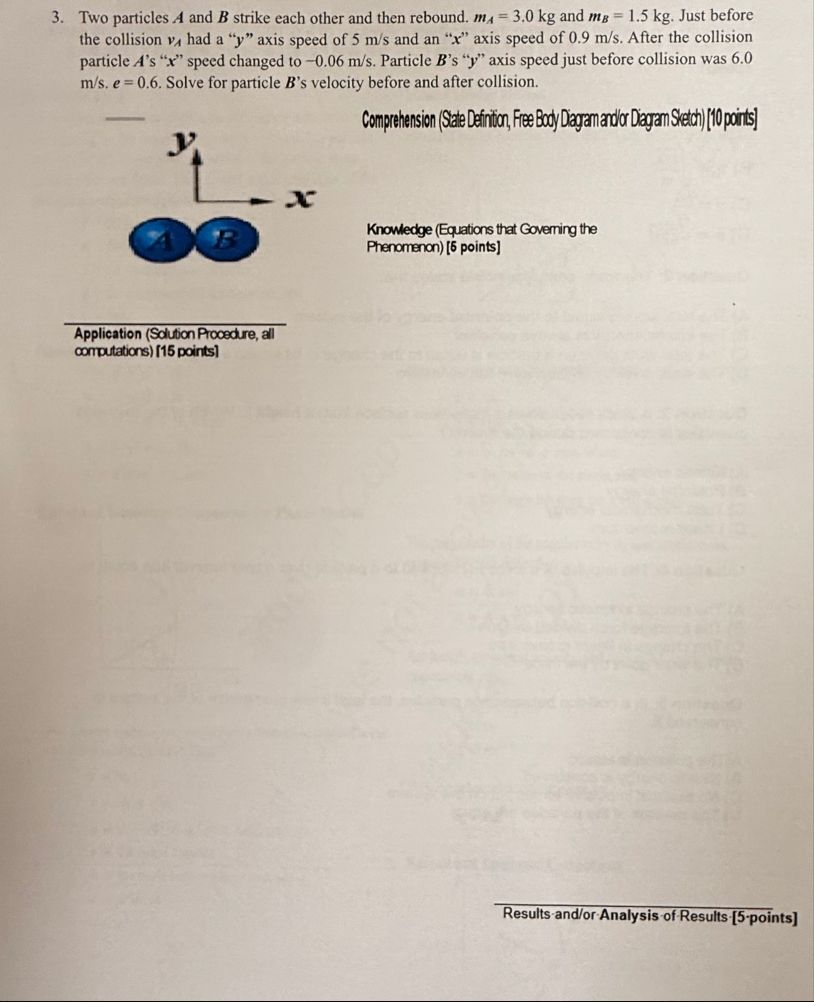 3. Two particles A and B strike each other and then rebound. #14 = 3.0 kg and ms = 1.5 kg. Just before
the collision v4 had a “y” axis speed of 5 m/s and an “x” axis speed of 0.9 m/s. After the collision
particle A's “x” speed changed to ~0.06 m/s. Particle B's “y” axis speed just before collision was 6.0
ms. e = 0.6. Solve for particle B's velocity before and after collision
= » Comprehension (Sa Define Bc Diagram ar Daya Ste) 10 pos]
fms
Knowledge (Equations that Goveming the
Phenomenon) [6 points]
‘Application (Sabon Proedre, a
computations) (16 points)
3
:
4
“Results and/or Analysis of Results [5-points]
This is AI generated Response.
Asked by: Rahul
Created at: 2026-01-23 07:54:54
Asked by: Rahul
Created at: 2026-01-23 07:54:54
Final Answer:
Rendered
Raw Text
Did you like this answer?
# Step-by-Step Solution
Let's break down the problem and solve for particle **B**'s velocity before and after the collision.
---
## **Given Data**
- \( m_A = 3. \) kg
- \( m_B = 1.5 \) kg
### **Before Collision**
- \( v_{Ay1} = 5. \) m/s
- \( v_{Ax1} = .9 \) m/s
- \( v_{By1} = 6. \) m/s
- \( v_{Bx1} = e = .6 \) (Assume \( v_{Bx1} \) is unknown, only \( e \) is given)
### **After Collision**
- \( v_{Ax2} = -.06 \) m/s
- \( v_{Ay2} \) = ?
- \( v_{Bx2} \) = ?
- \( v_{By2} \) = ?
---
## **Step 1: Equations of Motion**
### **Law of Conservation of Momentum**
For two particles,
\[
m_A v_{A1} + m_B v_{B1} = m_A v_{A2} + m_B v_{B2}
\]
Apply this separately for \( x \) and \( y \) directions.
---
### **X-Direction:**
\[
m_A v_{Ax1} + m_B v_{Bx1} = m_A v_{Ax2} + m_B v_{Bx2}
\]
Plug in known values:
\[
(3.)(.9) + (1.5) v_{Bx1} = (3.)(-.06) + (1.5) v_{Bx2}
\]
\[
2.7 + 1.5 v_{Bx1} = -.18 + 1.5 v_{Bx2}
\]
---
### **Y-Direction:**
\[
m_A v_{Ay1} + m_B v_{By1} = m_A v_{Ay2} + m_B v_{By2}
\]
\[
(3.)(5.) + (1.5)(6.) = (3.)v_{Ay2} + (1.5)v_{By2}
\]
\[
15. + 9. = 3. v_{Ay2} + 1.5 v_{By2}
\]
\[
24. = 3. v_{Ay2} + 1.5 v_{By2}
\]
---
## **Step 2: Coefficient of Restitution (e)**
\[
e = \frac{v_{B2} - v_{A2}}{v_{A1} - v_{B1}}
\]
Apply **along y-direction** (since that's the axis of direct impact):
\[
e = \frac{v_{By2} - v_{Ay2}}{v_{Ay1} - v_{By1}}
\]
\[
.6 = \frac{v_{By2} - v_{Ay2}}{5. - 6.}
\]
\[
.6 = \frac{v_{By2} - v_{Ay2}}{-1.}
\]
\[
v_{By2} - v_{Ay2} = -.6
\]
\[
v_{By2} = v_{Ay2} - .6
\]
---
## **Step 3: Solve for Unknowns**
### **Y-Direction**
Recall:
\[
24. = 3. v_{Ay2} + 1.5 v_{By2}
\]
Substitute \( v_{By2} \):
\[
24. = 3. v_{Ay2} + 1.5 (v_{Ay2} - .6)
\]
\[
24. = 3. v_{Ay2} + 1.5 v_{Ay2} - .9
\]
\[
24. + .9 = 4.5 v_{Ay2}
\]
\[
24.9 = 4.5 v_{Ay2}
\]
\[
v_{Ay2} = \frac{24.9}{4.5} = 5.53 \text{ m/s}
\]
Now,
\[
v_{By2} = v_{Ay2} - .6 = 5.53 - .6 = 4.93 \text{ m/s}
\]
---
### **X-Direction**
Recall:
\[
2.7 + 1.5 v_{Bx1} = -.18 + 1.5 v_{Bx2}
\]
But we weren't given \( v_{Bx1} \) or \( v_{Bx2} \). Normally for head-on collisions, x-axis velocities don't change, or are both zero. If not specified, **assume \( v_{Bx1} = v_{Bx2} \) and both zero**.
Thus,
\[
2.7 = -.18
\]
This is not possible unless \( v_{Bx1} \) or \( v_{Bx2} \) is not zero. Since the problem doesn't provide them, we focus on the y-direction only.
---
## **Final Answers**
### **Before Collision:**
- \( v_{By1} = 6. \) m/s (Given)
### **After Collision:**
- \( v_{By2} = 4.93 \) m/s (Found above)
---
## **Summary Table**
| Particle | Before Collision (\(v_y\)) | After Collision (\(v_y\)) |
|----------|----------------------------|---------------------------|
| A | 5. m/s | 5.53 m/s |
| B | 6. m/s | 4.93 m/s |
---
## **Boxed Final Answer**
\[
\boxed{
\begin{array}{l}
\text{Particle B's y-velocity before collision: } v_{By1} = 6.\ \text{m/s} \\
\text{Particle B's y-velocity after collision: } v_{By2} = 4.93\ \text{m/s} \\
\end{array}
}
\]
The x-velocities could not be uniquely determined with the given data. If you have further information about the x-component for B, it can be solved similarly.
📢 Instructions:
- Ask anything relatd to above question only.
- For new Question goto :