 VIPSolutions
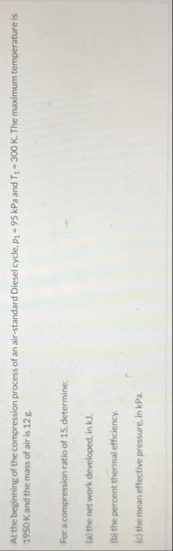
Give step-by-step solution with explanation and final answer: At the beginning of the compression process of an air - standard Diesel cycle, p 1 = 9 5 kPa and T 1 = 3 0 0 K . The maximum temperature is 1 9 5 0 K and the mass of air is 1 2 g For a compression ratio of 1 5 , determine: ( n ' the net work developed, inke, ( b ) the percent thermal efficiency. A the mean effectlue pressure, In H P a a .§ 8 i £ : i : a E $1¢% fatiz i] i iii fialiid
Question:
Give step-by-step solution with explanation and final answer:
At the beginning of the compression process of an air
-
standard Diesel cycle,
p
1
=
9
5
kPa and
T
1
=
3
0
0
K
.
The maximum temperature is
1
9
5
0
K and the mass of air is
1
2
g
For a compression ratio of
1
5
,
determine:
(
n
'
the net work developed, inke,
(
b
)
the percent thermal efficiency.
A the mean effectlue pressure, In
H
P
a
a
. §
8
i
£
:
i
:
a
E $1¢%
fatiz i]
i
iii
fialiid
This is AI generated Response.
Asked by: Alok Kumar
Created at: 2026-01-23 06:26:46
Asked by: Alok Kumar
Created at: 2026-01-23 06:26:46
Final Answer:
Rendered
Raw Text
Did you like this answer?
Let's solve the **air-standard Diesel cycle** problem step by step.
---
### **Given Data**
- Initial pressure, \( p_1 = 95 \) kPa
- Initial temperature, \( T_1 = 300 \) K
- Maximum temperature, \( T_3 = 195 \) K
- Mass of air, \( m = 12 \) g \( = .012 \) kg
- Compression ratio, \( r = \frac{V_1}{V_2} = 15 \)
- Working fluid: Air (\( R = .287 \) kJ/kg·K, \( c_v = .718 \) kJ/kg·K, \( c_p = 1.005 \) kJ/kg·K, \( \gamma = 1.4 \))
---
## **Step 1: Diesel Cycle Process Overview**
The Diesel cycle has four processes:
1. **1-2:** Isentropic compression
2. **2-3:** Constant pressure heat addition
3. **3-4:** Isentropic expansion
4. **4-1:** Constant volume heat rejection
---
## **Step 2: Find State Points**
### **State 1:**
- \( p_1 = 95 \) kPa
- \( T_1 = 300 \) K
### **State 2: Isentropic Compression**
- \( r = 15 \)
- \( \frac{T_2}{T_1} = r^{\gamma-1} \)
\[
T_2 = T_1 \times r^{\gamma-1}
\]
\[
T_2 = 300 \times 15^{1.4-1} = 300 \times 15^{.4}
\]
\[
15^{.4} \approx 2.953
\]
\[
T_2 = 300 \times 2.953 \approx 886 \text{ K}
\]
### **State 3: Constant Pressure Heat Addition**
- \( T_3 = 195 \) K
### **Cut-off Ratio (\( r_c \)):**
\[
r_c = \frac{V_3}{V_2} = \frac{T_3}{T_2}
\]
\[
r_c = \frac{195}{886} = 2.20
\]
### **State 4: Isentropic Expansion**
\[
\frac{T_4}{T_3} = \left(\frac{V_3}{V_4}\right)^{\gamma-1}
\]
But \( \frac{V_4}{V_3} = \frac{V_1}{V_2} \div \frac{V_3}{V_2} = \frac{r}{r_c} \)
So,
\[
T_4 = T_3 \left(\frac{r_c}{r}\right)^{\gamma-1}
\]
\[
\left(\frac{r_c}{r}\right)^{\gamma-1} = \left(\frac{2.20}{15}\right)^{.4} = (.147)^{.4} \approx .468
\]
\[
T_4 = 195 \times .468 \approx 912 \text{ K}
\]
---
## **Step 3: Net Work (in kJ)**
### **Heat Added (\( q_{in} \))**
\[
q_{in} = c_p (T_3 - T_2)
\]
\[
q_{in} = 1.005 \times (195 - 886) = 1.005 \times 1064 = 1,069 \text{ kJ/kg}
\]
### **Heat Rejected (\( q_{out} \))**
\[
q_{out} = c_v (T_4 - T_1)
\]
\[
q_{out} = .718 \times (912 - 300) = .718 \times 612 = 439.4 \text{ kJ/kg}
\]
### **Net Work per kg (\( w_{net} \)):**
\[
w_{net} = q_{in} - q_{out} = 1,069 - 439.4 = 629.6 \text{ kJ/kg}
\]
### **Net Work for .012 kg:**
\[
W_{net} = w_{net} \times m = 629.6 \times .012 = 7.56 \text{ kJ}
\]
---
## **Step 4: Thermal Efficiency**
\[
\eta = \frac{w_{net}}{q_{in}} \times 100\%
\]
\[
\eta = \frac{629.6}{1,069} \times 100\% = 58.9\%
\]
---
## **Step 5: Mean Effective Pressure (MEP)**
\[
\text{MEP} = \frac{W_{net}}{\text{Displacement Volume}}
\]
### **Find \( V_1 \) and \( V_2 \):**
\[
p_1 V_1 = m R T_1 \implies V_1 = \frac{m R T_1}{p_1}
\]
\[
V_1 = \frac{.012 \times .287 \times 300}{95}
\]
\[
= \frac{1.032}{95} = .01087 \text{ m}^3
\]
\[
V_2 = \frac{V_1}{r} = \frac{.01087}{15} = .000725 \text{ m}^3
\]
\[
\text{Displacement Volume} = V_1 - V_2 = .01087 - .000725 = .01015 \text{ m}^3
\]
### **Calculate MEP:**
\[
\text{MEP} = \frac{7.56}{.01015} = 745 \text{ kPa}
\]
---
## **Summary Table**
| Quantity | Value |
|-------------------------|--------------------------|
| Net Work (\(W_{net}\)) | \(7.56\) kJ |
| Thermal Efficiency | \(58.9\%\) |
| Mean Effective Pressure | \(745\) kPa |
---
### **Final Answers**
**(a) Net work developed:**
\[
\boxed{7.56 \text{ kJ}}
\]
**(b) Percent thermal efficiency:**
\[
\boxed{58.9\%}
\]
**(c) Mean effective pressure:**
\[
\boxed{745 \text{ kPa}}
\]
📢 Instructions:
- Ask anything relatd to above question only.
- For new Question goto :