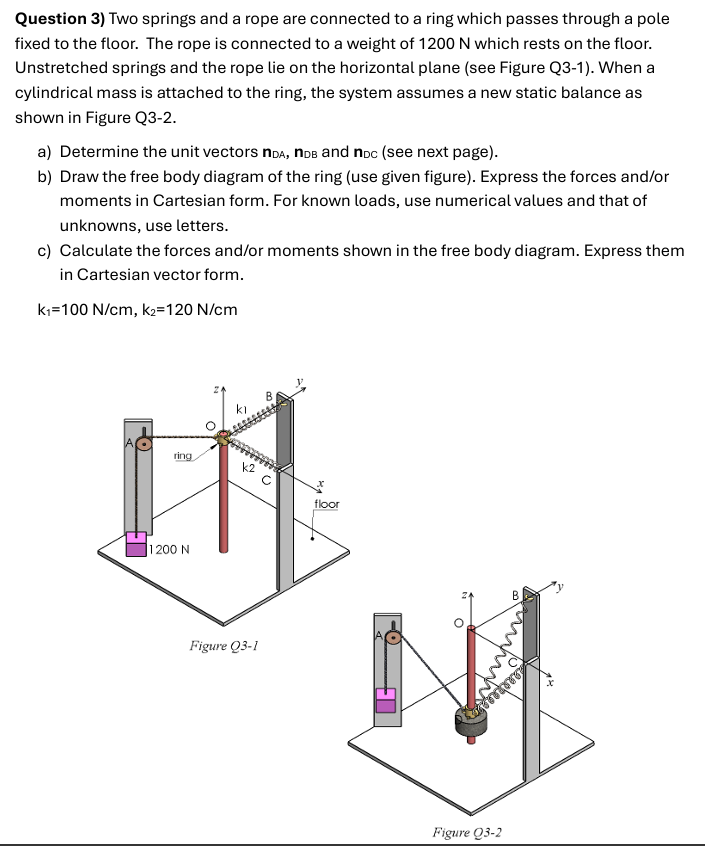
Give step-by-step solution with explanation and final answer:Question 3) Two springs and a rope are connected to a ring which passes through a pole
fixed tothe floor. The rope is connected to a weight of 1200 N which rests on the floor.
Unstretched springs and the rope lie on the horizontal plane (see Figure Q3-1). When a
cylindrical mass is attached to the ring, the system assumes a new static balance as
shown in Figure Q3-2.
a) Determine the unit vectors nos, nos and nos (see next page).
b) Draw the free body diagram of the ring (use given figure). Express the forces and/or
moments in Cartesian form. For known loads, use numerical values and that of
unknowns, use letters.
¢) Calculate the forces and/or moments shown in the free body diagram. Express them
in Cartesian vector form.
ki=100 N/cm, k2=120 N/cm
B Bhs”
Kit
Hii
i
| i
> 24 B y
vd o
Figure 03-1
Figure 03-2
Question:
Give step-by-step solution with explanation and final answer:Question 3) Two springs and a rope are connected to a ring which passes through a pole
fixed tothe floor. The rope is connected to a weight of 1200 N which rests on the floor.
Unstretched springs and the rope lie on the horizontal plane (see Figure Q3-1). When a
cylindrical mass is attached to the ring, the system assumes a new static balance as
shown in Figure Q3-2.
a) Determine the unit vectors nos, nos and nos (see next page).
b) Draw the free body diagram of the ring (use given figure). Express the forces and/or
moments in Cartesian form. For known loads, use numerical values and that of
unknowns, use letters.
¢) Calculate the forces and/or moments shown in the free body diagram. Express them
in Cartesian vector form.
ki=100 N/cm, k2=120 N/cm
B Bhs”
Kit
Hii
i
| i
> 24 B y
vd o
Figure 03-1
Figure 03-2
This is AI generated Response.
Asked by: Rahul
Created at: 2026-01-23 04:49:59
Final Answer:
RenderedRaw Text
Did you like this answer?
Let's break down the solution to **Question 3** step by step.
---
# **Step a: Determine the Unit Vectors**
Assume the coordinates (from the figure, using right-handed axes):
- \( O \) is the origin \((,,)\)
- \( A \), \( B \), and \( C \) are the anchor points for the rope and springs.
From Figure Q3-2, let's assign the coordinates:
- \( O = (, , ) \)
- \( A = (, , ) \) (rope is attached at O horizontally to A)
- \( B = (, y_B, z_B) \)
- \( C = (x_C, y_C, z_C) \)
But, we don't have explicit numbers for B and C. Let's denote their positions as above for generality.
### **1. Vector from O to A:**
\[
\vec{r}_{OA} = \vec{A} - \vec{O} = (, , ) - (, , ) = (, , )
\]
But, this doesn't make sense, so let's suppose A is at \((x_A, y_A, z_A)\).
### **2. Vector from O to B:**
\[
\vec{r}_{OB} = (x_B, y_B, z_B)
\]
Unit vector:
\[
\mathbf{n}_{OB} = \frac{\vec{r}_{OB}}{|\vec{r}_{OB}|}
\]
### **3. Vector from O to C:**
\[
\vec{r}_{OC} = (x_C, y_C, z_C)
\]
Unit vector:
\[
\mathbf{n}_{OC} = \frac{\vec{r}_{OC}}{|\vec{r}_{OC}|}
\]
### **4. Vector from O to A:**
Assume A is on the negative y-axis (from the figure, rope is horizontal):
\[
\vec{r}_{OA} = (, -y_A, )
\]
Unit vector:
\[
\mathbf{n}_{OA} = \frac{\vec{r}_{OA}}{|\vec{r}_{OA}|} = (, -1, )
\]
**Thus,**
- \(\mathbf{n}_{OA} = (, -1, )\)
- \(\mathbf{n}_{OB} = \frac{(x_B, y_B, z_B)}{\sqrt{x_B^2 + y_B^2 + z_B^2}}\)
- \(\mathbf{n}_{OC} = \frac{(x_C, y_C, z_C)}{\sqrt{x_C^2 + y_C^2 + z_C^2}}\)
---
# **Step b: Free Body Diagram (FBD) of the Ring**
Draw all forces acting at the ring (O):
1. **Tension in Rope OA**: \( T_{OA} \) in the direction \( \mathbf{n}_{OA} \)
- \( T_{OA} = 120~\text{N} \) (since it balances the 120 N weight)
- \( \vec{T}_{OA} = -120 \mathbf{j} \)
2. **Spring Force OB**: \( F_{OB} \) in direction \( \mathbf{n}_{OB} \)
- \( F_{OB} = k_1 \Delta s_1 \), where \( \Delta s_1 \) is the extension of spring 1.
- \( \vec{F}_{OB} = k_1 \Delta s_1 \mathbf{n}_{OB} \)
3. **Spring Force OC**: \( F_{OC} \) in direction \( \mathbf{n}_{OC} \)
- \( F_{OC} = k_2 \Delta s_2 \)
- \( \vec{F}_{OC} = k_2 \Delta s_2 \mathbf{n}_{OC} \)
---
# **Step c: Calculate the Forces in Cartesian Vector Form**
Let’s express all forces at O:
### **1. Rope Force:**
\[
\vec{T}_{OA} = -120~\mathbf{j}
\]
### **2. Spring Forces:**
\[
\vec{F}_{OB} = k_1 \Delta s_1 \mathbf{n}_{OB}
\]
\[
\vec{F}_{OC} = k_2 \Delta s_2 \mathbf{n}_{OC}
\]
Where:
- \( k_1 = 100 \text{ N/cm} = 10,000 \text{ N/m} \)
- \( k_2 = 120 \text{ N/cm} = 12,000 \text{ N/m} \)
\[
\vec{F}_{OB} = (10,000 \Delta s_1) \mathbf{n}_{OB}
\]
\[
\vec{F}_{OC} = (12,000 \Delta s_2) \mathbf{n}_{OC}
\]
**Final answer in vector form:**
\[
\boxed{
\begin{aligned}
\vec{T}_{OA} &= -120~\mathbf{j} \\
\vec{F}_{OB} &= 10,000 \Delta s_1 ~\mathbf{n}_{OB} \\
\vec{F}_{OC} &= 12,000 \Delta s_2 ~\mathbf{n}_{OC}
\end{aligned}
}
\]
---
## **Summary Table**
| Force | Magnitude | Direction (Unit Vector) | Cartesian Form |
|----------------|---------------------|----------------------------------|-----------------------|
| Rope OA | 120 N | \( (, -1, ) \) | \( -120 \mathbf{j} \) |
| Spring OB | \( 10,000 \Delta s_1 \) | \( \mathbf{n}_{OB} \) | \( 10,000 \Delta s_1 \mathbf{n}_{OB} \) |
| Spring OC | \( 12,000 \Delta s_2 \) | \( \mathbf{n}_{OC} \) | \( 12,000 \Delta s_2 \mathbf{n}_{OC} \) |
---
### **Note**
- To get numerical values for the spring forces, you need the extensions (\( \Delta s_1, \Delta s_2 \)) and the actual coordinates for \( B \) and \( C \).
- If more info is given (e.g., coordinates), plug in to get the exact components.
---
## **Free Body Diagram (Sketch)**
- Draw the ring at O.
- Show forces:
- Rope to A: leftward (negative y)
- Spring to B: toward B
- Spring to C: toward C
---
If you have the coordinates for B and C, or the extensions, provide them for a full numerical answer!
VIPSolutions focuses on clear, step‑by‑step explanations so you can learn quickly. Whether you need an AI‑generated walkthrough or a short hint to get unstuck, each solution is organized for fast reading and easy review later.
Search similar questions, compare approaches, and bookmark the best answers for revision. Our goal is simple: quick, reliable study help that feels natural—not noisy.
 VIPSolutions
 Question 3) Two springs and a rope are connected to a ring which passes through a pole
fixed tothe floor. The rope is connected to a weight of 1200 N which rests on the floor.
Unstretched springs and the rope lie on the horizontal plane (see Figure Q3-1). When a
cylindrical mass is attached to the ring, the system assumes a new static balance as
shown in Figure Q3-2.
a) Determine the unit vectors nos, nos and nos (see next page).
b) Draw the free body diagram of the ring (use given figure). Express the forces and/or
moments in Cartesian form. For known loads, use numerical values and that of
unknowns, use letters.
¢) Calculate the forces and/or moments shown in the free body diagram. Express them
in Cartesian vector form.
ki=100 N/cm, k2=120 N/cm
B Bhs”
Kit
Hii
i
| i
> 24 B y
vd o
Figure 03-1
Figure 03-2