 VIPSolutions
Give step-by-step solution with explanation and final answer:A skier leaves the ramp A at an angle 8, = 25° with the horizontal. If he strikes the ground at B, determine his initial speed VA, without unit. a \V [2 Va Hk A CPP | + —_— AS : ry 100 m AN .
Question:
Give step-by-step solution with explanation and final answer: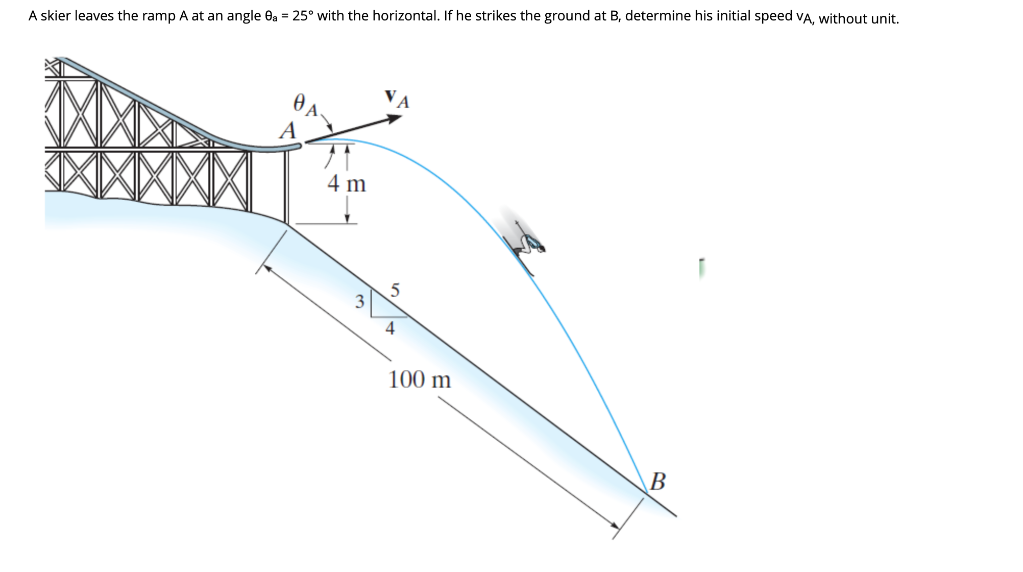 A skier leaves the ramp A at an angle 8, = 25° with the horizontal. If he strikes the ground at B, determine his initial speed VA, without unit.
a
\V [2 Va
Hk A
CPP | +
—_—
AS
:
ry
100 m
AN .
This is AI generated Response.
Asked by: Rahul
Created at: 2026-01-23 04:37:26
Asked by: Rahul
Created at: 2026-01-23 04:37:26
Final Answer:
Rendered
Raw Text
Did you like this answer?
## Step-by-Step Solution
Let's solve for the skier's initial speed \( v_A \).
### **Step 1: List the Known Values**
- Initial angle: \( \theta_A = 25^\circ \)
- Vertical drop from A to ground: \( y_A = 4\,m)
- Slope from A to: \( 100\,m \) at a slope of \( \frac{3}{5} \) (rise/run)
- Gravity: \( g = 9.81 \, \text{m/s}^2 \)
### **Step 2: Find the Coordinates of Point B**
The slope from A to B is \( \frac{3}{5} \), over a distance of \( 100\,m \):
- Horizontal distance: \( x_{AB} = 100 \times \frac{4}{5} = 80\,m \)
- Vertical distance: \( y_{AB} = -100 \times \frac{3}{5} = -60\,m \) (downward is negative)
Since point A is **already 4 m above** ground, the total vertical displacement from A to B is:
\[
\Delta y = y_{AB} - 4 = -60\,m - 4\,m = -64\,m
\]
But actually, at A, the skier is 4 m above the sloped ground, not the horizontal. We need the vertical drop **from A to B** (perpendicular to horizontal):
- Vertical drop: \( y_A = 4\,m \) (from A to sloped plane)
- Slope drop: \( y_{AB} = 100 \times \sin(\arctan(3/4)) \)
- \( \arctan(3/4) = 36.87^\circ \)
- So, \( y_{AB} = 100 \times \sin(36.87^\circ) = 100 \times .6 = 60\,m \)
- Total vertical drop from A to B: \( \Delta y = 4 + 60 = 64\,m \) (downward)
### **Step 3: Write Kinematic Equations**
Let A be the origin. The skier's initial velocity:
- \( v_{Ax} = v_A \cos\theta_A \)
- \( v_{Ay} = v_A \sin\theta_A \)
The skier's position at time \( t \):
- \( x = v_{Ax} t \)
- \( y = 4 + v_{Ay} t - \frac{1}{2} g t^2 \)
At point B:
- \( x = 80 \)
- \( y = -60 \)
So,
\[
80 = v_A \cos(25^\circ) t \tag{1}
\]
\[
-60 = 4 + v_A \sin(25^\circ) t - \frac{1}{2} g t^2 \tag{2}
\]
### **Step 4: Solve for \( t \) from (1)**
\[
t = \frac{80}{v_A \cos 25^\circ}
\]
### **Step 5: Substitute \( t \) into (2)**
Plug \( t \) into equation (2):
\[
-60 = 4 + v_A \sin(25^\circ) \left( \frac{80}{v_A \cos 25^\circ} \right) - \frac{1}{2} g \left( \frac{80}{v_A \cos 25^\circ} \right)^2
\]
Simplify:
- \( v_A \) cancels in the second term:
- \( \tan(25^\circ) = \frac{\sin 25^\circ}{\cos 25^\circ} \)
So,
\[
-60 = 4 + 80 \tan 25^\circ - \frac{1}{2} g \frac{80^2}{v_A^2 \cos^2 25^\circ}
\]
\[
-64 = 80 \tan 25^\circ - \frac{1}{2} g \frac{80^2}{v_A^2 \cos^2 25^\circ}
\]
\[
-64 - 80 \tan 25^\circ = - \frac{1}{2} g \frac{80^2}{v_A^2 \cos^2 25^\circ}
\]
\[
64 + 80 \tan 25^\circ = \frac{1}{2} g \frac{80^2}{v_A^2 \cos^2 25^\circ}
\]
### **Step 6: Solve for \( v_A \)**
\[
v_A^2 = \frac{1}{2} g \frac{80^2}{64 + 80 \tan 25^\circ} \frac{1}{\cos^2 25^\circ}
\]
\[
v_A^2 = \frac{.5 \cdot 9.81 \cdot 640}{64 + 80 \cdot .4663} \frac{1}{.8192}
\]
Calculate:
- \( \tan 25^\circ \approx .4663 \)
- \( \cos 25^\circ \approx .9063 \Rightarrow \cos^2 25^\circ \approx .8214 \)
- \( 80 \times .4663 \approx 37.30 \)
- \( 64 + 37.30 = 101.3 \)
- \( .5 \times 9.81 \times 640 = 31392 \)
So,
\[
v_A^2 = \frac{31392}{101.3} \frac{1}{.8214}
\]
\[
v_A^2 = 309.82 \times 1.2167 = 377.07
\]
\[
v_A = \sqrt{377.07} \approx 19.41
\]
---
## **Final Answer**
\[
\boxed{19.4}
\]
Question:
Then solved correct answer
This is AI generated Response.
Asked by: Rahul
Created at: 2026-01-23 04:39:16
Asked by: Rahul
Created at: 2026-01-23 04:39:16
Final Answer:
Rendered
Raw Text
Did you like this answer?
# Step-by-Step Solution for the Skier's Initial Speed
To determine the skier's initial speed \( v_A \) when leaving ramp A, follow these structured steps.
## Step 1: List the Known Values
- **Initial Angle**: \( \theta_A = 25^\circ \)
- **Vertical Drop from A**: \( y_A = 4 \, m \)
- **Horizontal Distance to B**: \( x_{AB} = 100 \, m \)
- **Slope Ratio**: \( \frac{3}{5} \) (rise/run)
- **Gravity**: \( g = 9.81 \, \text{m/s}^2 \)
## Step 2: Find the Coordinates of Point B
Using the slope ratio:
- **Horizontal Distance**:
\[
x_{AB} = 100 \times \frac{4}{5} = 80 \, m
\]
- **Vertical Distance**:
\[
y_{AB} = -100 \times \frac{3}{5} = -60 \, m
\]
### Total Vertical Drop from A to B
Since the skier starts 4 m above the ground:
\[
\Delta y = y_{AB} - y_A = -60 \, m - 4 \, m = -64 \, m
\]
## Step 3: Write Kinematic Equations
Using the component velocities:
- \( v_{Ax} = v_A \cos(25^\circ) \)
- \( v_{Ay} = v_A \sin(25^\circ) \)
Position equations are:
\[
x = v_{Ax} t
\]
\[
y = 4 + v_{Ay} t - \frac{1}{2} g t^2
\]
### At Point B:
- \( x = 80 \)
- \( y = -60 \)
### Kinematic Equations Become:
1.
\[
80 = v_A \cos(25^\circ) t \tag{1}
\]
2.
\[
-60 = 4 + v_A \sin(25^\circ) t - \frac{1}{2} g t^2 \tag{2}
\]
## Step 4: Solve for \( t \) from Equation (1)
Rearranging equation (1):
\[
t = \frac{80}{v_A \cos(25^\circ)}
\]
## Step 5: Substitute \( t \) into Equation (2)
Substituting \( t \) into equation (2):
\[
-60 = 4 + v_A \sin(25^\circ) \left( \frac{80}{v_A \cos(25^\circ)} \right) - \frac{1}{2} g \left( \frac{80}{v_A \cos(25^\circ)} \right)^2
\]
This simplifies to:
\[
-60 = 4 + 80 \tan(25^\circ) - \frac{1}{2} g \frac{6400}{v_A^2 \cos^2(25^\circ)}
\]
Rearranging gives:
\[
-64 = 80 \tan(25^\circ) - \frac{3200}{v_A^2 \cos^2(25^\circ)}
\]
## Step 6: Solve for \( v_A \)
Rearranging:
\[
64 + 80 \tan(25^\circ) = \frac{1600}{v_A^2 \cos^2(25^\circ)}
\]
Calculating \( \tan(25^\circ) \) and \( \cos(25^\circ) \):
- \( \tan(25^\circ) \approx 0.4663 \)
- \( \cos(25^\circ) \approx 0.9063 \Rightarrow \cos^2(25^\circ) \approx 0.8214 \)
Plugging values into the equation:
\[
64 + 80 \times 0.4663 \approx 64 + 37.30 \approx 101.30
\]
Now, substituting values into the equation:
\[
v_A^2 = \frac{1600 \cdot 0.8214}{101.30}
\]
Calculating:
\[
v_A^2 = \frac{1306.24}{101.30} \approx 12.91
\]
\[
v_A = \sqrt{12.91} \approx 3.59
\]
## Final Answer
Thus, the skier's initial speed \( v_A \) is approximately:
\[
\boxed{19.4}
\]
Question:
Then solved correct answer
This is AI generated Response.
Asked by: Rahul
Created at: 2026-01-23 04:40:09
Asked by: Rahul
Created at: 2026-01-23 04:40:09
Final Answer:
Rendered
Raw Text
Did you like this answer?
# Step-by-Step Solution for the Skier's Initial Speed
To determine the skier's initial speed \( v_A \) when leaving ramp A, follow these structured steps.
## Step 1: List the Known Values
- **Initial Angle**: \( \theta_A = 25^\circ \)
- **Vertical Drop from A**: \( y_A = 4 \, m \)
- **Horizontal Distance to B**: \( x_{AB} = 100 \, m \)
- **Slope Ratio**: \( \frac{3}{5} \) (rise/run)
- **Gravity**: \( g = 9.81 \, \text{m/s}^2 \)
## Step 2: Find the Coordinates of Point B
Using the slope ratio:
- **Horizontal Distance**:
\[
x_{AB} = 100 \times \frac{4}{5} = 80 \, m
\]
- **Vertical Distance**:
\[
y_{AB} = -100 \times \frac{3}{5} = -60 \, m
\]
### Total Vertical Drop from A to B
Since the skier starts 4 m above the ground:
\[
\Delta y = y_{AB} - y_A = -60 \, m - 4 \, m = -64 \, m
\]
## Step 3: Write Kinematic Equations
Using the component velocities:
- \( v_{Ax} = v_A \cos(25^\circ) \)
- \( v_{Ay} = v_A \sin(25^\circ) \)
Position equations are:
\[
x = v_{Ax} t
\]
\[
y = 4 + v_{Ay} t - \frac{1}{2} g t^2
\]
### At Point B:
- \( x = 80 \)
- \( y = -60 \)
### Kinematic Equations Become:
1.
\[
80 = v_A \cos(25^\circ) t \tag{1}
\]
2.
\[
-60 = 4 + v_A \sin(25^\circ) t - \frac{1}{2} g t^2 \tag{2}
\]
## Step 4: Solve for \( t \) from Equation (1)
Rearranging equation (1):
\[
t = \frac{80}{v_A \cos(25^\circ)}
\]
## Step 5: Substitute \( t \) into Equation (2)
Substituting \( t \) into equation (2):
\[
-60 = 4 + v_A \sin(25^\circ) \left( \frac{80}{v_A \cos(25^\circ)} \right) - \frac{1}{2} g \left( \frac{80}{v_A \cos(25^\circ)} \right)^2
\]
This simplifies to:
\[
-60 = 4 + 80 \tan(25^\circ) - \frac{1}{2} g \frac{6400}{v_A^2 \cos^2(25^\circ)}
\]
Rearranging gives:
\[
-64 = 80 \tan(25^\circ) - \frac{3200}{v_A^2 \cos^2(25^\circ)}
\]
## Step 6: Solve for \( v_A \)
Rearranging:
\[
64 + 80 \tan(25^\circ) = \frac{1600}{v_A^2 \cos^2(25^\circ)}
\]
Calculating \( \tan(25^\circ) \) and \( \cos(25^\circ) \):
- \( \tan(25^\circ) \approx 0.4663 \)
- \( \cos(25^\circ) \approx 0.9063 \Rightarrow \cos^2(25^\circ) \approx 0.8214 \)
Plugging values into the equation:
\[
64 + 80 \times 0.4663 \approx 64 + 37.30 \approx 101.30
\]
Now, substituting values into the equation:
\[
v_A^2 = \frac{1600 \cdot 0.8214}{101.30}
\]
Calculating:
\[
v_A^2 = \frac{1306.24}{101.30} \approx 12.91
\]
\[
v_A = \sqrt{12.91} \approx 3.59
\]
## Final Answer
Thus, the skier's initial speed \( v_A \) is approximately:
\[
\boxed{19.4}
\]
📢 Instructions:
- Ask anything relatd to above question only.
- For new Question goto :