 VIPSolutions
Give step-by-step solution with explanation and final answer:At the beginning of the compression process of an air-standard Diesel cycle, py = 95 kPa and T = 300 K. The maximum temperature is 2100K and the mass of aris 12g. Fora compression ratio of 15, determine: (2) the net work developed, in kJ. (b) the percent thermal efficiency. (c) the mean effective pressure, in kPa.
Question:
Give step-by-step solution with explanation and final answer: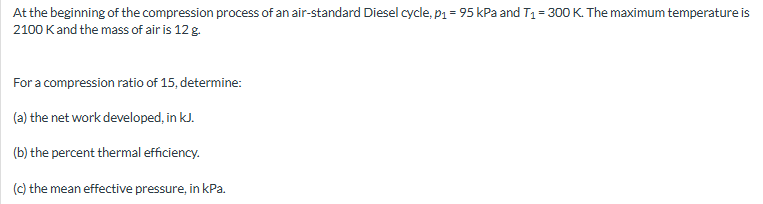 At the beginning of the compression process of an air-standard Diesel cycle, py = 95 kPa and T = 300 K. The maximum temperature is
2100K and the mass of aris 12g.
Fora compression ratio of 15, determine:
(2) the net work developed, in kJ.
(b) the percent thermal efficiency.
(c) the mean effective pressure, in kPa.
This is AI generated Response.
Asked by: Rahul
Created at: 2026-01-23 04:07:56
Asked by: Rahul
Created at: 2026-01-23 04:07:56
Final Answer:
Rendered
Raw Text
Did you like this answer?
Let's solve the air-standard Diesel cycle problem step by step.
---
## **Given Data**
- Initial Pressure, \( P_1 = 95 \) kPa
- Initial Temperature, \( T_1 = 300 \) K
- Maximum Temperature, \( T_3 = 210 \) K
- Mass of air, \( m = 12 \) g \( = .012 \) kg
- Compression ratio, \( r = 15 \)
- Air: \( R = .287 \) kJ/kg·K, \( c_v = .718 \) kJ/kg·K, \( c_p = 1.005 \) kJ/kg·K, \( k = 1.4 \)
---
## **1. State Points in the Diesel Cycle**
### **Process 1–2: Isentropic Compression**
\[
\frac{T_2}{T_1} = r^{k-1}
\]
\[
T_2 = T_1 \cdot r^{k-1} = 300 \times 15^{.4}
\]
\[
15^{.4} \approx 2.953
\]
\[
T_2 = 300 \times 2.953 \approx 886 \text{ K}
\]
---
### **Process 2–3: Constant Pressure Heat Addition**
Given \( T_3 = 210 \) K.
\[
\frac{V_3}{V_2} = \rho \quad \text{(cutoff ratio)}
\]
\[
\frac{T_3}{T_2} = \frac{V_3}{V_2} \implies \rho = \frac{T_3}{T_2} = \frac{210}{886} \approx 2.37
\]
---
### **Process 3–4: Isentropic Expansion**
\[
\frac{T_4}{T_3} = \left( \frac{V_4}{V_3} \right)^{1-k}
\]
But \( V_4/V_3 = (V_4/V_1) \cdot (V_1/V_2) \cdot (V_2/V_3) = r \cdot \frac{1}{\rho} \)
\[
\frac{T_4}{T_3} = \left( \frac{1}{r} \cdot \rho \right)^{k-1}
\]
\[
T_4 = T_3 \cdot \left( \frac{\rho}{r} \right)^{k-1}
\]
\[
\left( \frac{2.37}{15} \right)^{.4} = (.158)^{.4} \approx .470
\]
\[
T_4 = 210 \times .470 \approx 987 \text{ K}
\]
---
## **2. Diesel Cycle Heat and Work Calculations**
### **(a) Net Work Developed, \( W_{net} \) (in kJ)**
#### **Heat Added:**
\[
Q_{in} = m c_p (T_3 - T_2)
\]
\[
Q_{in} = .012 \times 1.005 \times (210 - 886)
\]
\[
Q_{in} = .012 \times 1.005 \times 1214 \approx 14.656 \text{ kJ}
\]
#### **Heat Rejected:**
\[
Q_{out} = m c_v (T_4 - T_1)
\]
\[
Q_{out} = .012 \times .718 \times (987 - 300)
\]
\[
Q_{out} = .012 \times .718 \times 687 \approx 5.919 \text{ kJ}
\]
#### **Net Work:**
\[
W_{net} = Q_{in} - Q_{out} = 14.656 - 5.919 = 8.737 \text{ kJ}
\]
---
### **(b) Percent Thermal Efficiency**
\[
\eta = \frac{W_{net}}{Q_{in}} \times 100\%
\]
\[
\eta = \frac{8.737}{14.656} \times 100 \approx 59.6\%
\]
---
### **(c) Mean Effective Pressure (MEP), in kPa**
\[
\text{MEP} = \frac{W_{net}}{V_{max} - V_{min}}
\]
#### **Find \( V_{max} - V_{min} \):**
- \( V_{min} = V_2 \)
- \( V_{max} = V_1 \)
- \( V_1 = \frac{mRT_1}{P_1} \)
\[
V_1 = \frac{.012 \times .287 \times 300}{95} = \frac{1.0324}{95} \approx .01087 \text{ m}^3
\]
\[
V_2 = V_1/r = .01087/15 = .0007245 \text{ m}^3
\]
\[
V_{max} - V_{min} = V_1 - V_2 = .01087 - .0007245 = .010145 \text{ m}^3
\]
\[
\text{MEP} = \frac{8.737}{.010145} = 861 \text{ kPa}
\]
---
## **Summary Table**
| Quantity | Value |
|---------------------|-----------|
| Net Work (\( W_{net} \)) | 8.74 kJ |
| Thermal Efficiency (\( \eta \)) | 59.6% |
| Mean Effective Pressure (MEP) | 861 kPa |
---
### **Final Answers**
**(a) Net work developed:** \(\boxed{8.74\ \text{kJ}}\)
**(b) Percent thermal efficiency:** \(\boxed{59.6\%}\)
**(c) Mean effective pressure:** \(\boxed{861\ \text{kPa}}\)
Let me know if you need further clarifications or calculations!
📢 Instructions:
- Ask anything relatd to above question only.
- For new Question goto :