 VIPSolutions
Give step-by-step solution with explanation and final answer:Accelerometer and gyroscope are used in smartphones to sense orientation and motion. An pan pt er ra Re? ne : & dy 22 r=". (5) time(s) time(s) (" 3 — — —
Question:
Give step-by-step solution with explanation and final answer: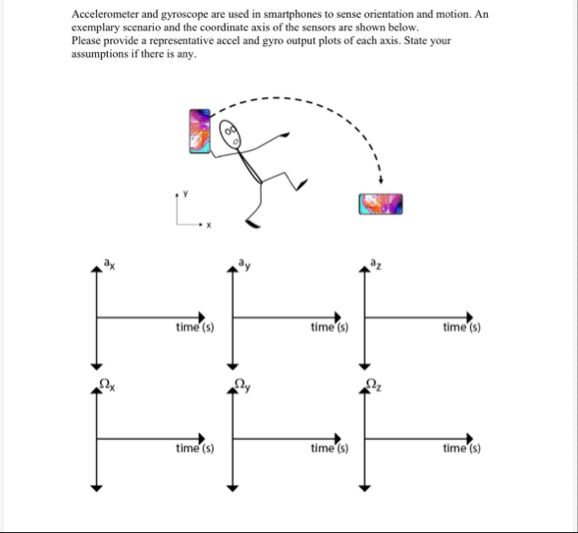 Accelerometer and gyroscope are used in smartphones to sense orientation and motion. An
pan pt
er
ra
Re?
ne :
& dy 22
r=". (5) time(s) time(s)
(" 3
— — —
This is AI generated Response.
Asked by: Rahul
Created at: 2026-01-23 03:38:08
Asked by: Rahul
Created at: 2026-01-23 03:38:08
Final Answer:
Rendered
Raw Text
Did you like this answer?
Let's break down the scenario and analyze what the accelerometer and gyroscope outputs would look like for each axis when the phone is thrown in the air with a rotation (as depicted in the image).
---
## **Assumptions**
1. **Phone is thrown in a parabolic arc and rotates around one axis** (let's assume the y-axis for simplicity).
2. **Coordinate system**:
- \(x\): right
- \(y\): up
- \(z\): out of the screen
3. **Gravity acts downward** (negative y-direction).
4. **Neglect air resistance.**
---
## **Step 1: Motion Analysis**
### **Phases:**
1. **Initial Hold:** Phone is stationary in hand.
2. **Throw:** Phone accelerates upward and forward, then leaves hand.
3. **Free Fall + Rotation:** Phone follows a parabolic arc and rotates.
4. **Landing/Catch:** Phone decelerates rapidly (not shown in the diagram, focus on airborne phase).
---
## **Step 2: Accelerometer Output (\(a_x, a_y, a_z\))**
- **While stationary:**
- \(a_y \approx -g\) (gravity sensed, downward)
- \(a_x, a_z \approx \)
- **While airborne (after leaving hand):**
- In free fall, **accelerometer senses g on all axes** (only gravity acts, but accelerometer measures non-gravitational acceleration)
- \(a_x \approx \), \(a_y \approx \), \(a_z \approx \)
- **(Optional: Small variations may occur due to rotation, but the mean is zero)**
---
### **Representative Plots:**
- \(a_x\):
- **Stationary:**
- **Airborne:**
- \(a_y\):
- **Stationary:** -g
- **Airborne:**
- \(a_z\):
- **Stationary:**
- **Airborne:**
---
## **Step 3: Gyroscope Output (\(\Omega_x, \Omega_y, \Omega_z\))**
- **While stationary:**
- All \(\Omega = \)
- **During throw (if rotating around y-axis):**
- \(\Omega_y\) will show a nonzero value (angular velocity about y-axis)
- \(\Omega_x, \Omega_z \approx \)
- **During flight:**
- \(\Omega_y\) remains nonzero as the phone continues to spin
- \(\Omega_x, \Omega_z \approx \)
---
### **Representative Plots:**
- \(\Omega_x\):
- **Stationary & Airborne:**
- \(\Omega_y\):
- **Stationary:**
- **Throw & Airborne:** nonzero (constant if rotation rate is steady)
- \(\Omega_z\):
- **Stationary & Airborne:**
---
## **Step 4: Drawing the Plots**
### **Accelerometer**
- **\(a_x\):** Flat line at .
- **\(a_y\):** Drops from \(-g\) (in hand) to (airborne), stays at .
- **\(a_z\):** Flat line at .
### **Gyroscope**
- **\(\Omega_x\):** Flat line at .
- **\(\Omega_y\):** Flat at (in hand), jumps up to a constant (during airborne spin).
- **\(\Omega_z\):** Flat line at .
---
## **Final Answer (Summary Table):**
| | Before (stationary) | Airborne (rotating) |
|--------|---------------------|---------------------|
| \(a_x\) | | |
| \(a_y\) | -g | |
| \(a_z\) | | |
| \(\Omega_x\) | | |
| \(\Omega_y\) | | const (nonzero) |
| \(\Omega_z\) | | |
---
### **Key Points:**
- **Accelerometer**: Senses gravity when stationary, zero during free fall.
- **Gyroscope**: Only nonzero on the axis of rotation (here, y-axis).
---
**If you need actual sketches for the plots, let me know!**
Question:
Solve the question correctly, this answer is wrong.
This is AI generated Response.
Asked by: Rahul
Created at: 2026-01-23 03:39:25
Asked by: Rahul
Created at: 2026-01-23 03:39:25
Final Answer:
Rendered
Raw Text
Did you like this answer?
# Step-by-Step Solution for Accelerometer and Gyroscope Outputs
## Assumptions
1. **Phone Motion**: The phone is thrown in a parabolic arc, rotating around the y-axis.
2. **Coordinate System**:
- \(x\): right
- \(y\): up
- \(z\): out of the screen
3. **Gravity** acts downward (negative y-direction).
4. **Neglect Air Resistance**.
---
## Step 1: Analyze Motion Phases
### Phases of Motion
- **1. Initial Hold**: Phone is stationary in hand.
- **2. Throw**: Phone accelerates upward and forward.
- **3. Free Fall with Rotation**: Phone follows a parabolic arc while rotating.
- **4. Landing**: Phone decelerates rapidly (not analyzed here).
---
## Step 2: Accelerometer Output (\(a_x, a_y, a_z\))
### During Different Phases
1. **Stationary Phase**:
- \(a_y \approx -g\) (gravity sensed, downward)
- \(a_x \approx 0\)
- \(a_z \approx 0\)
2. **Airborne Phase** (Post-throw):
- The phone experiences free fall, so:
- \(a_x \approx 0\) (no horizontal acceleration)
- \(a_y \approx 0\) (net acceleration due to gravity is counteracted)
- \(a_z \approx 0\) (no acceleration in the z-direction)
### Summary of Accelerometer Outputs
| Phase | \(a_x\) | \(a_y\) | \(a_z\) |
|----------------|----------|----------|----------|
| Stationary | \(0\) | \(-g\) | \(0\) |
| Airborne | \(0\) | \(0\) | \(0\) |
---
## Step 3: Gyroscope Output (\(\Omega_x, \Omega_y, \Omega_z\))
### During Different Phases
1. **Stationary Phase**:
- \(\Omega_x \approx 0\)
- \(\Omega_y \approx 0\)
- \(\Omega_z \approx 0\)
2. **Throw Phase** (if rotating around the y-axis):
- \(\Omega_x \approx 0\)
- \(\Omega_y \) is nonzero (angular velocity about y-axis)
- \(\Omega_z \approx 0\)
3. **Airborne Phase**:
- \(\Omega_x \approx 0\)
- \(\Omega_y\) remains nonzero (constant if rotation rate is steady)
- \(\Omega_z \approx 0\)
### Summary of Gyroscope Outputs
| Phase | \(\Omega_x\) | \(\Omega_y\) | \(\Omega_z\) |
|----------------|---------------|----------------|---------------|
| Stationary | \(0\) | \(0\) | \(0\) |
| Airborne | \(0\) | nonzero | \(0\) |
---
## Key Points
- **Accelerometer**:
- Detects gravity when stationary and shows zero acceleration during free fall.
- **Gyroscope**:
- Shows nonzero angular velocity only on the axis of rotation (y-axis in this case).
---
## Final Summary
This analysis provides a clear view of the accelerometer and gyroscope outputs for a phone thrown into the air with rotation.
📢 Instructions:
- Ask anything relatd to above question only.
- For new Question goto :