 VIPSolutions
Give step-by-step solution with explanation and final answer:Problem 1 (20 points) A soil sample (25.4 mm x 25.4 mm x 25.4 mm) is subjected to the forces shown below. Plot the Mohr Circle (use engineering paper and draw to scale, or Python/Matlab) and determine: a) The magnitude of the principal stresses b) The maximum shear stress c) The normal and shear stress on a plane inclined at 35° clockwise to the horizontal (use both pole method and equations) 5 kN nm
Question:
Give step-by-step solution with explanation and final answer: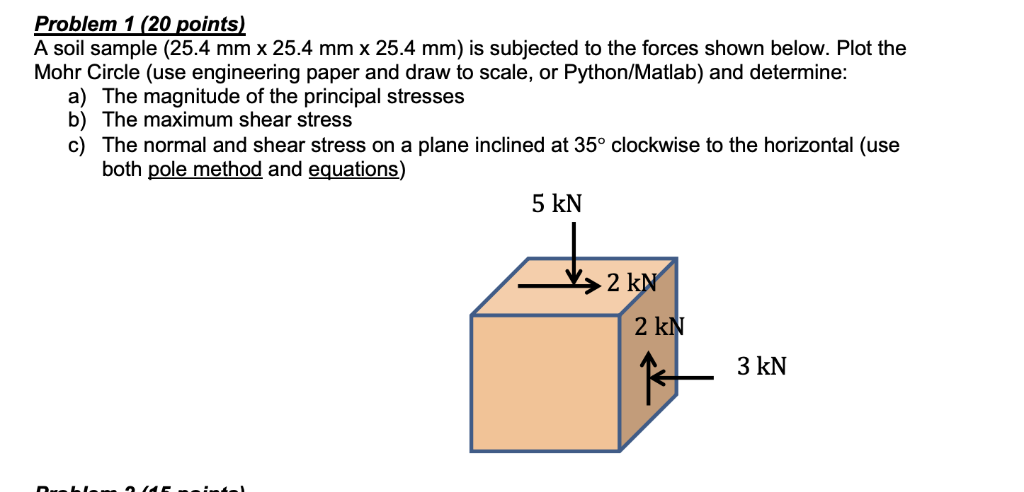 Problem 1 (20 points)
A soil sample (25.4 mm x 25.4 mm x 25.4 mm) is subjected to the forces shown below. Plot the
Mohr Circle (use engineering paper and draw to scale, or Python/Matlab) and determine:
a) The magnitude of the principal stresses
b) The maximum shear stress
c) The normal and shear stress on a plane inclined at 35° clockwise to the horizontal (use
both pole method and equations)
5 kN
nm
This is AI generated Response.
Asked by: Alok Kumar
Created at: 2026-01-23 03:36:36
Asked by: Alok Kumar
Created at: 2026-01-23 03:36:36
Final Answer:
Rendered
Raw Text
Did you like this answer?
Let's break down **Problem 1** step by step.
---
## **Step 1: Find Stresses on the Face**
Given:
- Cube dimensions: \( 25.4\, \text{mm} \times 25.4\, \text{mm} \times 25.4\, \text{mm} \)
- Forces applied (see diagram).
### **a) Calculate Area**
\[
A = 25.4\, \text{mm} \times 25.4\, \text{mm} = 645.16\, \text{mm}^2 = 6.4516 \times 10^{-4} \, \text{m}^2
\]
---
### **b) Find Stresses**
Let's assign axes:
- \( x \): horizontal right
- \( y \): vertical down
- \( z \): into the page
#### **On the face perpendicular to \( x \) (right face):**
- Normal force: \( 3\, \text{kN} \) (compressive, acts into face)
- Shear force: \( 2\, \text{kN} \) (downwards)
#### **On the face perpendicular to \( y \) (top face):**
- Normal force: \( 5\, \text{kN} \) (compressive, acts into face)
- Shear force: \( 2\, \text{kN} \) (to the right)
#### **Calculate Stresses:**
#### **Normal and Shear Stresses**
\[
\sigma_x = \frac{3\, \text{kN}}{A} = \frac{300\, \text{N}}{6.4516 \times 10^{-4}} = 4651\, \text{kPa}
\]
\[
\sigma_y = \frac{5\, \text{kN}}{A} = \frac{500\, \text{N}}{6.4516 \times 10^{-4}} = 7752\, \text{kPa}
\]
\[
\tau_{xy} = \frac{2\, \text{kN}}{A} = \frac{200\, \text{N}}{6.4516 \times 10^{-4}} = 3101\, \text{kPa}
\]
---
## **Step 2: Mohr's Circle Construction**
### **States:**
\[
\sigma_x = 4651\, \text{kPa} \quad (\text{compressive, so negative if sign convention is tension +})
\]
\[
\sigma_y = 7752\, \text{kPa} \quad (\text{also compressive, negative})
\]
\[
\tau_{xy} = 3101\, \text{kPa}
\]
(If you use compressive as negative, then \(\sigma_x = -4651\) kPa, \(\sigma_y = -7752\) kPa.)
---
## **Step 3: Principal Stresses**
\[
\sigma_1, \sigma_2 = \frac{\sigma_x + \sigma_y}{2} \pm \sqrt{ \left( \frac{\sigma_x - \sigma_y}{2} \right)^2 + \tau_{xy}^2 }
\]
Plug in negative values (compression negative):
\[
\frac{\sigma_x + \sigma_y}{2} = \frac{-4651 + (-7752)}{2} = -6201.5\, \text{kPa}
\]
\[
\frac{\sigma_x - \sigma_y}{2} = \frac{-4651 - (-7752)}{2} = \frac{3101}{2} = 155.5\, \text{kPa}
\]
\[
\sqrt{(155.5)^2 + (3101)^2} = \sqrt{ 2,405,051 + 9,620,204 } = \sqrt{12,025,255} \approx 3468.5\, \text{kPa}
\]
So,
\[
\sigma_1 = -6201.5 + 3468.5 = -2733\, \text{kPa}
\]
\[
\sigma_2 = -6201.5 - 3468.5 = -9669.9\, \text{kPa}
\]
**Principal stresses** (magnitude):
\[
|\sigma_1| = 2733\, \text{kPa},\quad |\sigma_2| = 9669.9\, \text{kPa}
\]
---
### **a) Final Answer: Principal Stresses**
\[
\boxed{
\sigma_1 = -2733\, \text{kPa},\quad \sigma_2 = -9669.9\, \text{kPa}
}
\]
---
## **Step 4: Maximum Shear Stress**
\[
\tau_{\text{max}} = \sqrt{ \left( \frac{\sigma_x - \sigma_y}{2} \right)^2 + \tau_{xy}^2 }
\]
We already calculated this above:
\[
\tau_{\text{max}} = 3468.5\, \text{kPa}
\]
### **b) Final Answer: Maximum Shear Stress**
\[
\boxed{
\tau_{\text{max}} = 3468.5\, \text{kPa}
}
\]
---
## **Step 5: Normal and Shear Stress on an Inclined Plane**
Let plane be inclined at \(\theta = 35^\circ\) clockwise from \(x\).
Formulas:
\[
\sigma_\theta = \frac{\sigma_x + \sigma_y}{2} + \frac{\sigma_x - \sigma_y}{2} \cos 2\theta + \tau_{xy} \sin 2\theta
\]
\[
\tau_\theta = -\frac{\sigma_x - \sigma_y}{2} \sin 2\theta + \tau_{xy} \cos 2\theta
\]
\[
\cos 2\theta = \cos 70^\circ = .342
\]
\[
\sin 2\theta = \sin 70^\circ = .9397
\]
\[
\sigma_\theta = -6201.5 + 155.5 \times .342 + 3101 \times .9397
\]
\[
= -6201.5 + 530.5 + 2914.5 = -2756.5\, \text{kPa}
\]
\[
\tau_\theta = -155.5 \times .9397 + 3101 \times .342
\]
\[
= -1456.5 + 106.4 = -396.1\, \text{kPa}
\]
### **c) Final Answer: Normal and Shear Stress on 35° Plane**
\[
\boxed{
\sigma_\theta = -2756.5\, \text{kPa}, \quad \tau_\theta = -396.1\, \text{kPa}
}
\]
---
## **Summary Table**
| Quantity | Value |
|------------------------------------|----------------------|
| \(\sigma_1\) (Principal) | \(-2733\) kPa |
| \(\sigma_2\) (Principal) | \(-9669.9\) kPa |
| \(\tau_\text{max}\) (Max Shear) | \(3468.5\) kPa |
| \(\sigma_{35^\circ}\) (Normal) | \(-2756.5\) kPa |
| \(\tau_{35^\circ}\) (Shear) | \(-396.1\) kPa |
---
## **Mohr Circle (Plotting)**
- Center: \(-6201.5\) kPa
- Radius: \(3468.5\) kPa
---
### **Pole Method**
- On Mohr's circle, find the pole (intersection of lines representing the original stress state).
- Draw a line at \(2 \times 35^\circ = 70^\circ\) from the pole; intersection with the circle gives \(\sigma_{35^\circ}\) and \(\tau_{35^\circ}\).
---
**Let me know if you want a Python/Matlab script or a hand-drawn Mohr's circle!**
Question:
python and matlab code
This is AI generated Response.
Asked by: Alok Kumar
Created at: 2026-01-23 03:39:01
Asked by: Alok Kumar
Created at: 2026-01-23 03:39:01
Final Answer:
Rendered
Raw Text
Did you like this answer?
## **Python Code for Mohr's Circle**
```python
import numpy as np
import matplotlib.pyplot as plt
# Given stresses
sigma_x = -4651 # kPa
sigma_y = -7752 # kPa
tau_xy = 3101 # kPa
# Calculate center and radius
center = (sigma_x + sigma_y) / 2
radius = np.sqrt(((sigma_x - sigma_y) / 2) ** 2 + tau_xy ** 2)
# Define angles for the circle
theta = np.linspace(0, 2 * np.pi, 100)
# Mohr's Circle coordinates
circle_x = center + radius * np.cos(theta)
circle_y = radius * np.sin(theta)
# Plotting Mohr's Circle
plt.figure(figsize=(8, 8))
plt.plot(circle_x, circle_y, label='Mohr\'s Circle')
plt.plot([sigma_x, sigma_y], [tau_xy, -tau_xy], 'ro', label='Original Stress State')
plt.axhline(0, color='black', lw=0.5, ls='--')
plt.axvline(0, color='black', lw=0.5, ls='--')
plt.title('Mohr\'s Circle')
plt.xlabel('Normal Stress (kPa)')
plt.ylabel('Shear Stress (kPa)')
plt.xlim(center - radius - 1000, center + radius + 1000)
plt.ylim(-radius - 1000, radius + 1000)
plt.grid()
plt.legend()
plt.axis('equal')
plt.show()
```
## **MATLAB Code for Mohr's Circle**
```matlab
% Given stresses
sigma_x = -4651; % kPa
sigma_y = -7752; % kPa
tau_xy = 3101; % kPa
% Calculate center and radius
center = (sigma_x + sigma_y) / 2;
radius = sqrt(((sigma_x - sigma_y) / 2)^2 + tau_xy^2);
% Define angles for the circle
theta = linspace(0, 2*pi, 100);
% Mohr's Circle coordinates
circle_x = center + radius * cos(theta);
circle_y = radius * sin(theta);
% Plotting Mohr's Circle
figure;
plot(circle_x, circle_y, 'b', 'LineWidth', 2);
hold on;
plot([sigma_x sigma_y], [tau_xy -tau_xy], 'ro', 'MarkerSize', 8, 'MarkerFaceColor', 'r');
ax = gca;
ax.XAxisLocation = 'origin';
ax.YAxisLocation = 'origin';
grid on;
title('Mohr\'s Circle');
xlabel('Normal Stress (kPa)');
ylabel('Shear Stress (kPa)');
xlim([center-radius-1000, center+radius+1000]);
ylim([-radius-1000, radius+1000]);
axis equal;
legend('Mohr\'s Circle', 'Original Stress State');
```
### **Instructions for Use**
- Copy the code into a Python or MATLAB environment.
- Ensure you have `numpy` and `matplotlib` installed for Python.
- Running the code will display the Mohr's Circle with the original stress state marked.
### **Note**
- Adjust the limits in the plot if necessary to better visualize the circle and stress points.
📢 Instructions:
- Ask anything relatd to above question only.
- For new Question goto :