 VIPSolutions
Give step-by-step solution with explanation and final answer:Accelerometer and gyroscope are used in smartphones 0 sense orientation and motion. An er ed ps ee tn oie lod be ore sie ol de eo doer, Fees \ ne & Jy J] Te (5) time(s) time(s) ( 3 time (s) time(s) time(s)
Question:
Give step-by-step solution with explanation and final answer: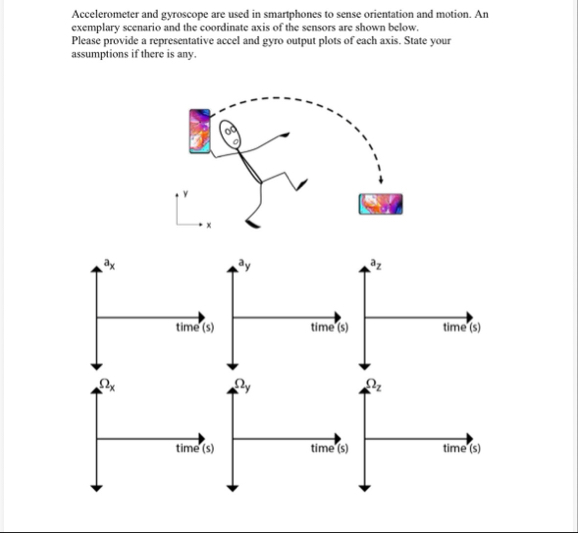 Accelerometer and gyroscope are used in smartphones 0 sense orientation and motion. An
er ed ps ee tn
oie lod be ore sie ol de eo doer,
Fees
\
ne
& Jy J]
Te (5) time(s) time(s)
( 3
time (s) time(s) time(s)
This is AI generated Response.
Asked by: Alok Kumar
Created at: 2026-01-23 03:20:09
Asked by: Alok Kumar
Created at: 2026-01-23 03:20:09
Final Answer:
Rendered
Raw Text
Did you like this answer?
## Step-by-Step Solution
### **Step 1: Understand the Scenario**
- The image shows a person throwing a smartphone in a parabolic arc.
- The phone rotates while in the air (as shown by the dashed curve and the orientation change).
- Axes \(x\), \(y\), \(z\) are defined as the phone's local axes.
- We are to sketch (qualitatively) the **accelerometer** (\(a_x, a_y, a_z\)) and **gyroscope** (\(\Omega_x, \Omega_y, \Omega_z\)) outputs over time.
---
### **Step 2: State Assumptions**
- The phone is thrown such that it rotates mainly about one axis (let’s assume the \(y\)-axis for simplicity).
- The phone is in free fall (no contact with hand) after being thrown.
- Gravity acts in the negative \(z\)-direction when the phone is upright.
- Air resistance is neglected.
---
### **Step 3: Analyze Accelerometer Outputs**
- **Before Throw (Held Upright):**
- \(a_x \approx \)
- \(a_y \approx \)
- \(a_z \approx -g\) (gravity, since accelerometer senses the normal force, which cancels gravity when stationary)
- **During Free Fall:**
- All axes: \(a_x \approx \), \(a_y \approx \), \(a_z \approx \)
(Accelerometer measures the net force; in free fall, only gravity acts, so it reads zero—**weightlessness**.)
- **After Catch (if caught upright):**
- \(a_x \approx \)
- \(a_y \approx \)
- \(a_z \approx -g\) (back to held position)
---
#### **Plots:**
- **\(a_x\) and \(a_y\):** Remain around zero throughout.
- **\(a_z\):** Starts at \(-g\), drops to \(\) during flight, returns to \(-g\) when caught.
---
### **Step 4: Analyze Gyroscope Outputs**
- **Before Throw (Held Upright, Stationary):**
- \(\Omega_x = \), \(\Omega_y = \), \(\Omega_z = \)
- **During Throw (When Thrown):**
- Quick spike in \(\Omega_y\) (if spun about \(y\)-axis) as the phone is given angular velocity.
- **During Flight (Rotating, Constant Angular Velocity):**
- \(\Omega_y\) stays at a constant value (if only spinning about \(y\)-axis).
- \(\Omega_x = \), \(\Omega_z = \).
- **After Catch (If stopped):**
- \(\Omega_y\) returns to \(\).
---
#### **Plots:**
- **\(\Omega_x\) and \(\Omega_z\):** Zero throughout (assuming only \(y\)-axis rotation).
- **\(\Omega_y\):** Sudden jump to a constant value during the throw, stays constant during flight, drops to zero after catch.
---
### **Step 5: Sketch Representative Plots**
#### **Accelerometer:**
```
a_x: |-------------------| (close to zero)
a_y: |-------------------| (close to zero)
a_z: |---(-g)---| |---(-g)---| (drops to during flight)
```
#### **Gyroscope:**
```
Ω_x: |-------------------| (zero)
Ω_y: |------|const|------| (spike to constant, back to zero)
Ω_z: |-------------------| (zero)
```
---
### **Final Answer**
#### **Summary Table**
| Signal | Before Throw | During Flight | After Catch |
|------------|--------------|---------------|--------------|
| \(a_x\) | | | |
| \(a_y\) | | | |
| \(a_z\) | \(-g\) | | \(-g\) |
| \(\Omega_x\)| | | |
| \(\Omega_y\)| | Constant | |
| \(\Omega_z\)| | | |
#### **Assumption**
- The phone rotates only about the \(y\)-axis after the throw, and air resistance is neglected.
---
#### **Explanatory Diagram**
- **Accelerometer:**
\[
\begin{align*}
a_z &: \text{Starts at } -g, \text{ goes to } \text{ during flight, returns to } -g \\
a_x, a_y &: \text{Stay at }
\end{align*}
\]
- **Gyroscope:**
\[
\begin{align*}
\Omega_y &: \text{ before throw, jumps to constant during flight, after catch} \\
\Omega_x, \Omega_z &:
\end{align*}
\]
---
If you need a hand-drawn sketch of the plots, let me know!
📢 Instructions:
- Ask anything relatd to above question only.
- For new Question goto :