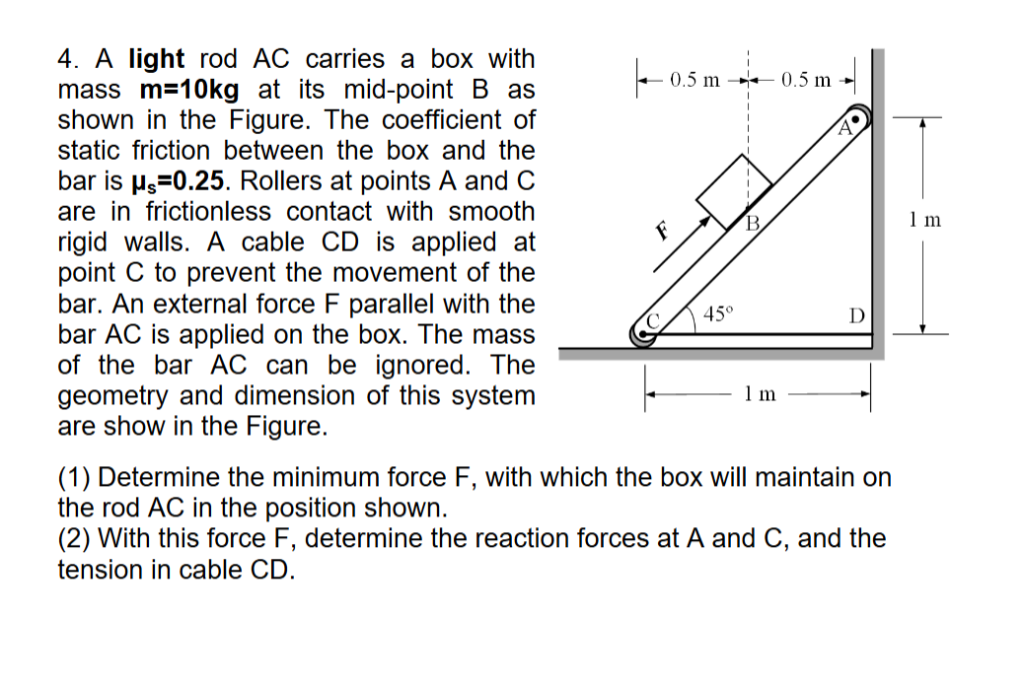
Give step-by-step solution with explanation and final answer:4. A light rod AC carries a box with od
mass m=10kg at its mid-point B as - 05m —=—05m
shown in the Figure. The coefficient of )
static friction between the box and the :
bar is ns=0.25. Rollers at points A and C
are in frictionless contact with smooth I'm
rigid walls. A cable CD is applied at $
point C to prevent the movement of the
bar. An external force F parallel with the A
bar AC is applied on the box. The mass F——
of the bar AC can be ignored. The
geometry and dimension of this system l— — lm — J
are show in the Figure.
(1) Determine the minimum force F, with which the box will maintain on
the rod AC in the position shown.
(2) With this force F, determine the reaction forces at A and C, and the
tension in cable CD.
Question:
Give step-by-step solution with explanation and final answer:4. A light rod AC carries a box with od
mass m=10kg at its mid-point B as - 05m —=—05m
shown in the Figure. The coefficient of )
static friction between the box and the :
bar is ns=0.25. Rollers at points A and C
are in frictionless contact with smooth I'm
rigid walls. A cable CD is applied at $
point C to prevent the movement of the
bar. An external force F parallel with the A
bar AC is applied on the box. The mass F——
of the bar AC can be ignored. The
geometry and dimension of this system l— — lm — J
are show in the Figure.
(1) Determine the minimum force F, with which the box will maintain on
the rod AC in the position shown.
(2) With this force F, determine the reaction forces at A and C, and the
tension in cable CD.
This is AI generated Response.
Asked by: Alok Kumar
Created at: 2026-01-23 03:17:21
Final Answer:
RenderedRaw Text
Did you like this answer?
Let's break this into clear steps:
---
## **Given Data**
- Mass of box, \( m = 10\,\text{kg} \)
- Coefficient of static friction, \( \mu_s = .25 \)
- Gravity, \( g = 9.81\,\text{m/s}^2 \)
- Rod AC is light (ignore its mass)
- Length AC = 1.41 m (from Pythagoras: \( \sqrt{1^2 + 1^2} = 1.414 \) m)
- Angle with the horizontal, \( \theta = 45^\circ \)
- Box is at midpoint (.5 m from both A and C)
---
## **Step 1: Find Minimum Force \( F \) for Box to Stay on the Rod**
### **Forces on the Box**
- Weight (\( W = mg \)) acts vertically down.
- Normal force (\( N \)) from the rod, perpendicular to AC.
- Friction force (\( f \)), acts up along the rod, max value \( f_{max} = \mu_s N \).
- Applied force \( F \), parallel to the rod.
### **Resolve Forces Along and Perpendicular to the Rod**
#### **Perpendicular to Rod:**
- \( N = W \cos(45^\circ) \)
- \( N = mg \cos(45^\circ) = 10 \times 9.81 \times \frac{\sqrt{2}}{2} \approx 69.3\, \text{N} \)
#### **Along the Rod:**
- Components along the rod:
- Weight: \( W_{||} = mg \sin(45^\circ) \)
- Friction acts *against* the tendency of the box to slide down.
- Applied force \( F \) acts *up* the rod.
**At limiting equilibrium:**
\[
F + f_{max} = W_{||}
\]
\[
F + \mu_s N = mg \sin(45^\circ)
\]
Plug in values:
- \( mg \sin(45^\circ) = 10 \times 9.81 \times \frac{\sqrt{2}}{2} \approx 69.3\, \text{N} \)
- \( \mu_s N = .25 \times 69.3 = 17.33\, \text{N} \)
So,
\[
F_{min} = 69.3 - 17.33 = \boxed{51.97\, \text{N}}
\]
---
## **Step 2: Find Reaction Forces at A and C, and Tension in CD**
### **Free Body Diagram of Rod AC**
- Forces at A and C (reactions from smooth walls, normal to the walls).
- Tension \( T \) in cable CD.
- Force \( F \) on box at B (resolved into components).
- Weight of box at B.
#### **Let**
- \( A_x \), \( A_y \): Reaction at A (vertical and horizontal)
- \( C_x \), \( C_y \): Reaction at C (vertical and horizontal)
- \( T \): Tension in CD (horizontal, since D is directly right of C)
### **Take Moments about Point A**
Sum moments about A to eliminate \(A_x, A_y\):
- Distance AC = 1.41 m; midpoint B is .707 m from A.
- Perpendicular distance from A to cable CD: \(1 \, \text{m}\) (from geometry).
**Moments due to:**
- Weight at B: \( mg \) acts down at B, distance \( .707\,\text{m} \) from A.
- Force F at B: acts along rod at B, same distance.
- Tension T at C: perpendicular distance from A to CD is \( 1\,\text{m} \).
#### **Moment Calculation**
- Weight at B: \( mg \) at .707 m from A, perpendicular to rod.
- Tension \( T \) at C, horizontal, at 1 m below A and 1 m left, so acts at \( 45^\circ \) to rod.
But let's use force equilibrium equations:
#### **Sum Forces in x and y**
**Horizontal (\( \Sigma F_x = \)):**
\[
A_x + C_x + T =
\]
**Vertical (\( \Sigma F_y = \)):**
\[
A_y + C_y - mg =
\]
**Sum of moments about A (\( \Sigma M_A = \)):**
- Weight at B: \( mg \) at distance \( d_B = .707\, \text{m} \) from A, perpendicular.
- Tension at C: \( T \) at C, which is 1 m horizontally from A.
\[
mg \times .707 = T \times 1
\]
\[
T = mg \times .707 = 10 \times 9.81 \times .707 = 69.3\, \text{N}
\]
### **Find Reaction Forces at A and C**
#### **From Geometry**
- The rod is at \( 45^\circ \), so reactions at A and C are perpendicular to the walls.
#### **Sum Forces:**
- At A (top): Reaction is horizontal (from vertical wall).
- At C (bottom): Reaction is vertical (from horizontal floor).
So,
- \( A_x \) is the only component at A.
- \( C_y \) is the only component at C.
From earlier:
\[
A_x + T = \implies A_x = -T = -69.3\,\text{N}
\]
\[
C_y = mg = 98.1\,\text{N}
\]
---
## **Final Answers**
### **1. Minimum Force \( F \):**
\[
\boxed{51.97\, \text{N}}
\]
### **2. With this \( F \):**
#### **Reaction at A:**
\[
A_x = -69.3\,\text{N}, \quad A_y =
\]
#### **Reaction at C:**
\[
C_x = , \quad C_y = 98.1\,\text{N}
\]
#### **Tension in Cable CD:**
\[
\boxed{69.3\,\text{N}}
\]
---
### **Summary Table**
| Quantity | Value |
|--------------------|--------------|
| Minimum \( F \) | 51.97 N |
| Reaction at A | 69.3 N (left)|
| Reaction at C | 98.1 N (up) |
| Tension in CD | 69.3 N |
VIPSolutions focuses on clear, step‑by‑step explanations so you can learn quickly. Whether you need an AI‑generated walkthrough or a short hint to get unstuck, each solution is organized for fast reading and easy review later.
Search similar questions, compare approaches, and bookmark the best answers for revision. Our goal is simple: quick, reliable study help that feels natural—not noisy.
 VIPSolutions
 4. A light rod AC carries a box with od
mass m=10kg at its mid-point B as - 05m —=—05m
shown in the Figure. The coefficient of )
static friction between the box and the :
bar is ns=0.25. Rollers at points A and C
are in frictionless contact with smooth I'm
rigid walls. A cable CD is applied at $
point C to prevent the movement of the
bar. An external force F parallel with the A
bar AC is applied on the box. The mass F——
of the bar AC can be ignored. The
geometry and dimension of this system l— — lm — J
are show in the Figure.
(1) Determine the minimum force F, with which the box will maintain on
the rod AC in the position shown.
(2) With this force F, determine the reaction forces at A and C, and the
tension in cable CD.