 VIPSolutions
Give step-by-step solution with explanation and final answer:
Question:
Give step-by-step solution with explanation and final answer: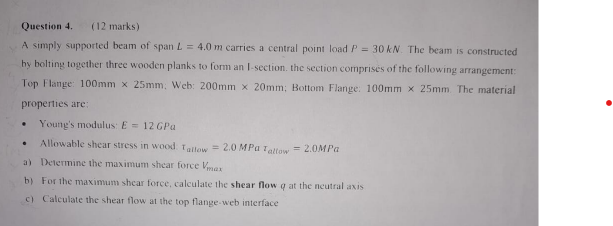
This is AI generated Response.
Asked by: Alok Kumar
Created at: 2026-01-23 03:07:51
Asked by: Alok Kumar
Created at: 2026-01-23 03:07:51
Final Answer:
Rendered
Raw Text
Did you like this answer?
Let's solve the problem step by step:
---
# Given Data
- **Beam span, \( L \) = 4. m**
- **Central point load, \( P \) = 30 kN = 30,000 N**
- **Section arrangement:**
- **Top Flange:** 100 mm × 25 mm
- **Web:** 200 mm × 20 mm
- **Bottom Flange:** 100 mm × 25 mm
- **Material Properties:**
- **Young's modulus, \( E \) = 12 GPa**
- **Allowable shear stress, \( \tau_{allow} \) = 2. MPa**
---
## (a) Determine the Maximum Shear Force, \( V_{max} \)
For a simply supported beam with a central point load:
\[
V_{max} = \frac{P}{2}
\]
\[
V_{max} = \frac{30,000~N}{2} = \boxed{15,000~N}
\]
---
## (b) Shear Flow at Neutral Axis
### **Step 1: Section Geometry**
#### **Overall Height, \( h \):**
\[
h = 25~\text{mm}~(\text{top flange}) + 200~\text{mm}~(\text{web}) + 25~\text{mm}~(\text{bottom flange}) = 250~\text{mm}
\]
#### **Find the Neutral Axis (NA) Location:**
Let’s set the bottom of the section as the reference ( \( y = \) ).
- **Bottom Flange:**
Area, \(A_b = 100 \times 25 = 250~\text{mm}^2\)
Centroid, \(y_b = 12.5~\text{mm}\) above bottom
- **Web:**
Area, \(A_w = 200 \times 20 = 400~\text{mm}^2\)
Centroid, \(y_w = 25 + 100 = 125~\text{mm}\) above bottom
- **Top Flange:**
Area, \(A_t = 100 \times 25 = 250~\text{mm}^2\)
Centroid, \(y_t = 225 + 12.5 = 237.5~\text{mm}\) above bottom
Weighted centroid (neutral axis):
\[
y_{NA} = \frac{A_b y_b + A_w y_w + A_t y_t}{A_b + A_w + A_t}
\]
\[
y_{NA} = \frac{(250 \times 12.5) + (400 \times 125) + (250 \times 237.5)}{250 + 400 + 250}
\]
\[
= \frac{31,250 + 500,000 + 593,750}{900}
\]
\[
= \frac{1,125,000}{900} = 125~\text{mm}
\]
So, the neutral axis is 125 mm from the bottom.
---
### **Step 2: Second Moment of Area (\(I\))**
Use the parallel axis theorem for each part.
#### **Bottom Flange:**
\[
I_b = \frac{1}{12}bh^3 + A_b d^2
\]
Here, \(d\) is the distance from centroid of the part to NA.
\[
d_b = y_{NA} - y_b = 125 - 12.5 = 112.5~\text{mm}
\]
\[
I_b = \frac{1}{12}(100)(25^3) + 250 \times (112.5^2)
\]
\[
= \frac{1}{12}(100)(15,625) + 250 \times 12,656.25
\]
\[
= 130,208.33 + 31,640,625 = 31,770,833.33~\text{mm}^4
\]
#### **Web:**
\[
d_w = |y_{NA} - y_w| = |125 - 125| =
\]
\[
I_w = \frac{1}{12}(20)(200^3) = \frac{1}{12}(20)(8,000,000)
\]
\[
= \frac{1}{12}(160,000,000) = 13,333,333.33~\text{mm}^4
\]
#### **Top Flange:**
\[
d_t = y_t - y_{NA} = 237.5 - 125 = 112.5~\text{mm}
\]
\[
I_t = \frac{1}{12}(100)(25^3) + 250 \times (112.5^2)
\]
(Same as bottom flange)
\[
= 130,208.33 + 31,640,625 = 31,770,833.33~\text{mm}^4
\]
**Total \(I\):**
\[
I = I_b + I_w + I_t = 31,770,833.33 + 13,333,333.33 + 31,770,833.33
\]
\[
I = 76,875,000~\text{mm}^4
\]
---
### **Step 3: Shear Flow at Neutral Axis**
Shear flow \(q\) at neutral axis (in the web) is:
\[
q = \frac{V Q}{I}
\]
Where:
- \(V\) = Shear force at the section (\(15,000~N\))
- \(Q\) = First moment of area above (or below) the point where shear flow is being calculated (about the NA)
- \(I\) = Second moment of area
#### **First Moment of Area (\(Q\)) at NA:**
Take area above NA:
- **Top flange:**
- Area = 250 mm²
- Distance from NA to its centroid = 237.5 - 125 = 112.5 mm
- \(Q_{tf} = 250 \times 112.5 = 281,250~\text{mm}^3\)
- **Upper part of web (from NA to top flange):**
- Height = 100 mm (from NA at 125 mm to top at 225 mm)
- Area = 20 mm × 100 mm = 200 mm²
- Centroid distance from NA = 125 + 50 = 175 mm, but **relative to NA**, centroid is at 50 mm above NA.
- \(Q_{web,upper} = 200 \times 50 = 100,000~\text{mm}^3\)
Total \(Q\):
\[
Q = Q_{tf} + Q_{web,upper} = 281,250 + 100,000 = 381,250~\text{mm}^3
\]
#### **Calculate \(q_{NA}\):**
\[
q_{NA} = \frac{15,000 \times 381,250}{76,875,000}
\]
\[
= \frac{5,718,750,000}{76,875,000}
\]
\[
= 74.4~\text{N/mm}
\]
---
## (c) Shear Flow at Top Flange-Web Interface
At the interface, **Q** is just the area of the top flange times the distance from NA:
\[
Q_{interface} = Q_{tf} = 281,250~\text{mm}^3
\]
So,
\[
q_{interface} = \frac{15,000 \times 281,250}{76,875,000}
\]
\[
= \frac{4,218,750,000}{76,875,000}
\]
\[
= 54.88~\text{N/mm}
\]
---
# **Final Answers**
### **(a) Maximum shear force \( V_{max} \):**
\[
\boxed{15,000~\text{N}}
\]
### **(b) Shear flow at the neutral axis:**
\[
\boxed{74.4~\text{N/mm}}
\]
### **(c) Shear flow at the top flange-web interface:**
\[
\boxed{54.88~\text{N/mm}}
\]
---
**Let me know if you need further clarification or a diagram!**
📢 Instructions:
- Ask anything relatd to above question only.
- For new Question goto :