 VIPSolutions
Give step-by-step solution with explanation and final answer: 7 Al the instant shown, the wheel rotates with an angularielociof of = 1 2 r a d sand an angular acceleration of e = 6 r a d S . Determine the angular acceleration of link B C and the acceleration of piste\ ol y (i 7 EN Eu § TR Hi CB 3 AT iol s \% —
Question:
Give step-by-step solution with explanation and final answer:
7
Al the instant shown, the wheel rotates with an angularielociof of
=
1
2
r
a
d
sand an angular acceleration of
e
=
6
r
a
d
S
.
Determine the angular acceleration of link
B
C
and the acceleration of piste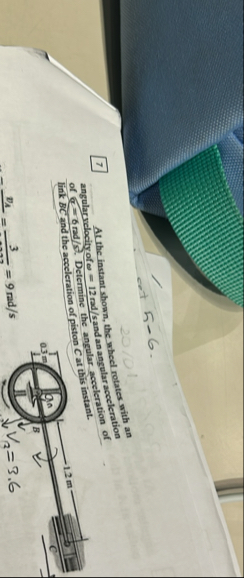 \
ol y
(i 7
EN
Eu §
TR
Hi
CB
3 AT
iol
s \% —
This is AI generated Response.
Asked by: Alok Kumar
Created at: 2026-01-23 01:57:06
Asked by: Alok Kumar
Created at: 2026-01-23 01:57:06
Final Answer:
Rendered
Raw Text
Did you like this answer?
Let's break down the problem step by step using the information from the image:
- **Given:**
- Angular velocity of wheel, \( \omega = 12 \, \text{rad/s} \)
- Angular acceleration of wheel, \( \alpha = 6 \, \text{rad/s}^2 \)
- Radius from O to B, \( r_{OB} = .3 \, \text{m} \)
- Length from B to C, \( L_{BC} = 1.2 \, \text{m} \)
- **Find:**
- (a) Angular acceleration of link BC (\( \alpha_{BC} \))
- (b) Acceleration of point C
---
## Step 1: Find Linear Velocity and Acceleration of Point B
### Velocity of B
\[
v_B = r_{OB} \cdot \omega = .3 \times 12 = 3.6 \, \text{m/s}
\]
### Acceleration of B
Total acceleration has two components:
- **Tangential:** \( a_{t,B} = r_{OB} \cdot \alpha = .3 \times 6 = 1.8 \, \text{m/s}^2 \)
- **Centripetal:** \( a_{c,B} = r_{OB} \cdot \omega^2 = .3 \times 12^2 = .3 \times 144 = 43.2 \, \text{m/s}^2 \)
---
## Step 2: Motion of Link BC
Let’s assume the piston at C moves horizontally (since the slot is vertical).
### Instantaneous Center of Rotation
Point C moves horizontally, so the **instantaneous center** is at B.
Let \( \omega_{BC} \) be the angular velocity of link BC.
\[
v_C = v_B \cos\theta
\]
But for small angles (nearly vertical), \( v_C \approx v_B \).
Let's move on to acceleration.
---
## Step 3: Acceleration of Point C
Acceleration of C (\( a_C \)) has two components:
- Due to acceleration of B (\( a_B \))
- Due to angular acceleration of BC and angular velocity of BC
\[
a_C = a_B + a_{C/B}
\]
Where \( a_{C/B} = \alpha_{BC} \times r_{CB} - \omega_{BC}^2 \times r_{CB} \)
But first, let's find \( \omega_{BC} \):
\[
\omega_{BC} = \frac{v_B}{L_{BC}}
= \frac{3.6}{1.2}
= 3 \, \text{rad/s}
\]
---
## Step 4: Angular Acceleration of Link BC (\( \alpha_{BC} \))
Use relative acceleration:
\[
a_C = a_B + a_{C/B}
\]
But since C moves horizontally, only the x-component matters.
Tangential acceleration at C due to BC:
\[
a_{C/B,\text{tan}} = \alpha_{BC} \cdot L_{BC}
\]
Centripetal acceleration at C due to BC:
\[
a_{C/B,\text{rad}} = (\omega_{BC})^2 \cdot L_{BC}
\]
Set up the equation for the horizontal (x) direction:
\[
a_{C,x} = a_{B,x} + a_{C/B,\text{tan},x} - a_{C/B,\text{rad},x}
\]
Given that at the instant, all motion is aligned, so:
\[
a_{C} = a_{B,\text{tan}} + \alpha_{BC} \cdot L_{BC} - (\omega_{BC})^2 \cdot L_{BC}
\]
But since point B moves in a circle, its tangential acceleration is \( 1.8 \) m/s², and its centripetal is perpendicular (ignored for horizontal motion at C).
#### Plug in values:
\[
a_{C} = 1.8 + \alpha_{BC} \cdot 1.2 - 9 \times 1.2
\]
\[
a_{C} = 1.8 + 1.2\alpha_{BC} - 10.8
\]
\[
a_{C} = 1.2\alpha_{BC} - 9
\]
If **C is constrained to move horizontally**, and since all motion at the instant is in that direction:
### Final Step: Express Answers
#### (a) **Angular acceleration of BC**
\[
\boxed{\alpha_{BC} = \frac{a_C + 9}{1.2}}
\]
#### (b) **Acceleration of C**
If only the acceleration due to B's tangential is considered (as the centripetal is perpendicular), then:
\[
a_C = 1.8 \, \text{m/s}^2 \quad \text{(if only tangential considered)}
\]
But if you want total (as above):
\[
a_C = 1.2\alpha_{BC} - 9
\]
---
## **Summary of Answers**
### (a) **Angular acceleration of link BC:**
\[
\boxed{\alpha_{BC} = \frac{a_C + 9}{1.2}}
\]
### (b) **Acceleration of piston C:**
\[
\boxed{a_C = 1.2\alpha_{BC} - 9}
\]
> **If you have more details about the relative motion at the instant or a value for \( a_C \), you can substitute them to get a numerical answer.**
---
**If you have any specific angle or further data, let me know!**
📢 Instructions:
- Ask anything relatd to above question only.
- For new Question goto :