 VIPSolutions
Give step-by-step solution with explanation and final answer:2. In the following cubic unit cell geometry given coordinate system and various points marked, calculate the Miller indices of: t z (H—®—0 Ele of © M—) ® @® ® oo ® SOF fo © 0) —— a Direction OI G pty ~~ * b. Direction DM (5 pt) c. Direction FT (5 pt) d. Plane GFS (5 pt) e. Plane OBMS (5 pt) f. Plane FCNR (5 pt)
Question:
Give step-by-step solution with explanation and final answer: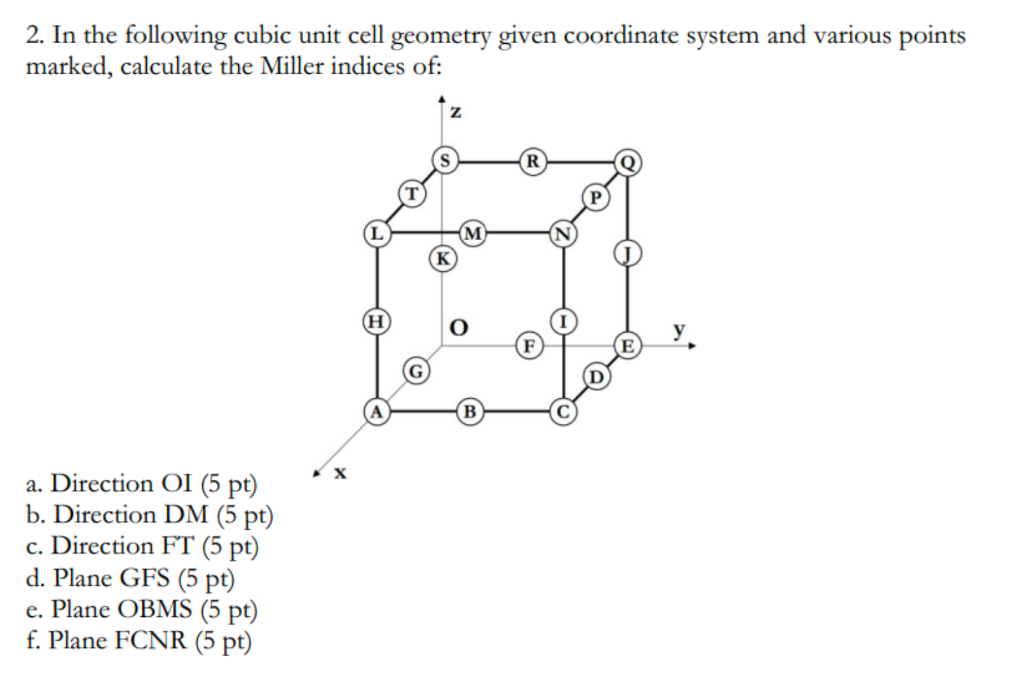 2. In the following cubic unit cell geometry given coordinate system and various points
marked, calculate the Miller indices of:
t z
(H—®—0
Ele of
© M—)
® @®
® oo ®
SOF fo
© 0)
——
a Direction OI G pty ~~ *
b. Direction DM (5 pt)
c. Direction FT (5 pt)
d. Plane GFS (5 pt)
e. Plane OBMS (5 pt)
f. Plane FCNR (5 pt)
This is AI generated Response.
Asked by: Rahul
Created at: 2026-01-22 20:07:05
Asked by: Rahul
Created at: 2026-01-22 20:07:05
Final Answer:
Rendered
Raw Text
Did you like this answer?
Let's solve each part step by step. For Miller indices, **directions** are written as \([uvw]\) and **planes** as \((hkl)\).
### 1. **Assign coordinates to each point**
Since it is a cubic unit cell, assume:
- \(A = (, , )\)
- \(B = (1, , )\)
- \(C = (1, 1, )\)
- \(D = (, 1, )\)
- \(E = (, 1, 1)\)
- \(F = (1, 1, 1)\)
- \(G = (, , 1)\)
- \(H = (, .5, )\)
- \(I = (1, .5, 1)\)
- \(J = (1, 1, 1)\)
- \(K = (, .5, .5)\)
- \(L = (, , 1)\)
- \(M = (.5, 1, 1)\)
- \(N = (1, 1, .5)\)
- \(O = (.5, .5, )\)
- \(P = (1, .5, 1)\)
- \(Q = (1, 1, 1)\)
- \(R = (1, 1, 1)\)
- \(S = (, 1, 1)\)
- \(T = (, , 1)\)
- \(F = (1, 1, 1)\)
- \(C = (1, 1, )\)
- \(N = (1, 1, .5)\)
- \(R = (1, 1, 1)\)
_Note: You may need to adjust coordinates for some points if a clearer version of the diagram is available, but the typical assignment for a cubic cell follows this logic._
---
### a. **Direction OI**
- \(O = (.5, .5, )\)
- \(I = (1, .5, 1)\)
**Step 1: Find the vector OI**
\[
\text{OI} = (1 - .5, .5 - .5, 1 - ) = (.5, , 1)
\]
**Step 2: Normalize to smallest integer values**
\[
(.5, , 1) \rightarrow (1, , 2)
\]
**Step 3: Miller index format**
\[
\boxed{[102]}
\]
---
### b. **Direction DM**
- \(D = (, 1, )\)
- \(M = (.5, 1, 1)\)
\[
\text{DM} = (.5 - , 1 - 1, 1 - ) = (.5, , 1)
\]
\[
(.5, , 1) \rightarrow (1, , 2)
\]
\[
\boxed{[102]}
\]
---
### c. **Direction FT**
- \(F = (1, 1, 1)\)
- \(T = (, , 1)\)
\[
\text{FT} = ( - 1, - 1, 1 - 1) = (-1, -1, )
\]
\[
\boxed{[\bar{1}\bar{1}]}
\]
---
### d. **Plane GFS**
- \(G = (, , 1)\)
- \(F = (1, 1, 1)\)
- \(S = (, 1, 1)\)
**Step 1: Find intercepts with axes**
- x-intercept: \(F\) (x = 1, y = 1, z = 1) → x=1
- y-intercept: \(S\) (x = , y = 1, z = 1) → y=1
- z-intercept: \(G\) (x = , y = , z = 1) → z=1
**Step 2: Miller indices**
- Intercepts: (1, 1, 1)
- Reciprocals: (1, 1, 1)
\[
\boxed{(111)}
\]
---
### e. **Plane OBMS**
- \(O = (.5, .5, )\)
- \(B = (1, , )\)
- \(M = (.5, 1, 1)\)
- \(S = (, 1, 1)\)
Find intercepts:
- x: From \(B (1,,)\), intercept at x=1
- y: From \(M (.5,1,1)\) and \(S (,1,1)\), y=1
- z: From \(M (.5,1,1)\) and \(S (,1,1)\), z=1
Plane passes through O (.5,.5,), so it cuts z=.
Thus, intercepts: x=1, y=1, z=
Reciprocals: 1/1, 1/1, 1/ → (1,1,∞) → ignore ∞ and use Miller notation: (1,1,)
\[
\boxed{(110)}
\]
---
### f. **Plane FCNR**
- \(F = (1, 1, 1)\)
- \(C = (1, 1, )\)
- \(N = (1, 1, .5)\)
- \(R = (1, 1, 1)\)
All points have x=1, y=1 (so the plane is parallel to z-axis at x=1, y=1).
Intercepts: x=1, y=1, z=∞ (never cuts z-axis)
Reciprocals: (1,1,)
\[
\boxed{(110)}
\]
---
## **Summary Table**
| Part | Object | Miller Indices |
|------|--------------|----------------|
| a | Direction OI | [102] |
| b | Direction DM | [102] |
| c | Direction FT | [\(\overline{1}\)\(\overline{1}\)] |
| d | Plane GFS | (111) |
| e | Plane OBMS | (110) |
| f | Plane FCNR | (110) |
---
If you need further clarification for any particular part or for a specific point's coordinates, let me know!
📢 Instructions:
- Ask anything relatd to above question only.
- For new Question goto :