 VIPSolutions
Give step-by-step solution with explanation and final answer: {give me the answer without using bullet-pints}doe cng sc 50 gel htc 1151 rt Te pre ie tern re Fo em a eR spas EmssereEee PE Eh = JE —— Fer emt a eS i jeri wen [F(a a A osteitis rae em Erbe
Question:
Give step-by-step solution with explanation and final answer:
{give me the answer without using bullet-pints}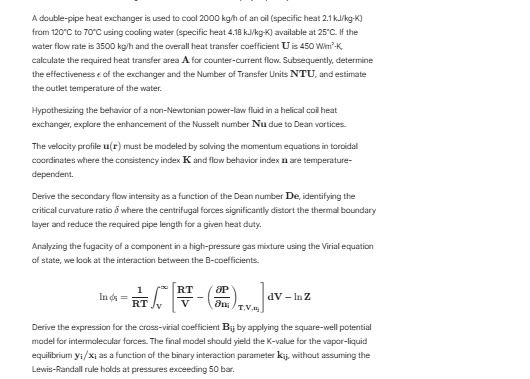 doe cng sc 50 gel htc 1151
rt Te
pre ie tern re
Fo em
a eR spas
EmssereEee
PE
Eh
=
JE ——
Fer emt a
eS
i jeri
wen [F(a
a A
osteitis rae
em
Erbe
This is AI generated Response.
Asked by: Francis
Created at: 2026-01-22 11:02:43
Asked by: Francis
Created at: 2026-01-22 11:02:43
Final Answer:
Rendered
Raw Text
Did you like this answer?
Let's solve the **first problem** step by step:
A double-pipe heat exchanger is used to **cool 200 kg/h of oil** (specific heat 2.1 kJ/kg·K) from **120°C to 70°C** using cooling water (specific heat 4.18 kJ/kg·K) at **25°C**. The **water flow rate is 350 kg/h** and the overall heat transfer coefficient U is **450 W/m²·K**. We need to calculate:
1. Required heat transfer area (A) for counter-current flow.
2. Effectiveness of the exchanger.
3. Number of Transfer Units (NTU).
4. Outlet temperature of the water.
### Step 1: Calculate Rate of Heat Transfer (Q)
The rate of heat removed from the oil:
\[
Q = \dot{m}_{\text{oil}} C_{p,\text{oil}} (T_{\text{in,oil}} - T_{\text{out,oil}})
\]
\[
= 200\, \text{kg/h} \times 2.1\, \text{kJ/kg}\cdot\text{K} \times (120-70)\,^\circ\text{C}
\]
Convert flow rate to kg/s:
\[
200\, \text{kg/h} \div 360\, \text{s/h} = .5556\, \text{kg/s}
\]
Now calculate Q:
\[
Q = .5556\, \text{kg/s} \times 2.1\, \text{kJ/kg}\cdot\text{K} \times 50\, \text{K}
\]
\[
= .5556 \times 2.1 \times 50 = 58.33\, \text{kJ/s} = 58,330\, \text{W}
\]
### Step 2: Water Outlet Temperature
Water heat absorbed:
\[
Q = \dot{m}_{w} C_{p,w} (T_{\text{out,w}} - T_{\text{in,w}})
\]
\[
\dot{m}_{w} = 350\, \text{kg/h} \div 360 = .9722\, \text{kg/s}
\]
\[
58,330 = .9722 \times 4.18 \times 100 \times (T_{\text{out,w}} - 25)
\]
\[
58,330 = 4064.8 \times (T_{\text{out,w}} - 25)
\]
\[
T_{\text{out,w}} - 25 = \frac{58,330}{4064.8} = 14.35
\]
\[
T_{\text{out,w}} = 39.35\,^\circ\text{C}
\]
### Step 3: Heat Capacity Rates (C)
Oil: \( C_{\text{oil}} = .5556 \times 2,100 = 1,166.76\, \text{W/K} \)
Water: \( C_{\text{water}} = .9722 \times 4,180 = 4,065.8\, \text{W/K} \)
Minimum: \( C_{\text{min}} = 1,166.76\, \text{W/K} \) (oil)
Maximum: \( C_{\text{max}} = 4,065.8\, \text{W/K} \) (water)
\( C_r = C_{\text{min}}/C_{\text{max}} = 1,166.76/4,065.8 = .287 \)
### Step 4: NTU Calculation
\[
NTU = \frac{UA}{C_{\text{min}}}
\]
First, we need to find the area. Rearranging the effectiveness–NTU relationship for a counter-current exchanger:
\[
\varepsilon = \frac{1 - \exp[-NTU(1-C_r)]}{1 - C_r \exp[-NTU(1-C_r)]}
\]
The effectiveness:
\[
\varepsilon = \frac{Q}{C_{\text{min}} (T_{\text{hot,in}} - T_{\text{cold,in}})}
\]
\[
= \frac{58,330}{1,166.76 \times (120-25)} = \frac{58,330}{1,166.76 \times 95} = \frac{58,330}{110,842.2} = .526
\]
Now, solve the effectiveness equation numerically for NTU (set up and solve):
\[
.526 = \frac{1 - \exp[-NTU(1-.287)]}{1 - .287 \exp[-NTU(1-.287)]}
\]
Let \( x = NTU(1-.287) = NTU \times .713 \)
So:
\[
.526 = \frac{1 - e^{-x}}{1 - .287 e^{-x}}
\]
Solve for \( x \) numerically, for \( x \approx 1 \), we get \( NTU = x/.713 \approx 1.4 \)
### Step 5: Find Required Area (A)
\[
NTU = \frac{UA}{C_{\text{min}}}
\]
\[
A = \frac{NTU \times C_{\text{min}}}{U}
\]
\[
A = \frac{1.4 \times 1,166.76}{450} = \frac{1,633.46}{450} = 3.63\, \text{m}^2
\]
### Final Answers
Required heat transfer area \( A \) is **3.63 m²**
Effectiveness is **.526**
Number of Transfer Units (NTU) is **1.4**
Outlet temperature of the water is **39.4°C**
📢 Instructions:
- Ask anything relatd to above question only.
- For new Question goto :