 VIPSolutions
Give step-by-step solution with explanation and final answer: {give me the answer without bullet-points}9. (10 pts) Shown below is the hydrolysis reaction of the amide group of glutamine to form glutamic acid, which upon deprotonation becomes glutamate. Propose a reasonable reaction mechanism with curved arrows. State whether you assume acidic or basic conditions. For proton transfers, use a generic acid/base pair consistently (e.g., HA/A~ or H-B*/B:). coo qo° HsN—C—H HN—g—H CHy + HO —zr CH, + NH CHp CH; fe go [¢) o Glutamine Glutamate
Question:
Give step-by-step solution with explanation and final answer:
{give me the answer without bullet-points}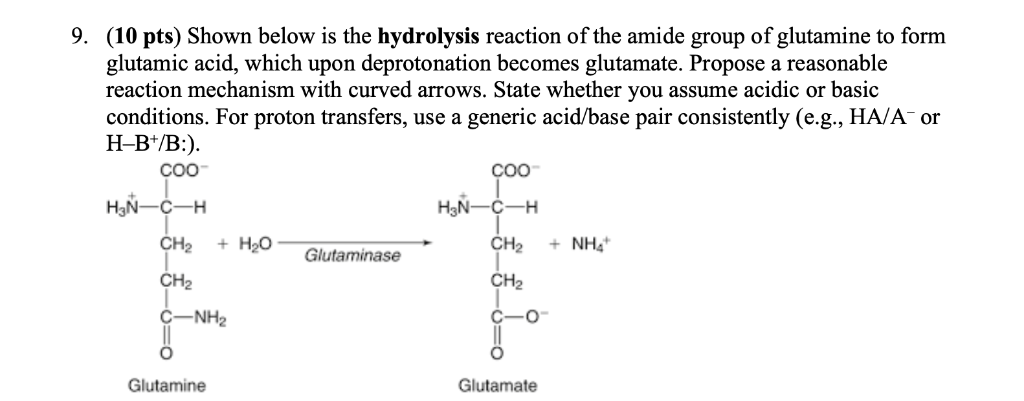 9. (10 pts) Shown below is the hydrolysis reaction of the amide group of glutamine to form
glutamic acid, which upon deprotonation becomes glutamate. Propose a reasonable
reaction mechanism with curved arrows. State whether you assume acidic or basic
conditions. For proton transfers, use a generic acid/base pair consistently (e.g., HA/A~ or
H-B*/B:).
coo qo°
HsN—C—H HN—g—H
CHy + HO —zr CH, + NH
CHp CH;
fe go
[¢) o
Glutamine Glutamate
This is AI generated Response.
Asked by: Francis
Created at: 2026-01-22 09:14:10
Asked by: Francis
Created at: 2026-01-22 09:14:10
Final Answer:
Rendered
Raw Text
Did you like this answer?
**Step-by-Step Solution: Mechanism for Amide Hydrolysis (Glutaminase-Catalyzed Hydrolysis of Glutamine to Glutamate)**
Assume **basic conditions** (because enzymes like glutaminase often use a base to activate water).
**Step 1: Nucleophilic Attack by Hydroxide (OH⁻) on Amide Carbonyl**
The base (B:) deprotonates a water molecule, generating hydroxide ion (OH⁻).
The OH⁻ attacks the carbonyl carbon of the amide group in glutamine, breaking the C=O π bond and pushing electrons onto the oxygen, forming a tetrahedral intermediate.
**Step 2: Tetrahedral Intermediate Formation**
The oxygen now bears a negative charge. The intermediate has an -OH and -NH₂ group attached to the former carbonyl carbon.
**Step 3: Expulsion of Ammonia (NH₃)**
The electrons on the negatively charged oxygen reform the C=O double bond, which leads to the expulsion of the -NH₂ group as a leaving group.
The -NH₂ group picks up a proton from water (or from a general acid, HA, in the enzyme active site) and leaves as NH₃ (which is protonated in solution to NH₄⁺).
**Step 4: Formation of Glutamic Acid, then Glutamate**
The product is glutamic acid (with a carboxylic acid group where the amide was).
Under basic conditions, the carboxylic acid is deprotonated to give glutamate (the carboxylate anion, COO⁻).
**Step 5: Summary of Proton Transfers**
The proton transfers can be mediated by water or a general acid/base in the enzyme. The departing NH₂ group is protonated to NH₄⁺, and the new carboxylic acid is likely deprotonated to COO⁻ under basic conditions.
**Final Mechanism (with Curved Arrows):**
1. B: + H₂O → BH + OH⁻
2. OH⁻ attacks the amide carbonyl carbon (curved arrow from OH⁻ to carbon, and from C=O π bond to O); tetrahedral intermediate forms.
3. Lone pair on O reforms C=O, expelling NH₂⁻ (arrow from O⁻ to reform C=O, arrow from C–NH₂ bond to NH₂).
4. NH₂⁻ is protonated by water or acid to NH₄⁺.
5. The product is glutamate (COO⁻), with NH₄⁺ as the byproduct.
**Final Answer:**
Under basic conditions, glutaminase catalyzes the hydrolysis of the amide group of glutamine by activating water (or hydroxide), which attacks the amide carbonyl to form a tetrahedral intermediate. The intermediate collapses, expelling ammonia (NH₃, which is protonated to NH₄⁺), and the newly formed carboxylic acid is deprotonated to form glutamate (COO⁻). The overall transformation converts glutamine + H₂O → glutamate + NH₄⁺.
📢 Instructions:
- Ask anything relatd to above question only.
- For new Question goto :