This is AI generated Response.
Asked by: Francis
Created at: 2026-01-22 08:54:42
Final Answer:
RenderedRaw Text
Did you like this answer?
## Step-by-Step Solution and Explanation
**Problem Summary:**
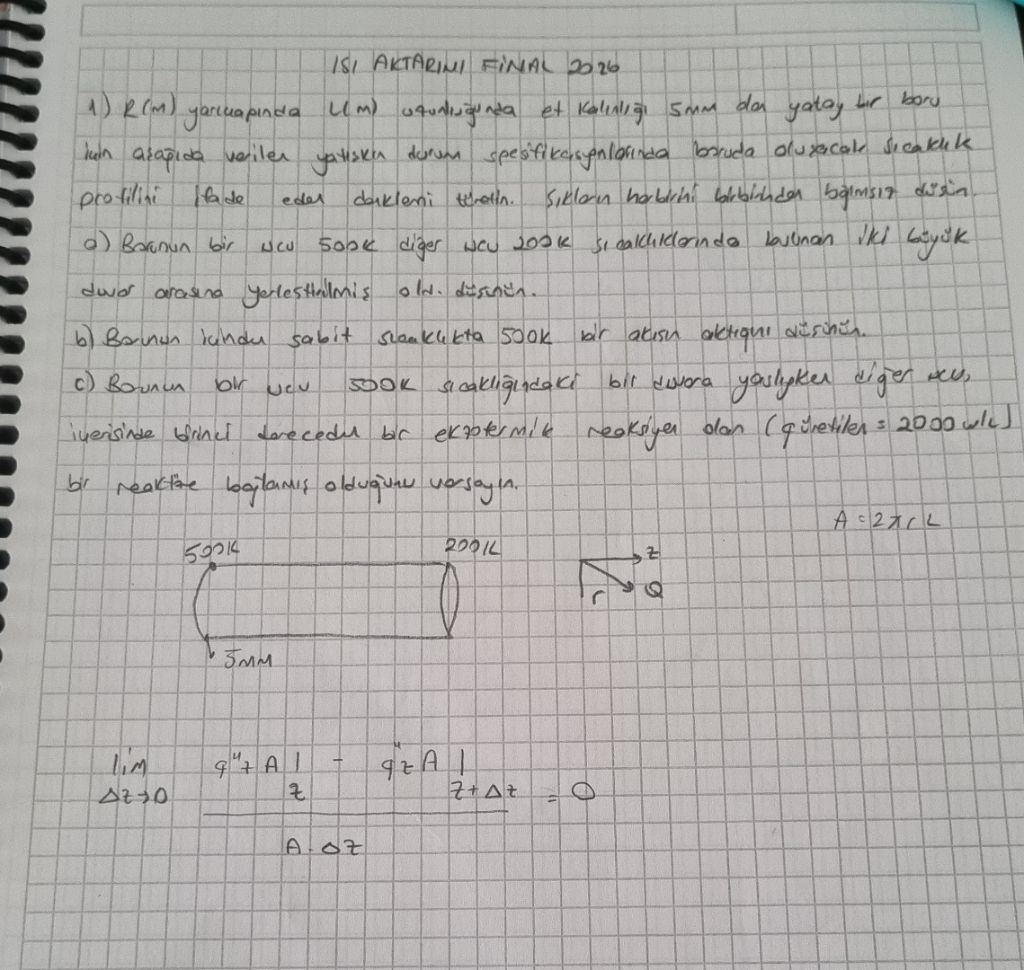
A horizontal cylindrical pipe of length \(L = 1\) m and inner diameter \(d = 5\) mm (radius \(r = 2.5\) mm) is considered. The pipe is made of a material with thermal conductivity \(k\) (not specified in the image, but let's denote it as \(k\)). Three scenarios are given for temperature boundary conditions at the ends of the pipe.
### Given Data:
- Length, \(L = 1\) m
- Inner diameter, \(d = 5\) mm \(\rightarrow r = 2.5\) mm = \(.0025\) m
- Cross-sectional area, \(A = 2\pi r L\) (for a thin pipe wall, but for a solid rod it would be \(\pi r^2\))
- \(T_1 = 500\) K at one end, \(T_2 = 200\) K at the other
Let's solve for part (a):
---
### **a) Temperature Profile with Both Ends at Fixed Temperatures (Steady-State 1D Conduction)**
For a steady-state, one-dimensional heat conduction in a rod (Fourier's Law):
\[
q = -kA \frac{dT}{dz}
\]
Where:
- \(q\) is the heat transfer rate (W)
- \(k\) is the thermal conductivity (W/m·K)
- \(A\) is the cross-sectional area (\(m^2\))
- \(\frac{dT}{dz}\) is the temperature gradient
#### **Step 1: Set Up the Differential Equation**
Since \(q\) is constant in steady state and there is no heat generation in the rod,
\[
\frac{d^2T}{dz^2} =
\]
#### **Step 2: Integrate**
\[
\frac{dT}{dz} = C_1
\]
\[
T(z) = C_1 z + C_2
\]
#### **Step 3: Apply Boundary Conditions**
At \(z = \), \(T = 500\) K
At \(z = L\), \(T = 200\) K
So,
\[
T() = C_2 = 500
\]
\[
T(L) = C_1 L + 500 = 200 \implies C_1 = \frac{200 - 500}{L} = \frac{-300}{1} = -300
\]
#### **Step 4: Write the Temperature Profile**
\[
T(z) = -300z + 500
\]
where \(z\) is in meters, \( \leq z \leq 1\).
---
### **Final Answer (Part a)**
\[
\boxed{T(z) = -300z + 500}
\]
---
If you need solutions for parts (b) or (c), let me know!
VIPSolutions focuses on clear, step‑by‑step explanations so you can learn quickly. Whether you need an AI‑generated walkthrough or a short hint to get unstuck, each solution is organized for fast reading and easy review later.
Search similar questions, compare approaches, and bookmark the best answers for revision. Our goal is simple: quick, reliable study help that feels natural—not noisy.
 VIPSolutions
 { | 181 PETA Lu i - :
1) 0m) EA pA AE EU RSH ER \
Jortuapincia LL =) Ay
if odeduyna el Kalil 3 A.
~ ei i gum 1 3. iSqm. clot gatey Lr | ory
fi In| Atoka | spel
bE pro | Fel | cli [ad a) BE faa
i |darilorai | theta. ; I
- @) Bini! br | we Son i . § ian ac) bkldsdon x fora
+ J © |diger| wey 102g aalthidarinda | loan )
9 ams Sertestialonls ol. | desad amu as
- bb) Banda | 1d) i nu |
. a Ndndal sabit | aaktita [S30k |r
> ©) olan! JOM Lydul ls MEEuEm:
ile EF
® [11 OL] gortligudacs (bit dwora ous lipl /
IME J lip eA vg ra |
: ] Ue | ekwtrmle | rook, olan | (qed
Tas Hl as iyo deter = 2000 lc]
1 E-3 = BJ 5 TAB
» gol o7e] 0
: 29174] ALi Aga]
| ERIE EEE
) iis |
SMM
|
HE RE J 8 8 RR 51
gall] | 7 EIU | | fet
A230 2 gr] bili] FREREEE SEE
| ZVI WIN
| Ialala ae EEE HD AEE
Fi TEE I Li
HHH I 6 1
Sar E JE ER 7 CA ee TELE
[7] I mENEENEE ENE
| FR EE EE EP RE mA
F500 DA VER ER En