 VIPSolutions
Give step-by-step solution with explanation and final answer:I 5. Foo tou react hm, rons sed civ ro mn be V2 rt So ose oS ea Sr Sv a yo re Imachaniam, or you can wee “8” and HA" or Dasa’ and “sce, eapaciely Z a 0 att SR C5. eR eee ed in oc bo, Une. ee po pc SA. eo oe dw. a. Ll ed
Question:
Give step-by-step solution with explanation and final answer: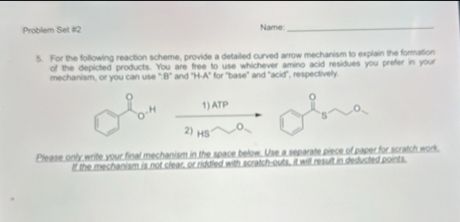 I
5. Foo tou react hm, rons sed civ ro mn be V2 rt
So ose oS ea Sr Sv a yo re
Imachaniam, or you can wee “8” and HA" or Dasa’ and “sce, eapaciely Z
a 0
att SR C5.
eR
eee ed in oc bo, Une. ee po pc SA.
eo oe dw. a. Ll ed
This is AI generated Response.
Asked by: Rahul
Created at: 2026-01-22 07:54:41
Asked by: Rahul
Created at: 2026-01-22 07:54:41
Final Answer:
Rendered
Raw Text
Did you like this answer?
Let's break down the reaction step-by-step and provide a detailed curved arrow mechanism.
---
## **Step-by-Step Solution**
### **Given Reaction**
**Reactants:**
- Benzyl alcohol derivative (Ph-CH₂OH)
- ATP (Adenosine Triphosphate)
- HS⁻ (Thiol)
**Product:**
- Benzyl thioester (Ph-CH₂-SR)
---
### **Step 1: Activation of Alcohol by ATP**
ATP can act as a phosphorylating agent, converting the alcohol into a good leaving group (phosphate ester).
#### **Mechanism:**
1. The lone pair of electrons on the alcohol oxygen attacks the γ-phosphorus atom of ATP (the terminal phosphate), displacing ADP and forming a **benzyl phosphate ester**.
**Curved arrow:**
- From alcohol O: lone pair → γ-phosphorus of ATP
- From P-O bond in ATP: break bond, leaving as ADP
**Intermediate formed:**
Ph-CH₂-O-PO₃²⁻ (benzyl phosphate ester)
---
### **Step 2: Nucleophilic Substitution by Thiol**
HS⁻ acts as a nucleophile, attacking the electrophilic carbon (benzylic carbon) and displacing the phosphate group via an **S_N2 mechanism**.
#### **Mechanism:**
1. HS⁻ attacks the benzylic carbon from the backside, causing the O-PO₃²⁻ group to leave.
**Curved arrow:**
- From S⁻: lone pair → benzylic carbon
- From C-O bond: break bond, electrons to O (leaving with phosphate)
**Product formed:**
Ph-CH₂-SH (benzyl thioether)
---
### **Final Answer: Detailed Mechanism**
#### **Step 1: Formation of Benzyl Phosphate Ester**
```markdown
O
||
Ph-CH2-OH + ATP → Ph-CH2-O-PO3^2- + ADP
```
- Alcohol attacks γ-phosphate of ATP; ADP leaves.
#### **Step 2: Nucleophilic Substitution**
```markdown
Ph-CH2-O-PO3^2- + HS^- → Ph-CH2-SH + PO4^3-
```
- Thiolate anion (HS⁻) attacks benzylic carbon, phosphate group leaves.
---
### **Curved Arrow Mechanism (Summary)**
1. **Nucleophilic attack by alcohol oxygen on ATP (γ-phosphate), forming benzyl phosphate ester.**
2. **Nucleophilic S_N2 attack by HS⁻ on benzylic carbon, displacing phosphate group and forming thioether.**
---
## **Final Product**
The product is a **benzyl thioether**:
**Ph-CH₂-SH**
---
### **Summary Table**
| Step | Reactant(s) | Intermediate/Product | Key Transformation |
|------|-----------------------|--------------------------|----------------------------------------|
| 1 | Ph-CH₂OH + ATP | Ph-CH₂-O-PO₃²⁻ | Alcohol to phosphate ester (activation)|
| 2 | Ph-CH₂-O-PO₃²⁻ + HS⁻ | Ph-CH₂-SH + PO₄³⁻ | S_N2 displacement by thiol |
---
If you need a hand-drawn curved arrow mechanism, let me know!
📢 Instructions:
- Ask anything relatd to above question only.
- For new Question goto :