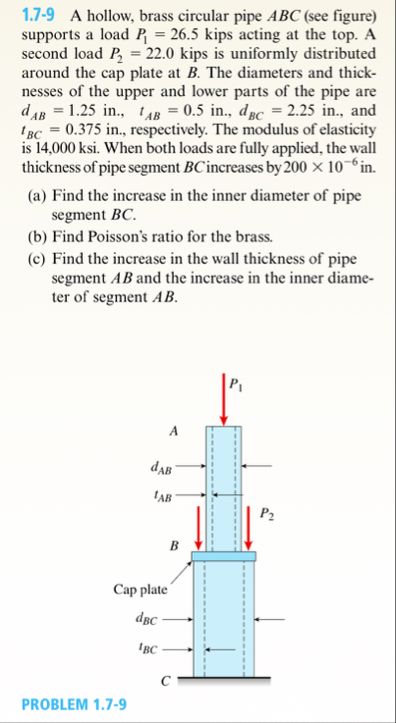
Give step-by-step solution with explanation and final answer:17-9 A hollow, brass circular pipe ABC (see figure)
supports a load B, = 26.5 kips acting at the top. A
second load P, = 22.0 kips is uniformly distributed
around the cap plate at B. The diameters and thick-
nesses of the upper and lower parts of the pipe are
dgy =125 in, fg =05 in, dsc =225 in. and
I5¢ = 0.375 in, respectively. The modulus of elasticity
is 14,000 ksi. When both loads are fully applied. the wall
thickness of pipe segment BCincreases by200 X 10 “in.
(a) Find the increase in the inner diameter of pipe
segment BC.
(b) Find Poissons ratio for the brass.
(c) Find the increase in the wall thickness of pipe
segment AB and the increase in the inner diame-
ter of segment AB.
”
A
da
tan
Py
B
Capplate” | 1!
doc—s i
wd
&
PROBLEM 1.7-9
Question:
Give step-by-step solution with explanation and final answer:17-9 A hollow, brass circular pipe ABC (see figure)
supports a load B, = 26.5 kips acting at the top. A
second load P, = 22.0 kips is uniformly distributed
around the cap plate at B. The diameters and thick-
nesses of the upper and lower parts of the pipe are
dgy =125 in, fg =05 in, dsc =225 in. and
I5¢ = 0.375 in, respectively. The modulus of elasticity
is 14,000 ksi. When both loads are fully applied. the wall
thickness of pipe segment BCincreases by200 X 10 “in.
(a) Find the increase in the inner diameter of pipe
segment BC.
(b) Find Poissons ratio for the brass.
(c) Find the increase in the wall thickness of pipe
segment AB and the increase in the inner diame-
ter of segment AB.
”
A
da
tan
Py
B
Capplate” | 1!
doc—s i
wd
&
PROBLEM 1.7-9
This is AI generated Response.
Asked by: Rahul
Created at: 2026-01-22 05:02:59
Final Answer:
RenderedRaw Text
Did you like this answer?
Let's solve **Problem 1.7-9** step by step.
---
## **Given Data**
- **Loads:**
\( P_1 = 26.5 \) kips
\( P_2 = 22. \) kips
- **Diameters and Thicknesses:**
\( d_{AB} = 1.25 \) in, \( t_{AB} = .5 \) in
\( d_{BC} = 2.25 \) in, \( t_{BC} = .375 \) in
- **Modulus of Elasticity:**
\( E = 14,000 \) ksi
- **Increase in wall thickness of BC:**
\( \Delta t_{BC} = 200 \times 10^{-6} \) in
---
## **Part (a): Increase in the Inner Diameter of Pipe Segment BC**
### **Step 1: Find Original Inner Diameter of BC**
\[
d_{i,BC} = d_{BC} - 2t_{BC}
\]
\[
d_{i,BC} = 2.25 - 2 \times .375 = 2.25 - .75 = 1.50 \text{ in}
\]
### **Step 2: Find Increase in Inner Diameter**
The increase in wall thickness means the outer diameter remains constant, so the inner diameter must decrease by twice the increase in thickness:
\[
\Delta d_{i,BC} = -2 \Delta t_{BC}
\]
\[
\Delta d_{i,BC} = -2 \times 200 \times 10^{-6} = -400 \times 10^{-6} = -.0004 \text{ in}
\]
**Final Answer:**
\[
\boxed{\text{The inner diameter of segment BC decreases by } .0004 \text{ in}}
\]
---
## **Part (b): Find Poisson's Ratio for the Brass**
### **Step 1: Axial Strain Calculation**
Axial strain (from mechanics of materials):
\[
\varepsilon = \frac{\Delta t_{BC}}{t_{BC}}
\]
\[
\varepsilon = \frac{200 \times 10^{-6}}{.375} = 533.33 \times 10^{-6}
\]
### **Step 2: Axial Stress in Segment BC**
Total load on BC: \( P_1 + P_2 \)
\[
P = P_1 + P_2 = 26.5 + 22. = 48.5 \text{ kips} = 48,500 \text{ lb}
\]
Cross-sectional area:
\[
A = \pi \left[ \frac{(d_{BC})^2 - (d_{i,BC})^2}{4} \right]
\]
\[
A = \pi \left[ \frac{(2.25)^2 - (1.50)^2}{4} \right] = \pi \left[ \frac{5.0625 - 2.25}{4} \right] = \pi \left[ \frac{2.8125}{4} \right] = \pi \times .7031 = 2.209 \text{ in}^2
\]
Axial stress:
\[
\sigma = \frac{P}{A} = \frac{48,500}{2.209} = 21,956 \text{ psi} = 21.96 \text{ ksi}
\]
### **Step 3: Axial Strain from Stress and Modulus**
\[
\varepsilon_{axial} = \frac{\sigma}{E} = \frac{21,956}{14,000 \times 100} = .001568
\]
### **Step 4: Poisson's Ratio**
Lateral strain:
\[
\varepsilon_{lateral} = \frac{\Delta t_{BC}}{t_{BC}} = 533.33 \times 10^{-6}
\]
Poisson's ratio, \( \nu \):
\[
\varepsilon_{lateral} = -\nu \varepsilon_{axial}
\implies \nu = -\frac{\varepsilon_{lateral}}{\varepsilon_{axial}}
\]
\[
\nu = -\frac{533.33 \times 10^{-6}}{.001568} = -.340
\]
(Take absolute value since Poisson's ratio is positive.)
**Final Answer:**
\[
\boxed{\nu = .34}
\]
---
## **Part (c): Increase in Wall Thickness and Inner Diameter of Segment AB**
### **Step 1: Find Axial Stress in Segment AB**
- **Load on AB:** Only \( P_1 \) passes through AB.
\[
A_{AB} = \pi \left[ \frac{(d_{AB})^2 - (d_{i,AB})^2}{4} \right]
\]
\[
d_{i,AB} = d_{AB} - 2t_{AB} = 1.25 - 2 \times .5 = .25 \text{ in}
\]
\[
A_{AB} = \pi \left[ \frac{(1.25)^2 - (.25)^2}{4} \right] = \pi \left[ \frac{1.5625 - .0625}{4} \right] = \pi \left[ \frac{1.5}{4} \right] = \pi \times .375 = 1.178 \text{ in}^2
\]
\[
\sigma_{AB} = \frac{P_1}{A_{AB}} = \frac{26,500}{1.178} = 22,494 \text{ psi} = 22.49 \text{ ksi}
\]
### **Step 2: Axial Strain in AB**
\[
\varepsilon_{axial,AB} = \frac{22,494}{14,000 \times 100} = .001607
\]
### **Step 3: Lateral Strain (Thickness Increase)**
\[
\varepsilon_{lateral,AB} = \nu \varepsilon_{axial,AB} = .34 \times .001607 = .000546
\]
\[
\Delta t_{AB} = t_{AB} \times \varepsilon_{lateral,AB} = .5 \times .000546 = .000273 \text{ in}
\]
### **Step 4: Change in Inner Diameter of AB**
\[
\Delta d_{i,AB} = -2 \Delta t_{AB} = -2 \times .000273 = -.000546 \text{ in}
\]
---
## **Final Answers**
### **(a)**
\[
\boxed{\text{The inner diameter of pipe segment BC decreases by } .0004 \text{ in}}
\]
### **(b)**
\[
\boxed{\nu = .34}
\]
### **(c)**
- **Increase in wall thickness of AB:**
\(\boxed{.000273 \text{ in}}\)
- **Decrease in inner diameter of AB:**
\(\boxed{.000546 \text{ in}}\)
VIPSolutions focuses on clear, step‑by‑step explanations so you can learn quickly. Whether you need an AI‑generated walkthrough or a short hint to get unstuck, each solution is organized for fast reading and easy review later.
Search similar questions, compare approaches, and bookmark the best answers for revision. Our goal is simple: quick, reliable study help that feels natural—not noisy.
 VIPSolutions
 17-9 A hollow, brass circular pipe ABC (see figure)
supports a load B, = 26.5 kips acting at the top. A
second load P, = 22.0 kips is uniformly distributed
around the cap plate at B. The diameters and thick-
nesses of the upper and lower parts of the pipe are
dgy =125 in, fg =05 in, dsc =225 in. and
I5¢ = 0.375 in, respectively. The modulus of elasticity
is 14,000 ksi. When both loads are fully applied. the wall
thickness of pipe segment BCincreases by200 X 10 “in.
(a) Find the increase in the inner diameter of pipe
segment BC.
(b) Find Poissons ratio for the brass.
(c) Find the increase in the wall thickness of pipe
segment AB and the increase in the inner diame-
ter of segment AB.
”
A
da
tan
Py
B
Capplate” | 1!
doc—s i
wd
&
PROBLEM 1.7-9