 VIPSolutions
Give step-by-step solution with explanation and final answer:Required information In the given figure, the bent rod ABEFis supported by bearings at Cand D and by wire AH. The portion AB of the rod is 250 mm long, and the load W is 520 N. Assume that the bearing at D does not exert any axial thrust. y N 2a | B 4 c P30 250 mm | i < D 2X 50mm 300mm 7 Zz mm x somm Determine the reactions at Cand D. (Include a minus sign if necessary) The reactionat Cis (Nj +([___|Nk The reaction at Dis ((___JN)j+([__]NKk
Question:
Give step-by-step solution with explanation and final answer: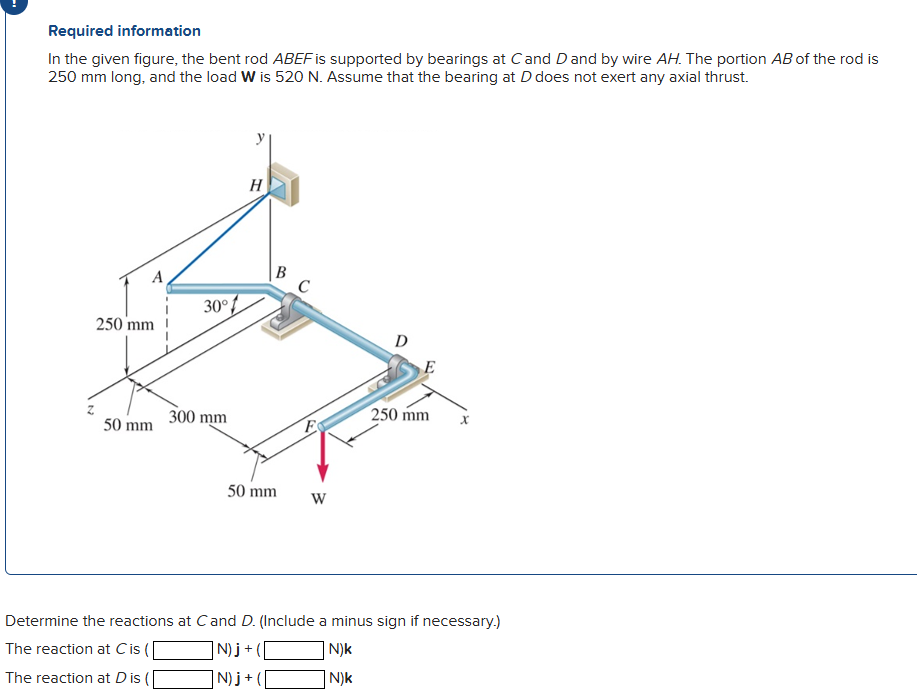 Required information
In the given figure, the bent rod ABEFis supported by bearings at Cand D and by wire AH. The portion AB of the rod is
250 mm long, and the load W is 520 N. Assume that the bearing at D does not exert any axial thrust.
y
N
2a
| B
4 c
P30
250 mm |
i < D
2X
50mm 300mm 7 Zz mm x
somm
Determine the reactions at Cand D. (Include a minus sign if necessary)
The reactionat Cis (Nj +([___|Nk
The reaction at Dis ((___JN)j+([__]NKk
This is AI generated Response.
Asked by: Rahul
Created at: 2026-01-22 04:46:44
Asked by: Rahul
Created at: 2026-01-22 04:46:44
Final Answer:
Rendered
Raw Text
Did you like this answer?
Let's solve the problem step by step.
---
## **Step 1: Understand the Problem**
Given:
- Bent rod **ABEF** is supported at **C** and **D** (bearings allow reactions in \(j\) and \(k\) directions).
- Supported by wire **AH**.
- \(AB = 250 \text{ mm}\), \(BE = 300 \text{ mm}\), \(EF = 250 \text{ mm}\), \(FA = 50 \text{ mm}\).
- Load \(W = 520 \text{ N}\) acts downward at \(F\).
- Bearing at **D** does **not** exert axial thrust (\(\vec{i}\) direction reaction at \(D\) is zero).
---
## **Step 2: Free-Body Diagram and Coordinates**
Let's assign coordinates to key points:
- \(A: (, 250, 50)\)
- \(B: (, 250, )\)
- \(C: (, , )\)
- \(E: (250, , )\)
- \(F: (250, , 50)\)
- \(H: (, 500, )\)
---
## **Step 3: Write Equilibrium Equations**
**Sum of Forces:**
\[
\sum \vec{F} =
\]
In \(j\) and \(k\) directions (since bearings cannot resist in \(i\)).
Let:
- Reaction at \(C = C_j \mathbf{j} + C_k \mathbf{k}\)
- Reaction at \(D = D_j \mathbf{j} + D_k \mathbf{k}\)
- Wire tension at \(A\) (let's call it \(T_{AH}\)), having only a \(j\) component since it runs in the y-direction.
- Load at \(F: -520\mathbf{k}\)
#### **Force Equilibrium in \(j\) and \(k\):**
\[
C_j + D_j + T_{AH} = \tag{1}
\]
\[
C_k + D_k - 520 = \tag{2}
\]
---
## **Step 4: Moment Equilibrium about Point \(C\)**
Take moments about point \(C\):
- Position vectors from \(C\) to each force application point:
- \(E_C = (250, , )\)
- \(F_C = (250, , 50)\)
- \(A_C = (, 250, 50)\)
- Let's write the moment due to each:
### **a) Load at F**
\[
\vec{r}_{F/C} = (250, , 50)
\]
\[
\vec{F}_F = -520\mathbf{k}
\]
\[
\vec{M}_{F/C} = \vec{r}_{F/C} \times \vec{F}_F
\]
\[
= \begin{vmatrix}
\mathbf{i} & \mathbf{j} & \mathbf{k} \\
250 & & 50 \\
& & -520 \\
\end{vmatrix}
= \mathbf{i}( \times -520 - 50 \times ) - \mathbf{j}(250 \times -520 - 50 \times ) + \mathbf{k}(250 \times - \times )
\]
\[
= \mathbf{i}() - \mathbf{j}(-130,000) + \mathbf{k}()
= 130,000\mathbf{j}
\]
### **b) Reaction at D**
\[
\vec{r}_{D/C} = (250, , )
\]
\[
\vec{F}_D = D_j \mathbf{j} + D_k \mathbf{k}
\]
\[
\vec{M}_{D/C} = \vec{r}_{D/C} \times \vec{F}_D
= (250, , ) \times (D_j \mathbf{j} + D_k \mathbf{k})
\]
Compute:
- \( (250, , ) \times (, D_j, ) = (, , 250 D_j) \)
- \( (250, , ) \times (, , D_k) = (, -250 D_k, ) \)
So,
\[
\vec{M}_{D/C} = 250 D_j \mathbf{k} - 250 D_k \mathbf{j}
\]
### **c) Tension at A (Wire AH)**
\[
\vec{r}_{A/C} = (, 250, 50)
\]
\[
\vec{F}_{AH} = T_{AH}\mathbf{j}
\]
\[
\vec{M}_{A/C} = (, 250, 50) \times (, T_{AH}, )
\]
\[
= \mathbf{i}(250 \times - 50 \times T_{AH}) - \mathbf{j}( \times - 50 \times ) + \mathbf{k}( \times T_{AH} - 250 \times )
\]
\[
= -50 T_{AH} \mathbf{i}
\]
---
### **Sum Moments about C:**
\[
\sum \vec{M}_C =
\]
\[
\vec{M}_{F/C} + \vec{M}_{D/C} + \vec{M}_{A/C} =
\]
\[
(130,000\mathbf{j}) + [250 D_j \mathbf{k} - 250 D_k \mathbf{j}] + [-50 T_{AH} \mathbf{i}] =
\]
So, group components:
- \(i:\) \(-50 T_{AH} = \implies T_{AH} = \)
- \(j:\) \(130,000 - 250 D_k = \implies D_k = \frac{130,000}{250} = 520\, \text{N}\)
- \(k: \) \(250 D_j = \implies D_j = \)
---
## **Step 5: Substitute Back into Force Equations**
From above:
- \(T_{AH} = \)
- \(D_k = 520\, N\)
- \(D_j = \)
From the force equilibrium equations:
\[
C_j + D_j = \implies C_j = -D_j =
\]
\[
C_k + D_k - 520 = \implies C_k + 520 - 520 = \implies C_k =
\]
---
## **Step 6: Final Answers**
- **Reaction at C:** \(\, \mathbf{j} + \, \mathbf{k}\)
- **Reaction at D:** \(\, \mathbf{j} + 520\, \mathbf{k}\)
---
## **Final Answers (Fill in the Blanks)**
\[
\boxed{
\begin{aligned}
\text{The reaction at C is } & \quad ()\text{ N}\, \mathbf{j} + ()\text{ N}\, \mathbf{k} \\
\text{The reaction at D is } & \quad ()\text{ N}\, \mathbf{j} + (520)\text{ N}\, \mathbf{k} \\
\end{aligned}
}
\]
---
**Summary Table:**
| Location | \(j\) (N) | \(k\) (N) |
|----------|-----------|-----------|
| C | | |
| D | | 520 |
---
If you have any further questions, let me know!
📢 Instructions:
- Ask anything relatd to above question only.
- For new Question goto :