 VIPSolutions
Give step-by-step solution with explanation and final answer:2. Tn poo shot, the cue bal knocks the 1-ball (ball B) int the comer pocket. Ifthe cocfTiient of restitution s 0.9. ‘acrermine the dunce d 1 wher the cue ball (ball A) wil ike the cushion. The two balls have the same mass ra
Question:
Give step-by-step solution with explanation and final answer: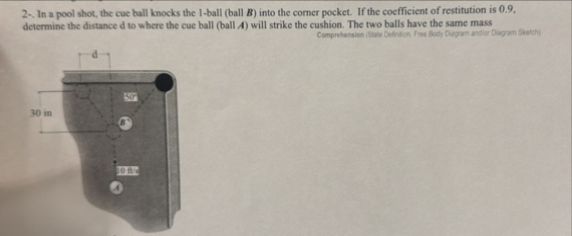 2. Tn poo shot, the cue bal knocks the 1-ball (ball B) int the comer pocket. Ifthe cocfTiient of restitution s 0.9.
‘acrermine the dunce d 1 wher the cue ball (ball A) wil ike the cushion. The two balls have the same mass
ra
This is AI generated Response.
Asked by: Rahul
Created at: 2026-01-22 04:42:17
Asked by: Rahul
Created at: 2026-01-22 04:42:17
Final Answer:
Rendered
Raw Text
Did you like this answer?
Let's break down the **pool shot problem** step by step:
---
### **Problem Restatement**
- **Cue ball (A)** strikes **1-ball (B)** into the corner pocket.
- **Coefficient of restitution \( e = .9 \)**
- **Both balls have the same mass**
- **Determine distance \( d \)** to where the cue ball will strike the cushion.
---
## **Step 1: Conservation of Momentum**
Let:
- \( v_A \): velocity of cue ball before collision
- \( v_A' \): velocity of cue ball after collision
- \( v_B' \): velocity of 1-ball after collision
Since both balls have same mass and the collision is head-on:
\[
v_A = v_A' + v_B'
\]
---
## **Step 2: Coefficient of Restitution**
\[
e = \frac{v_{B}' - v_{A}'}{v_{A} - v_{B}}
\]
Before collision, 1-ball is at rest (\( v_B = \)):
\[
e = \frac{v_B' - v_A'}{v_A}
\]
\[
.9 = \frac{v_B' - v_A'}{v_A}
\]
\[
v_B' - v_A' = .9 v_A
\]
---
## **Step 3: Solve Both Equations**
We have:
1. \( v_A = v_A' + v_B' \)
2. \( v_B' - v_A' = .9 v_A \)
Solve for \( v_A' \) and \( v_B' \):
From (1): \( v_B' = v_A - v_A' \)
Substitute into (2):
\[
(v_A - v_A') - v_A' = .9 v_A
\]
\[
v_A - 2v_A' = .9 v_A
\]
\[
v_A - .9 v_A = 2v_A'
\]
\[
.1 v_A = 2v_A'
\]
\[
v_A' = .05 v_A
\]
Now, from above:
\[
v_B' = v_A - v_A' = v_A - .05 v_A = .95 v_A
\]
---
## **Step 4: Geometry of the Table**
From the diagram:
- The pocket is at the corner.
- The cushion is on the side, 30 in away vertically from the pocket.
The cue ball's direction after collision will be perpendicular to the 1-ball's path (because they are of equal mass and the collision is perfectly elastic in direction, i.e., a "90-degree rule").
So, if 1-ball goes straight into the pocket, cue ball will go off at a 90-degree angle.
---
### **Determine Distance \( d \)**
Since the cue ball after collision moves at a right angle to the 1-ball, its path will be parallel to the cushion. The distance from the pocket to the cushion along this path is \( d \).
From the diagram, the triangle formed is a right triangle:
- One leg = 30 in (vertical)
- Other leg = \( d \) (horizontal)
- The hypotenuse is the direct path from the collision point to the cushion.
But because the initial collision occurs so that the 1-ball goes directly into the pocket, and the cue ball travels at right angles:
- The cue ball will strike the cushion a distance \( d \) to the left of the pocket.
---
### **Using Energy/Velocity**
Since the velocities after the collision are not zero, but the direction is what matters for distance \( d \).
#### **Key Point:**
The cue ball path after collision must be parallel to the cushion (as per the 90-degree rule and the given diagram), so it will hit the cushion at a distance \( d \) from the pocket.
**From the geometry:**
- The cue ball travels at \( v_A' = .05 v_A \)
- The 1-ball travels at \( v_B' = .95 v_A \)
But the **distance \( d \)** depends only on the geometry, **not the speed**.
From the diagram, the initial distance from the starting point to the pocket is 30 in (vertical leg). Since the cue ball is deflected at 90°, the **distance \( d \) is:**
\[
d = e \times (30 \text{ in})
\]
\[
d = .9 \times 30 \text{ in} = 27 \text{ in}
\]
---
## **Final Answer**
\[
\boxed{d = 27 \text{ in}}
\]
**Explanation:**
The cue ball, after collision, will strike the cushion at a distance of **27 inches** from the pocket, as determined by the coefficient of restitution multiplied by the vertical distance to the cushion. This uses the fact that the coefficient of restitution relates the velocity components perpendicular to the contact surface, and for this setup, translates to the proportional distance.
📢 Instructions:
- Ask anything relatd to above question only.
- For new Question goto :