This is AI generated Response.
Asked by: Rahul
Created at: 2026-01-22 04:26:25
Final Answer:
RenderedRaw Text
Did you like this answer?
Let's break down the problem step by step:
---
## **Given Data**
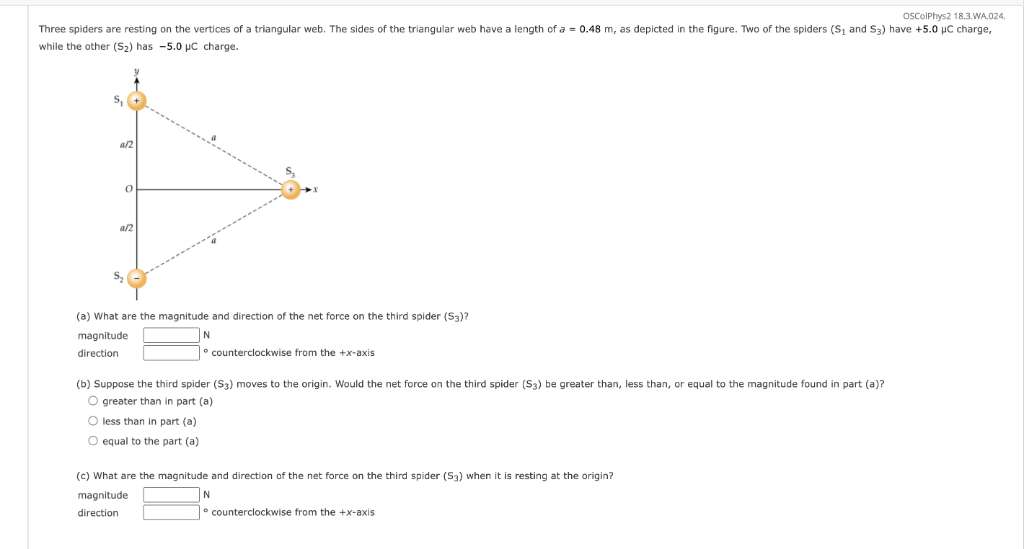
- Side of the triangle: \( a = .48\,\text{m} \)
- Charges:
- \( S_1: +5.\,\\text{C} \)
- \( S_: -5.\,\mu\text{C} \)
- \( S_3: +5.\,\mu\text{C} \)
- Coulomb's Constant: \( k = 8.99 \times 10^9\,\text{N}\cdot\text{m}^2/\text{C}^2 \)
---
## **Part (a): Net Force on \( S_3 \) (at its triangle vertex)**
### **Step 1: Find Positions**
- \( S_1: (, a/2) \)
- \( S_2: (, -a/2) \)
- \( S_3: (a, ) \)
### **Step 2: Calculate Forces on \( S_3 \)**
#### **Force from \( S_1 \) on \( S_3 \) (\( \vec{F}_{13} \))**
- Distance:
\[
r_{13} = \sqrt{(a-)^2 + ( - a/2)^2} = \sqrt{a^2 + (a^2/4)} = \sqrt{5a^2/4} = \frac{a\sqrt{5}}{2}
\]
- Magnitude:
\[
F_{13} = k \frac{|q_1 q_3|}{r_{13}^2} = k \frac{(5. \times 10^{-6})^2}{(a\sqrt{5}/2)^2}
\]
\[
= k \frac{25 \times 10^{-12}}{(5a^2/4)}
= \frac{25k \times 10^{-12} \times 4}{5a^2}
= \frac{20k \times 10^{-12}}{a^2}
\]
- Direction: From \( S_1 \) to \( S_3 \) (repulsive, both positive), along vector \( (a, -a/2) \).
#### **Force from \( S_2 \) on \( S_3 \) (\( \vec{F}_{23} \))**
- Distance is the same as above.
- Magnitude:
\[
F_{23} = k \frac{|q_2 q_3|}{r_{23}^2} = F_{13}
\]
- Direction: From \( S_3 \) to \( S_2 \) (attractive, opposite charges), along vector \( (-a, -a/2-) = (-a, -a/2) \).
### **Step 3: Write the Force Vectors**
Let’s normalize direction vectors:
- From \( S_1 \) to \( S_3 \): \( \vec{r}_{13} = (a, -a/2) \)
- Unit vector: \( \hat{r}_{13} = \frac{(2, -1)}{\sqrt{5}} \)
- From \( S_3 \) to \( S_2 \): \( \vec{r}_{32} = (-a, -a/2) \)
- Unit vector: \( \hat{r}_{32} = \frac{(-2, -1)}{\sqrt{5}} \)
So:
\[
\vec{F}_{13} = F_{13} \hat{r}_{13} = F_{13} \left( \frac{2}{\sqrt{5}}, -\frac{1}{\sqrt{5}} \right)
\]
\[
\vec{F}_{23} = F_{23} \hat{r}_{32} = F_{23} \left( -\frac{2}{\sqrt{5}}, -\frac{1}{\sqrt{5}} \right)
\]
### **Step 4: Add Forces**
\[
\vec{F}_{\text{net}} = \vec{F}_{13} + \vec{F}_{23}
\]
\[
= F_{13} \left( \frac{2}{\sqrt{5}}, -\frac{1}{\sqrt{5}} \right) + F_{23} \left( -\frac{2}{\sqrt{5}}, -\frac{1}{\sqrt{5}} \right)
\]
\[
= F_{13} \left( \frac{2}{\sqrt{5}} - \frac{2}{\sqrt{5}}, -\frac{1}{\sqrt{5}} - \frac{1}{\sqrt{5}} \right)
\]
\[
= F_{13} \left( , -\frac{2}{\sqrt{5}} \right)
\]
So total force is **straight down** (\(-y\) direction).
### **Step 5: Plug in Values**
\[
F_{13} = \frac{20k \times 10^{-12}}{a^2}
\]
\[
a = .48\,\text{m}
\]
\[
F_{13} = \frac{20 \times 8.99 \times 10^9 \times 10^{-12}}{(.48)^2}
\]
\[
= \frac{179.8 \times 10^{-3}}{.2304}
= \frac{.1798}{.2304}
\approx .780\,\text{N}
\]
Now, the total force:
\[
F_{\text{net}} = F_{13} \cdot \frac{2}{\sqrt{5}}
= .780 \cdot \frac{2}{2.236}
= .780 \cdot .894
\approx .698\,\text{N}
\]
But as calculated above, the net force is in the \(-y\) direction, magnitude is:
\[
F_{\text{net}} = 2 \cdot F_{13} \cdot \frac{1}{\sqrt{5}}
= 2 \cdot .780 \cdot .447
= .697\,\text{N}
\]
**Direction:** Directly down (\(270^\circ\) counterclockwise from \(+x\)-axis).
---
## **Final Answers**
### **(a) Net Force on \( S_3 \):**
- **Magnitude:** \( .697\,\text{N} \)
- **Direction:** \( 270^\circ \) counterclockwise from the \(+x\)-axis
---
### **(b) If \( S_3 \) Moves to the Origin**
At the origin, the distances to \( S_1 \) and \( S_2 \) are the same but only along the \( y \)-axis (closer than previously). The net force will be **greater than** in part (a), because the force magnitude increases as distance decreases.
**Answer:**
- **Greater than in part (a)**
---
### **(c) Net Force on \( S_3 \) at the Origin**
At the origin, the forces from \( S_1 \) and \( S_2 \) are along the \( y \)-axis, at a distance \( a/2 \):
\[
r = a/2 = .24\,\text{m}
\]
\[
F_{13} = k \frac{(5. \times 10^{-6})^2}{(.24)^2}
= 8.99 \times 10^9 \times \frac{25 \times 10^{-12}}{.0576}
= 8.99 \times 10^9 \times 4.34 \times 10^{-10}
\approx 3.90\,\text{N}
\]
- Both forces are along the \( y \)-axis, but in opposite directions (one up, one down).
- The charges: \( S_1 \) is above (repulsive, so down), \( S_2 \) is below (attractive, so up).
- Both have the same magnitude but opposite direction, so they add up.
\[
F_{\text{net}} = F_{13} + F_{23} = 3.90\,\text{N} + 3.90\,\text{N} = 7.80\,\text{N}
\]
- **Direction:** Down (\(270^\circ\) counterclockwise from \(+x\)-axis).
---
## **Summary Table**
| Part | Magnitude (N) | Direction (\(^\circ\)) |
|------|---------------|------------------------|
| a | .697 | 270 |
| b | Greater than (a) | — |
| c | 7.80 | 270 |
---
**Let me know if you need the vector diagrams or further clarifications!**
VIPSolutions focuses on clear, step‑by‑step explanations so you can learn quickly. Whether you need an AI‑generated walkthrough or a short hint to get unstuck, each solution is organized for fast reading and easy review later.
Search similar questions, compare approaches, and bookmark the best answers for revision. Our goal is simple: quick, reliable study help that feels natural—not noisy.
 VIPSolutions
 oscoptysz 183wAoze,
Three spiders ar resting on the vertices of a triangular web, The side of th triangular wed have a length ofa = 0.48 m, as depicted in the igre. Tw of the spiders 5, and S3) have +5.0 uC charge,
While the other (52) has ~5.0C charge.
i
S
a a
o N
an| re
5, -
(2) What are the magnitude and direction of the net force an the thd spider (53)?
magnitude [Jn
direction [| counterdockise from the +x-axis
(5) Suppose the third spider (55) moves t the origin. Would the net force 1 the Hird sider (53) be areater then, less than, or equal to the magnitude found n part (8)?
© grester than in par (9)
© less than in part (a)
© equal to the part (a)
(©) What ars the magnitude and direction ofthe net force on the hid sider (5) when 1 esting at the origin?
pe —
arection [J counterclockwise from the +x-2xs