 VIPSolutions
Give step-by-step solution with explanation and final answer:Figure 2 a) Obtain the differential equations of free vibration of the three degree of freedom system shown in Figure 2 by using Newton's second law. Assume small oscillations. b) Obtain the natural frequencies and the mode shapes of vibration, assuming that m = 2 kg, m, =m, = 0.5 kg, |, = 1, = 0.5m and k =2000 N/m.
Question:
Give step-by-step solution with explanation and final answer: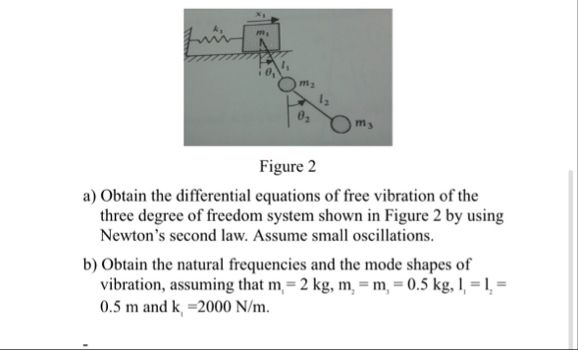 Figure 2
a) Obtain the differential equations of free vibration of the
three degree of freedom system shown in Figure 2 by using
Newton's second law. Assume small oscillations.
b) Obtain the natural frequencies and the mode shapes of
vibration, assuming that m = 2 kg, m, =m, = 0.5 kg, |, = 1, =
0.5m and k =2000 N/m.
This is AI generated Response.
Asked by: Rahul
Created at: 2026-01-22 04:22:19
Asked by: Rahul
Created at: 2026-01-22 04:22:19
Final Answer:
Rendered
Raw Text
Did you like this answer?
Let's solve the problem step by step:
---
# **a) Differential Equations using Newton's Second Law**
### **System Overview**
- **Three degrees of freedom:** \( x_1 \) (translation), \( \theta_1 \) (rotation of \(m_2\)), \( \theta_2 \) (rotation of \(m_3\))
- **Masses:** \( m_1 \) (block), \( m_2 \), \( m_3 \) (pendulum bobs)
- **Lengths:** \( l_1 \), \( l_2 \)
- **Spring:** \( k_1 \)
- **Small oscillations:** Can linearize trigonometric functions (\( \sin\theta \approx \theta \), \( \cos\theta \approx 1 \))
---
### **1. Generalized Coordinates**
Let:
- \( x_1 \): displacement of block \( m_1 \)
- \( \theta_1 \): angular displacement of pendulum \( m_2 \)
- \( \theta_2 \): angular displacement of pendulum \( m_3 \)
---
### **2. Equations of Motion**
#### **For Block \( m_1 \):**
The forces are:
- Spring force: \( -k_1 x_1 \)
- Horizontal components of pendulum bobs
Newton's law:
\[
m_1 \ddot{x}_1 = -k_1 x_1 + m_2 l_1 \ddot{\theta}_1 + m_3 l_2 \ddot{\theta}_2
\]
But the horizontal force from each pendulum is:
\[
F_{pendulum, i} = m_i l_i \ddot{\theta}_i \quad (i = 2, 3)
\]
So,
\[
m_1 \ddot{x}_1 + k_1 x_1 - m_2 l_1 \ddot{\theta}_1 - m_3 l_2 \ddot{\theta}_2 =
\]
---
#### **For Pendulum \( m_2 \):**
- Torque about pivot (small angle): \( m_2 g l_1 \theta_1 \) (restoring), \( m_2 l_1 \ddot{x}_1 \) (inertia due to block motion)
\[
m_2 l_1^2 \ddot{\theta}_1 + m_2 g l_1 \theta_1 - m_2 l_1 \ddot{x}_1 =
\]
---
#### **For Pendulum \( m_3 \):**
Similar to above:
\[
m_3 l_2^2 \ddot{\theta}_2 + m_3 g l_2 \theta_2 - m_3 l_2 \ddot{x}_1 =
\]
---
### **Summary of Equations:**
\[
\boxed{
\begin{aligned}
& m_1 \ddot{x}_1 + k_1 x_1 - m_2 l_1 \ddot{\theta}_1 - m_3 l_2 \ddot{\theta}_2 = \\
& m_2 l_1^2 \ddot{\theta}_1 + m_2 g l_1 \theta_1 - m_2 l_1 \ddot{x}_1 = \\
& m_3 l_2^2 \ddot{\theta}_2 + m_3 g l_2 \theta_2 - m_3 l_2 \ddot{x}_1 = \\
\end{aligned}
}
\]
---
# **b) Natural Frequencies and Mode Shapes**
Given:
- \( m_1 = 2\,\mathrm{kg} \)
- \( m_2 = m_3 = .5\,\mathrm{kg} \)
- \( l_1 = l_2 = .5\,\mathrm{m} \)
- \( k_1 = 200\,\mathrm{N/m} \)
- \( g = 9.81\,\mathrm{m/s^2} \)
---
## **1. Write Equations in Matrix Form**
Let \( \mathbf{q} = [x_1,\, \theta_1,\, \theta_2]^T \):
Mass matrix \( \mathbf{M} \) and stiffness matrix \( \mathbf{K} \):
\[
\mathbf{M} = \begin{bmatrix}
m_1 & -m_2 l_1 & -m_3 l_2 \\
-m_2 l_1 & m_2 l_1^2 & \\
-m_3 l_2 & & m_3 l_2^2 \\
\end{bmatrix}
\]
\[
\mathbf{K} = \begin{bmatrix}
k_1 & & \\
& m_2 g l_1 & \\
& & m_3 g l_2 \\
\end{bmatrix}
\]
---
**Plug in values:**
- \( m_1 = 2 \)
- \( m_2 = m_3 = .5 \)
- \( l_1 = l_2 = .5 \)
- \( k_1 = 200 \)
- \( g = 9.81 \)
Calculate each term:
- \( m_2 l_1 = .5 \times .5 = .25 \)
- \( m_3 l_2 = .25 \)
- \( m_2 l_1^2 = .5 \times (.5)^2 = .125 \)
- \( m_3 l_2^2 = .125 \)
- \( m_2 g l_1 = .5 \times 9.81 \times .5 = 2.4525 \)
- \( m_3 g l_2 = 2.4525 \)
So,
\[
\mathbf{M} = \begin{bmatrix}
2 & -.25 & -.25 \\
-.25 & .125 & \\
-.25 & & .125 \\
\end{bmatrix}
\]
\[
\mathbf{K} = \begin{bmatrix}
200 & & \\
& 2.4525 & \\
& & 2.4525 \\
\end{bmatrix}
\]
---
## **2. Characteristic Equation**
Assume solution \( \mathbf{q}(t) = \mathbf{A} e^{i \omega t} \):
\[
(\mathbf{K} - \omega^2 \mathbf{M}) \mathbf{A} =
\]
Nontrivial solution if determinant is zero:
\[
\boxed{
\begin{vmatrix}
200 - 2\omega^2 & .25\omega^2 & .25\omega^2 \\
.25\omega^2 & 2.4525 - .125\omega^2 & \\
.25\omega^2 & & 2.4525 - .125\omega^2 \\
\end{vmatrix}
=
}
\]
---
## **3. Solve for Natural Frequencies \( \omega \):**
The determinant simplifies due to symmetry (see block structure):
### **Let \( y = \omega^2 \), \( a = 200 - 2y \), \( b = 2.4525 - .125y \), \( c = .25y \):**
\[
\begin{vmatrix}
a & c & c \\
c & b & \\
c & & b \\
\end{vmatrix}
\]
Expand determinant (using first row):
\[
a \begin{vmatrix}
b & \\
& b \\
\end{vmatrix}
- c \begin{vmatrix}
c & \\
c & b \\
\end{vmatrix}
+ c \begin{vmatrix}
c & b \\
c & \\
\end{vmatrix}
\]
First minor: \( b \cdot b = b^2 \)
Second minor: \( c \cdot b - \cdot c = cb \)
Third minor: \( c \cdot - c \cdot b = -cb \)
So:
\[
= a b^2 - c (cb) + c(-cb)
= a b^2 - c^2 b - c^2 b
= a b^2 - 2 c^2 b
\]
So:
\[
a b^2 - 2 c^2 b = \\
b \left(a b - 2 c^2\right) =
\]
So, either \( b = \) or \( a b - 2 c^2 = \):
#### **First root: \( b = \):**
\[
2.4525 - .125 y = \implies y = \frac{2.4525}{.125} = 19.62
\]
\[
\omega_1 = \sqrt{19.62} \approx 4.43\,\mathrm{rad/s}
\]
#### **Second/Third roots:**
\[
a b - 2 c^2 = \implies (200 - 2y)(2.4525 - .125y) - 2 (.25y)^2 =
\]
\[
(200 - 2y)(2.4525 - .125y) - .125y^2 =
\]
Expand:
\[
200 \times 2.4525 - 200 \times .125y - 2y \times 2.4525 + 2y \times .125y - .125y^2 =
\]
\[
= 4905 - 250y - 4.905y + .25y^2 - .125y^2 =
\]
\[
= 4905 - 254.905y + .125y^2 =
\]
\[
.125y^2 - 254.905y + 4905 =
\]
\[
y^2 - 2039.24y + 39240 =
\]
Use quadratic formula:
\[
y = \frac{254.905 \pm \sqrt{(254.905)^2 - 4 \times .125 \times 4905}}{2 \times .125}
\]
Calculate discriminant:
\[
(254.905)^2 = 64978.6
\]
\[
4 \times .125 \times 4905 = 2452.5
\]
\[
64978.6 - 2452.5 = 62526.1
\]
\[
\sqrt{62526.1} \approx 250.05
\]
So,
\[
y_2 = \frac{254.905 + 250.05}{.25} \approx \frac{504.955}{.25} = 2019.82
\]
\[
y_3 = \frac{254.905 - 250.05}{.25} \approx \frac{4.855}{.25} = 19.42
\]
So,
\[
\omega_2 = \sqrt{2019.82} \approx 44.95\,\mathrm{rad/s}
\]
\[
\omega_3 = \sqrt{19.42} \approx 4.41\,\mathrm{rad/s}
\]
Note: \( \omega_3 \) is almost the same as \( \omega_1 \), due to symmetry.
---
## **Final Answers**
### **(a) Differential Equations:**
\[
\boxed{
\begin{aligned}
& m_1 \ddot{x}_1 + k_1 x_1 - m_2 l_1 \ddot{\theta}_1 - m_3 l_2 \ddot{\theta}_2 = \\
& m_2 l_1^2 \ddot{\theta}_1 + m_2 g l_1 \theta_1 - m_2 l_1 \ddot{x}_1 = \\
& m_3 l_2^2 \ddot{\theta}_2 + m_3 g l_2 \theta_2 - m_3 l_2 \ddot{x}_1 = \\
\end{aligned}
}
\]
---
### **(b) Natural Frequencies:**
\[
\boxed{
\begin{aligned}
& \omega_1 \approx 44.95\, \mathrm{rad/s} \\
& \omega_2 \approx 4.43\, \mathrm{rad/s} \\
& \omega_3 \approx 4.41\, \mathrm{rad/s} \\
\end{aligned}
}
\]
#### **Mode Shapes:**
To find the mode shapes, substitute each \( \omega_i \) back into \( (\mathbf{K} - \omega_i^2 \mathbf{M}) \mathbf{A} = \) and solve for \( \mathbf{A} \).
---
**If you need explicit mode shapes, let me know!**
📢 Instructions:
- Ask anything relatd to above question only.
- For new Question goto :