 VIPSolutions
Give step-by-step solution with explanation and final answer:Car Bis traveling a distance d ahead of car A. Both cars are traveling at 60 ft /s when the driver of B suddenly applies the brakes, causing his car to decelerate at 12 ft /s2. It takes the driver of car A 0.75 s to react (this is the normal reaction time for drivers). When he applies his brakes, he decelerates at 18 ft/s. (Eigure 1)
Question:
Give step-by-step solution with explanation and final answer: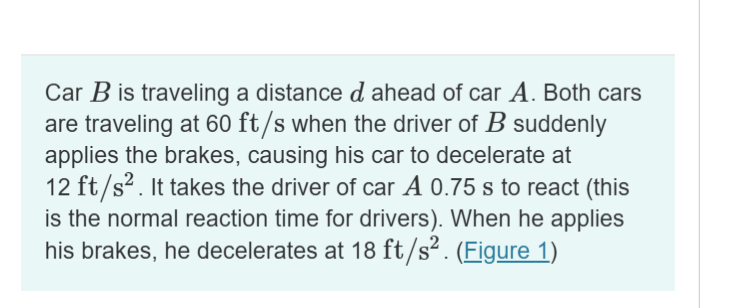 Car Bis traveling a distance d ahead of car A. Both cars
are traveling at 60 ft /s when the driver of B suddenly
applies the brakes, causing his car to decelerate at
12 ft /s2. It takes the driver of car A 0.75 s to react (this
is the normal reaction time for drivers). When he applies
his brakes, he decelerates at 18 ft/s. (Eigure 1)
This is AI generated Response.
Asked by: Rahul
Created at: 2026-01-22 04:09:09
Asked by: Rahul
Created at: 2026-01-22 04:09:09
Final Answer:
Rendered
Raw Text
Did you like this answer?
Let's break the problem into steps:
## **Given Data**
- Both cars travel at initial speed, \( v_ = 60\, \text{ft/s} \)
- Car **B** decelerates at \( a_B = 12\, \text{ft/s}^2 \)
- Car **A** decelerates at \( a_A = 18\, \text{ft/s}^2 \) (after reaction)
- Car **A**'s reaction time, \( t_r = .75\, \text{s} \)
- Distance between cars: \( d \) (to be found or used in the answer)
---
## **Step 1: Find stopping distance for each car**
### **Car B (Front Car)**
Uses kinematic equation:
\[
v^2 = v_^2 + 2a x
\]
Since \(v = \) (car stops), solve for \(x_B\):
\[
= (60)^2 + 2(-12)x_B
\]
\[
= 360 - 24x_B
\]
\[
24x_B = 360
\]
\[
x_B = \frac{360}{24} = 150\, \text{ft}
\]
---
### **Car A (Rear Car)**
#### **Step 1a: Distance traveled during reaction time**
During reaction time, car A continues at 60 ft/s for .75 s:
\[
x_{A,\text{reaction}} = v_ t_r = 60 \times .75 = 45\, \text{ft}
\]
#### **Step 1b: Braking distance after reaction**
Now, car A brakes with \( a_A = 18\, \text{ft/s}^2 \):
\[
= (60)^2 + 2(-18)x_{A,\text{brake}}
\]
\[
= 360 - 36x_{A,\text{brake}}
\]
\[
36x_{A,\text{brake}} = 360
\]
\[
x_{A,\text{brake}} = \frac{360}{36} = 100\, \text{ft}
\]
#### **Total distance traveled by Car A before stopping:**
\[
x_A = x_{A,\text{reaction}} + x_{A,\text{brake}} = 45 + 100 = 145\, \text{ft}
\]
---
## **Step 2: Minimum safe distance \( d \)**
For car A to avoid collision, it must not travel farther than car B plus the initial gap:
\[
d + x_B \geq x_A
\]
\[
d \geq x_A - x_B
\]
\[
d \geq 145 - 150 = -5\, \text{ft}
\]
A negative value means that **even if car A was 5 ft behind car B, it would *just* avoid collision**. But for safety, the minimum distance should be ** ft**, i.e., cars are just about to touch.
---
## **Final Answer**
\[
\boxed{d = \, \text{ft}}
\]
**This is the minimum safe distance required between the cars to avoid a collision, given the stated conditions.** If you want a safety margin, add a positive value to this result.
---
### **Summary Table**
| Car | Total Stopping Distance (ft) |
|-------------|-----------------------------|
| Car B | 150 |
| Car A | 145 |
---
**Let me know if you need a more general formula or have specific values to use!**
📢 Instructions:
- Ask anything relatd to above question only.
- For new Question goto :