 VIPSolutions
Give step-by-step solution with explanation and final answer:P —— k-
Question:
Give step-by-step solution with explanation and final answer: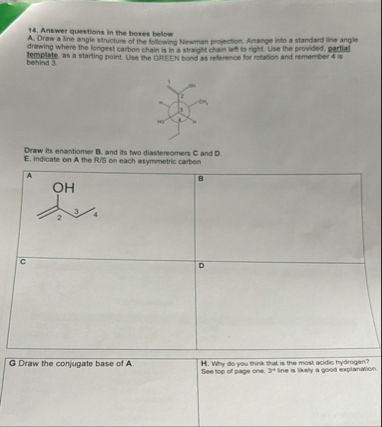 P —— k-
This is AI generated Response.
Asked by: Rahul
Created at: 2026-01-22 04:05:25
Asked by: Rahul
Created at: 2026-01-22 04:05:25
Final Answer:
Rendered
Raw Text
Did you like this answer?
Let's break down and answer each part step-by-step as requested.
---
## **Step 1: Draw Line Angle Structure (A)**
First, let's identify the molecule from the Newman projection.
### **Newman Projection Analysis**
- The projection shows a 4-carbon chain:
- C1: Has OH and H
- C2: Is central
- C3: Has CH₃ and H
- C4: Has CH₃
### **Line Angle Structure**
The longest carbon chain is 4 carbons:
- C1: Has OH group (let's assume it's 2-butanol based on the groups attached)
- C2 and C3: Internal
- C4: Terminal methyl
So, the structure is **2-butanol**: `CH3-CH(OH)-CH2-CH3`
Here's the line angle structure with numbers:
```markdown
OH
|
1 - 2 - 3 - 4
```
Or more conventionally:
```
OH
|
CH3-CH-CH2-CH3
```
### **Label R/S**
- **C2** (where OH is attached) is chiral.
- **C3** is not chiral.
#### **Assign Priorities for C2**
- OH > CH3CH2- > CH3 > H
If OH is drawn to the right, ethyl group down, CH₃ left, H back:
- With lowest priority (H) in the back, trace OH → ethyl → methyl:
- **Clockwise** = **R**
So, **C2 is R**.
---
## **Step 2: Draw Enantiomer B**
The enantiomer will have the opposite configuration at the chiral center.
- **B:** 2-butanol, but with **S** configuration.
- To show this, swap any two groups (e.g., swap OH and CH₃).
---
## **Step 3: Draw Diastereomers C and D**
Diastereomers require at least two chiral centers. In 2-butanol, there's only **one** chiral center. However, if the projection was interpreted as 2,3-butanediol or similar, then C3 could be chiral if it had an OH group instead of H.
However, **with the given structure**, only one chiral center is present, so diastereomers don't exist for this molecule.
---
## **Step 4: Draw Conjugate Base of A (G)**
Deprotonate the alcohol group:
- Remove H from OH, leaving O⁻.
- Structure: `CH3-CH(O⁻)-CH2-CH3`
---
## **Step 5: Most Acidic Hydrogen (H)**
The most acidic hydrogen is the one on the **OH group** because alcohol hydrogens are more acidic than alkyl hydrogens.
**Explanation:**
- The O-H bond is more polar, and the resulting conjugate base (alkoxide ion) is stabilized by the electronegative oxygen atom.
---
## **Summary Table**
| Structure | Description | Configuration |
|-----------|------------------------------------|---------------|
| A |  | 2R |
| B | Enantiomer (swap OH and CH₃) | 2S |
| C | Diastereomer (not possible here) | - |
| D | Diastereomer (not possible here) | - |
| G | Conjugate base: O⁻ instead of OH | - |
---
### **Final Answers in the Boxes**
**A:**
Drawn as above with (R) on C2.
**B:**
Mirror image of A, with (S) on C2.
**C & D:**
Not applicable (no diastereomers for 2-butanol).
**G:**
Draw structure with O⁻ at former OH position.
**H:**
The most acidic hydrogen is on the OH group because the conjugate base (alkoxide) is stabilized by the negative charge on oxygen.
---
Let me know if you need the actual drawings or further clarification!
📢 Instructions:
- Ask anything relatd to above question only.
- For new Question goto :