 VIPSolutions
Give step-by-step solution with explanation and final answer:In mass spectrometry, McLafferty Rearrangements are common in carbonyl compounds. Draw the daughter ion that would be observed in the mass spectrum resulting from McLafferty Rearrangement of this molecule. 0: POP. (]
Question:
Give step-by-step solution with explanation and final answer: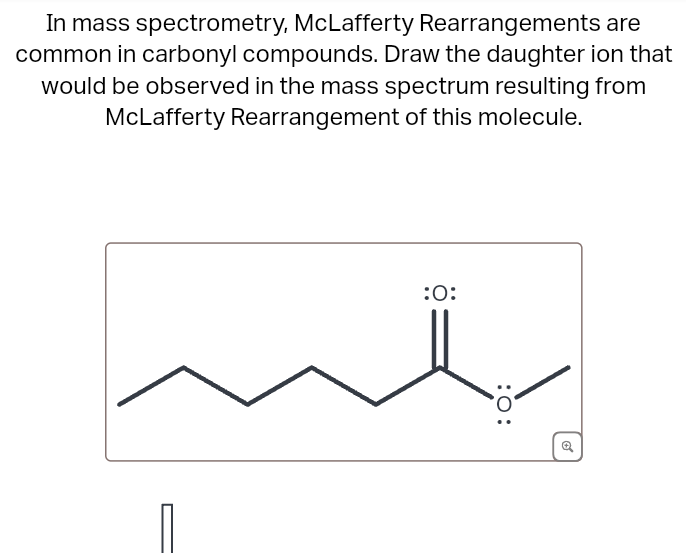 In mass spectrometry, McLafferty Rearrangements are
common in carbonyl compounds. Draw the daughter ion that
would be observed in the mass spectrum resulting from
McLafferty Rearrangement of this molecule.
0:
POP.
(]
This is AI generated Response.
Asked by: Rahul
Created at: 2026-01-22 04:01:00
Asked by: Rahul
Created at: 2026-01-22 04:01:00
Final Answer:
Rendered
Raw Text
Did you like this answer?
## Step-by-Step Solution
### 1. **Identify the Compound**
The structure is **ethyl hexanoate**, an ester with the formula:
```
CH3CH2CH2CH2CH2COOCH2CH3
```
### 2. **Locate the Carbonyl Group**
The carbonyl group (C=O) is in the ester functional group.
### 3. **McLafferty Rearrangement Overview**
The McLafferty rearrangement is a mass spectrometry fragmentation process that occurs in carbonyl compounds with a γ-hydrogen (a hydrogen three carbons away from the carbonyl carbon).
- **A six-membered cyclic transition state** forms, and the γ-hydrogen is transferred to the carbonyl oxygen, **cleaving the molecule**.
### 4. **Find the γ-Carbon**
- **α-carbon:** Adjacent to the carbonyl (ester) carbon.
- **β-carbon:** Second carbon away.
- **γ-carbon:** Third carbon away.
Let's number from the carbonyl carbon (in the main chain):
```
O=C-1-2-3-4-5-6
```
γ-Hydrogen is on **carbon 3**.
### 5. **McLafferty Rearrangement Mechanism**
- The γ-hydrogen is transferred to the carbonyl oxygen.
- The bond between the α and β carbons breaks, resulting in:
- An enol (or its tautomer) fragment **ion**
- A neutral alkene fragment
### 6. **Draw the Daughter Ion**
The daughter ion is the charged fragment containing the carbonyl group, now as an enol (due to the hydrogen transfer):
#### **Fragment after Cleavage**
- The main chain is cleaved between the α and β carbons.
- The γ-hydrogen is transferred to the carbonyl oxygen.
#### **Resulting Daughter Ion**
For ethyl hexanoate:
- The fragment containing the ester and three carbons from the main chain will remain as the ion.
**Structure:**
```
[CH2=CH-COOCH2CH3]^+
```
Or, more precisely, the enol form:
```
CH2=CH-COOCH2CH3^+
```
Alternatively, you can show the enol tautomer as:
```
CH3-CH=COOCH2CH3^+
```
But the important feature is the double bond between the α and β carbons.
---
## **Final Answer**
### **The daughter ion observed from McLafferty Rearrangement is:**
```
O
||
CH2=CH-C-OCH2CH3^+
```
- The positive charge is typically delocalized on the oxygen.
- The ion is called the **enol-ester fragment ion** (m/z = 101 for this molecule).
---
### **Summary Table**
| Step | Description |
|-----------------------------|---------------------------------------------|
| Identify γ-carbon | 3 carbons from carbonyl |
| Hydrogen transfer | γ-H to carbonyl oxygen |
| Bond cleavage | Between α and β carbons |
| Daughter ion | CH2=CH-COOCH2CH3^+ |
---
**[Drawn structure for clarity:]**
```
H2C=CH–C(=O)–O–CH2CH3 (with a positive charge)
```
This is the daughter ion you would observe in the mass spectrum after a McLafferty rearrangement of ethyl hexanoate.
📢 Instructions:
- Ask anything relatd to above question only.
- For new Question goto :