 VIPSolutions
Give step-by-step solution with explanation and final answer:Problem 9 (7% of Assignment Value) “The eeciric potential, which sa scalar fled, may be represented grpficaly by esupotental curves. The ins of electric fie may be obtained from those equipentals. A number of points have been specified with black dots on the drawing below. Consider the direction of the electric fiekd at each of those points, and move the best choice arrow label, or the E = 0 label, if appropriate, to the corresponding bucket. Grade Summary ® BE Deductions 10% 0.00 vv Potential 90% 30.00 v Submissions Attempts) Remaining: 1 , 10% Deduction 40.00 v tempt per . detailed view N 1 10% any] 60.09 Ll 80.00 V ]
Question:
Give step-by-step solution with explanation and final answer: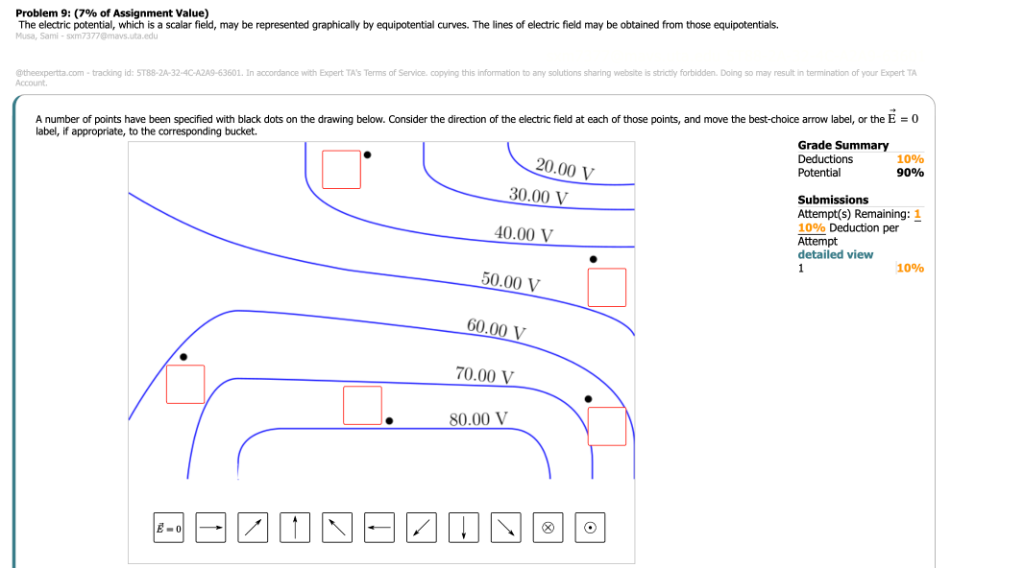 Problem 9 (7% of Assignment Value)
“The eeciric potential, which sa scalar fled, may be represented grpficaly by esupotental curves. The ins of electric fie may be obtained from those equipentals.
A number of points have been specified with black dots on the drawing below. Consider the direction of the electric fiekd at each of those points, and move the best choice arrow label, or the E = 0
label, if appropriate, to the corresponding bucket.
Grade Summary
® BE Deductions 10%
0.00 vv Potential 90%
30.00 v Submissions
Attempts) Remaining: 1
, 10% Deduction
40.00 v tempt per
. detailed view
N 1 10%
any]
60.09
Ll 80.00 V ]
This is AI generated Response.
Asked by: Rahul
Created at: 2026-01-22 03:47:45
Asked by: Rahul
Created at: 2026-01-22 03:47:45
Final Answer:
Rendered
Raw Text
Did you like this answer?
Let's break down the problem step by step:
---
## **Step 1: Understanding the Problem**
- **Equipotential Lines:** The blue lines are lines of constant electric potential (V).
- **Electric Field Direction:** The electric field (**E**) always points **from high potential to low potential** and is **perpendicular** to the equipotential lines.
- **Black Dots:** Your task is to determine the direction of **E** at each black dot.
---
## **Step 2: Analyzing Each Point**
Let's consider the position of each black dot relative to the equipotential lines.
---
### **Dot 1 (Top Left)**
- Between 20V and 30V lines.
- 30V is to the right, 20V is to the left.
- **E** points from high to low, so **left to right**.
**Arrow:** Right (→)
---
### **Dot 2 (Middle Left)**
- Between 30V and 40V lines.
- 40V is below, 30V is above.
- **E** points from high to low, so **up to down**.
**Arrow:** Down (↓)
---
### **Dot 3 (Middle Right)**
- Between 60V and 70V lines.
- 70V is below, 60V is above.
- **E** points from high to low, so **up to down**.
**Arrow:** Down (↓)
---
### **Dot 4 (Bottom Left)**
- Between 70V and 80V lines.
- 80V is to the right, 70V is to the left.
- **E** points from high to low, so **left to right**.
**Arrow:** Right (→)
---
### **Dot 5 (Bottom Right)**
- Between 70V and 80V lines.
- 80V is below, 70V is above.
- **E** points from high to low, so **up to down**.
**Arrow:** Down (↓)
---
## **Step 3: Final Answers**
| Dot Position | Direction of Electric Field |
|-----------------|----------------------------|
| Top Left | Right (→) |
| Middle Left | Down (↓) |
| Middle Right | Down (↓) |
| Bottom Left | Right (→) |
| Bottom Right | Down (↓) |
---
### **Summary of Explanation**
- The electric field is always perpendicular to equipotential lines.
- The direction is from higher potential to lower potential.
- Check the values of the equipotential lines near each dot to determine direction.
---
**If you need to drag arrows in the interface, use the right or down arrows as indicated above for each dot.**
📢 Instructions:
- Ask anything relatd to above question only.
- For new Question goto :