 VIPSolutions
Give step-by-step solution with explanation and final answer:2.17. Al the springs in Figure P2.17 are identical, each with spring constant K. The spring forces are zero when x; =x; =x3 =0. a. Draw the free-body diagrams, including the gravitational forces, and write the differential equations describing the system. b. Determine the constant elongation of each spring caused by the gravitational forces when the masses are stationary in position of static equilibrium and when fal) =0. g Ig Hi 3g gx B B . : al 3x i] i bd ; B EN By 2 3 Te 3 rv Jn Jo Figure P2.17 Figure P2.18
Question:
Give step-by-step solution with explanation and final answer: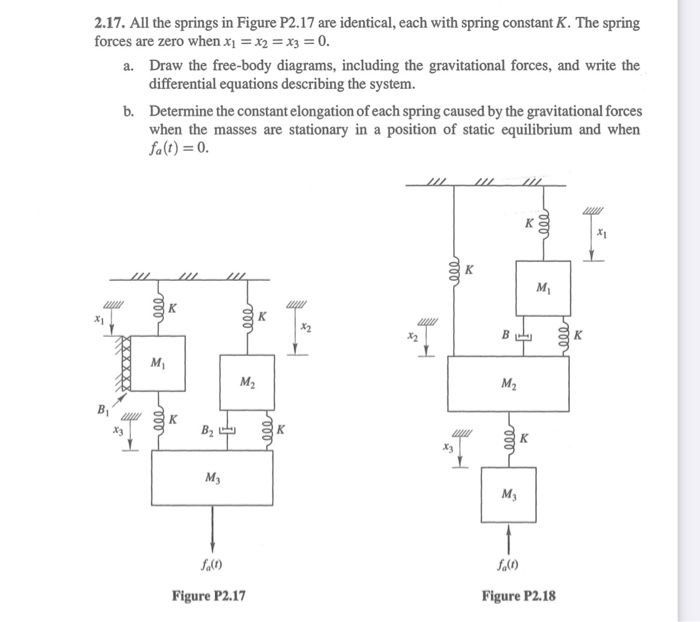 2.17. Al the springs in Figure P2.17 are identical, each with spring constant K. The spring
forces are zero when x; =x; =x3 =0.
a. Draw the free-body diagrams, including the gravitational forces, and write the
differential equations describing the system.
b. Determine the constant elongation of each spring caused by the gravitational forces
when the masses are stationary in position of static equilibrium and when
fal) =0.
g Ig
Hi 3g gx B B
. : al 3x
i]
i
bd
; B EN
By 2 3
Te 3 rv
Jn Jo
Figure P2.17 Figure P2.18
This is AI generated Response.
Asked by: Rahul
Created at: 2026-01-22 03:22:01
Asked by: Rahul
Created at: 2026-01-22 03:22:01
Final Answer:
Rendered
Raw Text
Did you like this answer?
Let's solve **Problem 2.17** step by step for **Figure P2.17**.
---
## (a) **Free-Body Diagrams and Equations of Motion**
### **Free-Body Diagrams**
#### **Mass M1**
- **Upward forces:**
- Spring force: \( K(x_2 - x_1) \) (from M2)
- Wall spring force: \( K(-x_1) \)
- **Downward forces:**
- Damping: \( B_1 \dot{x}_1 \)
- Gravity: \( M_1g \)
#### **Mass M2**
- **Upward forces:**
- Spring force: \( K(-x_2) \) (from ceiling)
- **Downward forces:**
- Spring force: \( K(x_3 - x_2) \) (to M3)
- Damping: \( B_2 \dot{x}_2 \)
- Gravity: \( M_2g \)
#### **Mass M3**
- **Upward forces:**
- Spring force: \( K(-x_3) \) (from ceiling)
- **Downward forces:**
- External force: \( f_a(t) \)
- Gravity: \( M_3g \)
---
### **Equations of Motion**
Let \( x_1, x_2, x_3 \) be the displacements **downward**. Using Newton's 2nd law:
#### **For \( M_1 \):**
\[
M_1 \ddot{x}_1 = -K x_1 + K(x_2 - x_1) - B_1 \dot{x}_1 - M_1g
\]
\[
M_1 \ddot{x}_1 + (2K) x_1 - K x_2 + B_1 \dot{x}_1 = -M_1 g
\]
---
#### **For \( M_2 \):**
\[
M_2 \ddot{x}_2 = -K x_2 + K(x_3 - x_2) - B_2 \dot{x}_2 - M_2g
\]
\[
M_2 \ddot{x}_2 + (2K) x_2 - K x_3 + B_2 \dot{x}_2 = -M_2 g
\]
---
#### **For \( M_3 \):**
\[
M_3 \ddot{x}_3 = -K x_3 + f_a(t) - M_3 g
\]
\[
M_3 \ddot{x}_3 + K x_3 = f_a(t) - M_3 g
\]
---
## (b) **Static Elongations (\( f_a(t) = \), system in equilibrium)**
At equilibrium, \( \ddot{x}_i = \), \( \dot{x}_i = \):
### **Equilibrium equations:**
- \( 2K x_1 - K x_2 = -M_1 g \)
- \( -K x_2 + K(x_3 - x_2) = -M_2 g \implies -2K x_2 + K x_3 = -M_2 g \)
- \( -K x_3 = -M_3 g \implies x_3 = \frac{M_3 g}{K} \)
---
### **Solve for \( x_2 \):**
From above: \( -2K x_2 + K x_3 = -M_2 g \)
\[
-2K x_2 + K \frac{M_3 g}{K} = -M_2 g
\implies -2K x_2 + M_3 g = -M_2 g
\implies -2K x_2 = -M_2 g - M_3 g
\implies x_2 = \frac{M_2 g + M_3 g}{2K}
\]
---
### **Solve for \( x_1 \):**
\[
2K x_1 - K x_2 = -M_1 g
\implies 2K x_1 - K \left( \frac{M_2 g + M_3 g}{2K} \right) = -M_1 g
\implies 2K x_1 - \frac{M_2 g + M_3 g}{2} = -M_1 g
\implies 2K x_1 = -M_1 g + \frac{M_2 g + M_3 g}{2}
\implies x_1 = \frac{-M_1 g + \frac{M_2 g + M_3 g}{2}}{2K}
\]
\[
x_1 = \frac{-2M_1 g + M_2 g + M_3 g}{4K}
\]
---
## **Final Answers**
### **Differential Equations:**
\[
\begin{align*}
M_1 \ddot{x}_1 + 2K x_1 - K x_2 + B_1 \dot{x}_1 &= -M_1 g \\
M_2 \ddot{x}_2 + 2K x_2 - K x_3 + B_2 \dot{x}_2 &= -M_2 g \\
M_3 \ddot{x}_3 + K x_3 &= f_a(t) - M_3 g \\
\end{align*}
\]
### **Static Elongations (\( f_a(t) = \)):**
\[
\boxed{
\begin{align*}
x_1 &= \frac{-2M_1 g + M_2 g + M_3 g}{4K} \\
x_2 &= \frac{(M_2 + M_3) g}{2K} \\
x_3 &= \frac{M_3 g}{K}
\end{align*}
}
\]
---
If you need the solution for Figure P2.18, let me know!
📢 Instructions:
- Ask anything relatd to above question only.
- For new Question goto :