 VIPSolutions
Give step-by-step solution with explanation and final answer:Required information A ball is dropped from a boat so that it strikes the surface of a lake with a speed of 16.5 ft/s. While in the water, the ball experiences an acceleration of @ = 10 — 0.8v, where aand vare expressed in ft/s” and fils, respectively. The ball takes 45500 s to reach the bottom of the lake. EE 7, re ee — ————————— BE Co —— — —_— ——_—— — Ae — —_——— — etermine the speed of the ball when it hits the bottom of the lake. he speed of the ball is [| ftls.
Question:
Give step-by-step solution with explanation and final answer: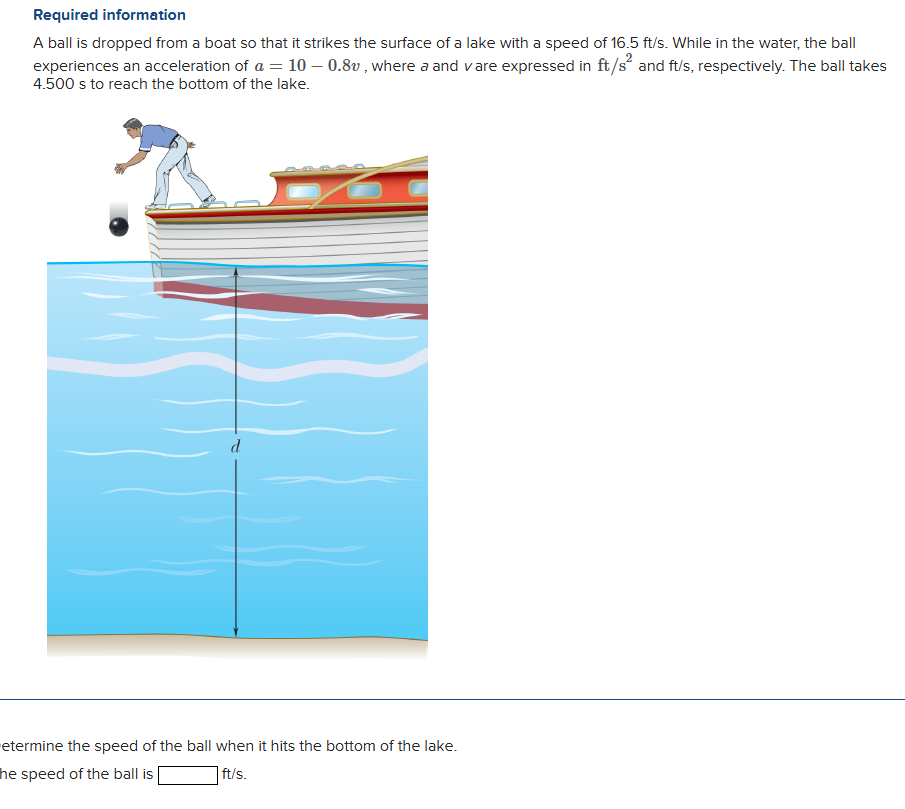 Required information
A ball is dropped from a boat so that it strikes the surface of a lake with a speed of 16.5 ft/s. While in the water, the ball
experiences an acceleration of @ = 10 — 0.8v, where aand vare expressed in ft/s” and fils, respectively. The ball takes
45500 s to reach the bottom of the lake.
EE
7, re
ee —
—————————
BE
Co —— —
—_— ——_——
— Ae —
—_———
—
etermine the speed of the ball when it hits the bottom of the lake.
he speed of the ball is [| ftls.
This is AI generated Response.
Asked by: Rahul
Created at: 2026-01-22 03:16:05
Asked by: Rahul
Created at: 2026-01-22 03:16:05
Final Answer:
Rendered
Raw Text
Did you like this answer?
Let's break down the problem step-by-step:
---
## **Given Data**
- Initial velocity when entering water, \( v_ = 16.5 \) ft/s
- Acceleration in water: \( a = 10 - .8v \) (in \( \text{ft/s}^2 \), \( v \) in ft/s)
- Time to reach bottom: \( t = 4.500 \) s
- **Required:** Final speed \( v \) when the ball hits the bottom
---
## **Step 1: Write the Differential Equation**
The acceleration is given as:
\[
a = \frac{dv}{dt} = 10 - .8v
\]
---
## **Step 2: Separate Variables and Integrate**
\[
\frac{dv}{dt} = 10 - .8v
\]
\[
\Rightarrow \frac{dv}{10 - .8v} = dt
\]
Integrate both sides:
\[
\int_{v_}^{v} \frac{dv}{10 - .8v} = \int_{}^{t} dt
\]
Let \( u = 10 - .8v \), so \( du = -.8 dv \), \( dv = \frac{du}{-.8} \):
\[
\int_{v_}^{v} \frac{dv}{10 - .8v} = -\frac{1}{.8} \int_{u_}^{u} \frac{du}{u}
\]
\[
= -\frac{1}{.8} [\ln(u)]_{u_}^{u}
\]
\[
= -\frac{1}{.8} [\ln(10 - .8v) - \ln(10 - .8v_)]
\]
\[
= -\frac{1}{.8} \ln \left( \frac{10 - .8v}{10 - .8v_} \right)
\]
Set equal to \( t \):
\[
-\frac{1}{.8} \ln \left( \frac{10 - .8v}{10 - .8v_} \right) = t
\]
---
## **Step 3: Solve for Final Speed \( v \)**
Let \( v_ = 16.5 \) ft/s, \( t = 4.5 \) s:
\[
-\frac{1}{.8} \ln \left( \frac{10 - .8v}{10 - .8 \times 16.5} \right) = 4.5
\]
\[
10 - .8 \times 16.5 = 10 - 13.2 = -3.2
\]
So:
\[
-\frac{1}{.8} \ln \left( \frac{10 - .8v}{-3.2} \right) = 4.5
\]
\[
\ln \left( \frac{10 - .8v}{-3.2} \right) = -.8 \times 4.5
\]
\[
= -3.6
\]
\[
\frac{10 - .8v}{-3.2} = e^{-3.6}
\]
\[
10 - .8v = -3.2 e^{-3.6}
\]
\[
-.8v = -3.2 e^{-3.6} - 10
\]
\[
.8v = 3.2 e^{-3.6} + 10
\]
\[
v = \frac{3.2 e^{-3.6} + 10}{.8}
\]
---
## **Step 4: Calculate the Value**
Find \( e^{-3.6} \):
\[
e^{-3.6} \approx .0273
\]
\[
3.2 \times .0273 \approx .08736
\]
\[
v = \frac{.08736 + 10}{.8}
\]
\[
v = \frac{10.08736}{.8}
\]
\[
v \approx 12.609 \text{ ft/s}
\]
---
## **Final Answer**
\[
\boxed{12.6 \text{ ft/s}}
\]
---
### **Summary Table**
| Step | Description | Value/Formula |
|------|------------------------------|------------------------|
| 1 | Write acceleration equation | \( a = 10 - .8v \) |
| 2 | Separate and integrate | See above |
| 3 | Plug in values, solve for \(v\) | \( v \approx 12.6 \) ft/s |
| 4 | **Final speed** | \(\boxed{12.6~\text{ft/s}}\) |
---
**The speed of the ball when it hits the bottom of the lake is \(\boxed{12.6~\text{ft/s}}\).**
Question:
Then solved
This is AI generated Response.
Asked by: Rahul
Created at: 2026-01-22 03:17:38
Asked by: Rahul
Created at: 2026-01-22 03:17:38
Final Answer:
Rendered
Raw Text
Did you like this answer?
# Step-by-Step Solution
## Given Data
- Initial velocity when entering water, \( v_0 = 16.5 \) ft/s
- Acceleration in water: \( a = 10 - 0.8v \) (in ft/s², \( v \) in ft/s)
- Time to reach bottom: \( t = 4.500 \) s
- **Required:** Final speed \( v \) when the ball hits the bottom
---
## Step 1: Write the Differential Equation
The acceleration is given as:
\[
a = \frac{dv}{dt} = 10 - 0.8v
\]
---
## Step 2: Separate Variables and Integrate
Rearranging gives:
\[
\frac{dv}{dt} = 10 - 0.8v
\]
\[
\Rightarrow \frac{dv}{10 - 0.8v} = dt
\]
Integrate both sides:
\[
\int_{v_0}^{v} \frac{dv}{10 - 0.8v} = \int_{}^{t} dt
\]
Let \( u = 10 - 0.8v \), then \( du = -0.8 dv \), or \( dv = \frac{du}{-0.8} \):
\[
\int_{v_0}^{v} \frac{dv}{10 - 0.8v} = -\frac{1}{0.8} \int_{u_0}^{u} \frac{du}{u}
\]
\[
= -\frac{1}{0.8} [\ln(u)]_{u_0}^{u}
\]
\[
= -\frac{1}{0.8} [\ln(10 - 0.8v) - \ln(10 - 0.8v_0)]
\]
\[
= -\frac{1}{0.8} \ln \left( \frac{10 - 0.8v}{10 - 0.8v_0} \right)
\]
Setting equal to \( t \):
\[
-\frac{1}{0.8} \ln \left( \frac{10 - 0.8v}{10 - 0.8v_0} \right) = t
\]
---
## Step 3: Solve for Final Speed \( v \)
Substituting \( v_0 = 16.5 \) ft/s and \( t = 4.5 \) s:
\[
-\frac{1}{0.8} \ln \left( \frac{10 - 0.8v}{10 - 0.8 \times 16.5} \right) = 4.5
\]
Calculating:
\[
10 - 0.8 \times 16.5 = 10 - 13.2 = -3.2
\]
Thus,
\[
-\frac{1}{0.8} \ln \left( \frac{10 - 0.8v}{-3.2} \right) = 4.5
\]
\[
\ln \left( \frac{10 - 0.8v}{-3.2} \right) = -0.8 \times 4.5 = -3.6
\]
\[
\frac{10 - 0.8v}{-3.2} = e^{-3.6}
\]
\[
10 - 0.8v = -3.2 e^{-3.6}
\]
\[
-0.8v = -3.2 e^{-3.6} - 10
\]
\[
0.8v = 3.2 e^{-3.6} + 10
\]
\[
v = \frac{3.2 e^{-3.6} + 10}{0.8}
\]
---
## Step 4: Calculate the Value
1. Calculate \( e^{-3.6} \):
\[
e^{-3.6} \approx 0.0273
\]
2. Substitute into the equation:
\[
3.2 \cdot 0.0273 \approx 0.08736
\]
\[
v = \frac{0.08736 + 10}{0.8}
\]
\[
v = \frac{10.08736}{0.8}
\]
\[
v \approx 12.609 \text{ ft/s}
\]
---
## Final Answer
The speed of the ball when it hits the bottom of the lake is:
\[
\boxed{12.6 \text{ ft/s}}
\]
---
### Summary Table
| Step | Description | Value/Formula |
|------|------------------------------|------------------------|
| 1 | Write acceleration equation | \( a = 10 - 0.8v \) |
| 2 | Separate and integrate | See above |
| 3 | Plug in values, solve for \(v\) | \( v \approx 12.6 \) ft/s |
| 4 | **Final speed** | \(\boxed{12.6~\text{ft/s}}\) |
📢 Instructions:
- Ask anything relatd to above question only.
- For new Question goto :