 VIPSolutions
Give step-by-step solution with explanation and final answer:xs Xx . Determine the product(s) of the following reaction and determine ifthey are orarenat. reductions. By > E Ey oa pees, od Hy, Pd/C La Bea al A RS ge E: BT, B SEN hi po in TL The Pes; we mCPBA i fie > Ee es i flor aa
Question:
Give step-by-step solution with explanation and final answer: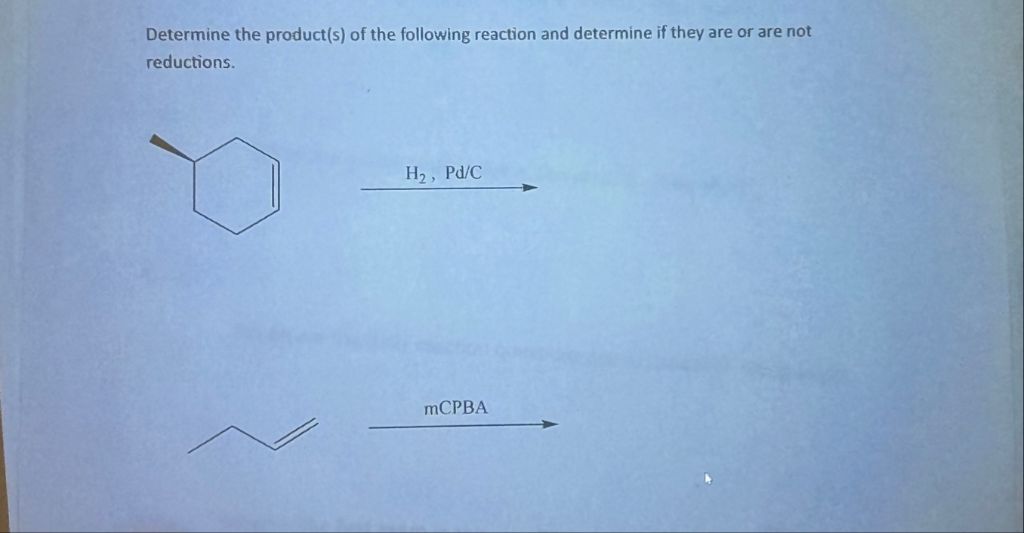 xs Xx .
Determine the product(s) of the following reaction and determine ifthey are orarenat.
reductions. By
> E Ey
oa pees,
od Hy, Pd/C La
Bea
al A
RS ge
E: BT,
B SEN
hi po
in TL The
Pes; we mCPBA i
fie > Ee
es i
flor aa
This is AI generated Response.
Asked by: Rahul
Created at: 2026-01-22 02:55:07
Asked by: Rahul
Created at: 2026-01-22 02:55:07
Final Answer:
Rendered
Raw Text
Did you like this answer?
Let's solve each reaction step-by-step.
---
## **1. Cyclohexene + H₂, Pd/C**
### **Step-by-Step Solution:**
- **Reagent:** H₂ (hydrogen gas) with Pd/C (palladium on carbon) is a catalyst for **catalytic hydrogenation**.
- **Reaction:** This reagent reduces (adds H₂ across) C=C double bonds, converting alkenes to alkanes.
- **Starting Material:** Methylcyclohexene (a six-membered ring with one double bond and a methyl group).
- **Product:** The double bond is reduced to a single bond, yielding **methylcyclohexane**.
**Reaction:**
\[
\text{Methylcyclohexene} \xrightarrow{\text{H}_2, \text{Pd/C}} \text{Methylcyclohexane}
\]
- **Reduction?** **Yes,** because hydrogen is being added to the molecule (increase in hydrogen, decrease in unsaturation).
---
## **2. 1-Butene + mCPBA**
### **Step-by-Step Solution:**
- **Reagent:** mCPBA (meta-Chloroperoxybenzoic acid) is a **peracid**.
- **Reaction:** mCPBA reacts with alkenes to form **epoxides** (epoxidation reaction).
- **Starting Material:** 1-butene (CH₂=CH-CH₂-CH₃).
- **Product:** The double bond forms a three-membered epoxide ring. Product is **1,2-epoxybutane** (butene oxide).
**Reaction:**
\[
\text{1-butene} \xrightarrow{\text{mCPBA}} \text{1,2-epoxybutane (butene oxide)}
\]
- **Reduction?** **No,** this is **not a reduction**. It's an oxidation, as an oxygen atom is inserted into the molecule.
---
## **Summary Table**
| Reaction | Product | Reduction? |
|----------|---------|------------|
| Methylcyclohexene + H₂, Pd/C | Methylcyclohexane | Yes |
| 1-Butene + mCPBA | 1,2-Epoxybutane (Butene oxide) | No |
---
### **Final Answers**
1. **Methylcyclohexene + H₂, Pd/C → Methylcyclohexane (This is a reduction)**
2. **1-Butene + mCPBA → 1,2-Epoxybutane (This is not a reduction, it is an oxidation)**
Let me know if you need the structures drawn!
📢 Instructions:
- Ask anything relatd to above question only.
- For new Question goto :