Give step-by-step solution with explanation and final answer:
(Give me answer without using bullet points)HEAT TRANSFER FINAL 2026
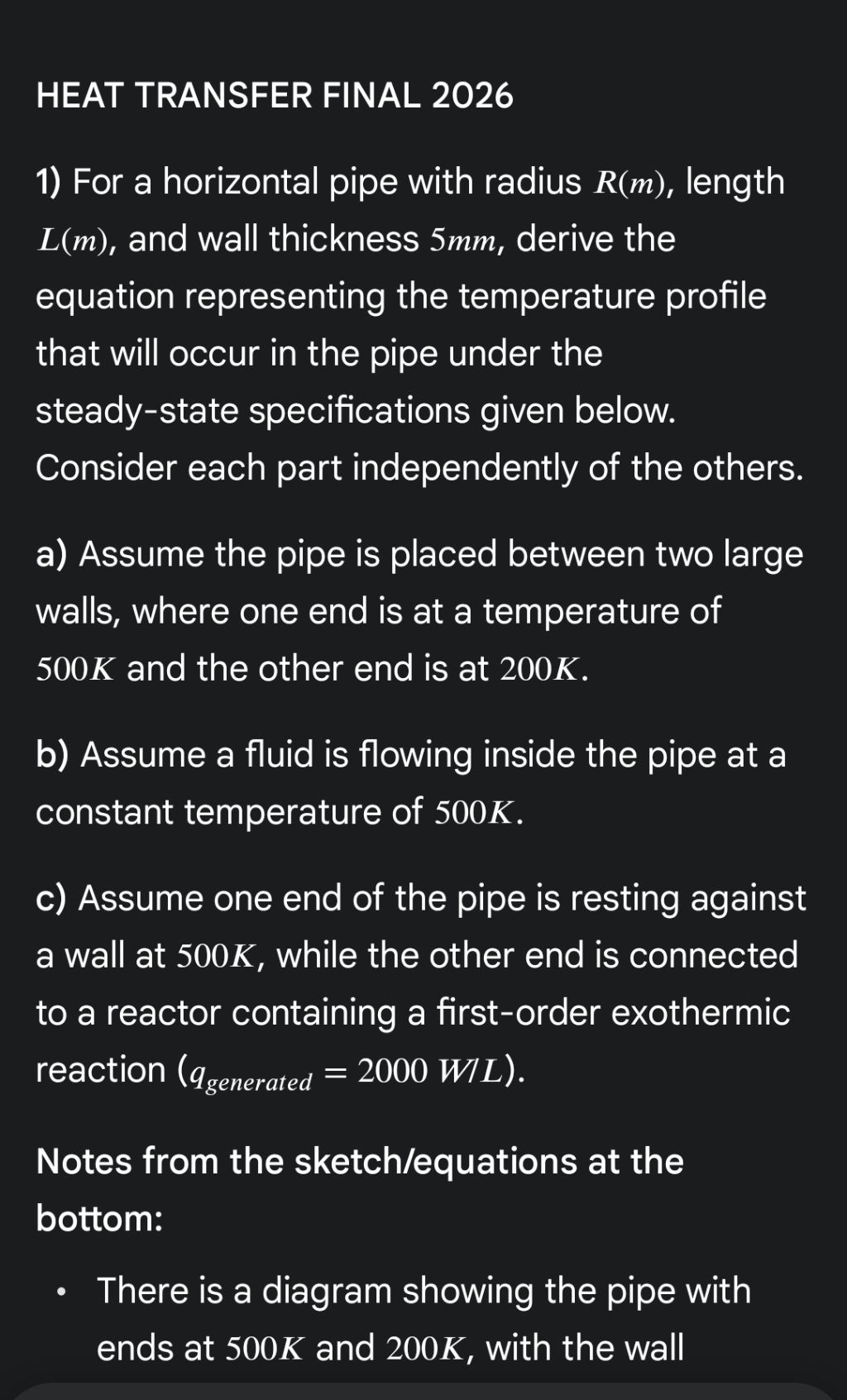
1) For a horizontal pipe with radius R(m), length
L(m), and wall thickness 5mm, derive the
equation representing the temperature profile
that will occur in the pipe under the
steady-state specifications given below.
Consider each part independently of the others.
a) Assume the pipe is placed between two large
walls, where one end is at a temperature of
500K and the other end is at 200K.
b) Assume a fluid is flowing inside the pipe at a
constant temperature of 500K.
c) Assume one end of the pipe is resting against
a wall at 500K, while the other end is connected
to a reactor containing a first-order exothermic
reaction (qenerarea = 2000 W/L).
Notes from the sketch/equations at the
bottom:
+ There is a diagram showing the pipe with
ends at 500K and 200K, with the wall
Question:
Give step-by-step solution with explanation and final answer:
(Give me answer without using bullet points)HEAT TRANSFER FINAL 2026
1) For a horizontal pipe with radius R(m), length
L(m), and wall thickness 5mm, derive the
equation representing the temperature profile
that will occur in the pipe under the
steady-state specifications given below.
Consider each part independently of the others.
a) Assume the pipe is placed between two large
walls, where one end is at a temperature of
500K and the other end is at 200K.
b) Assume a fluid is flowing inside the pipe at a
constant temperature of 500K.
c) Assume one end of the pipe is resting against
a wall at 500K, while the other end is connected
to a reactor containing a first-order exothermic
reaction (qenerarea = 2000 W/L).
Notes from the sketch/equations at the
bottom:
+ There is a diagram showing the pipe with
ends at 500K and 200K, with the wall
This is AI generated Response.
Asked by: Francis
Created at: 2026-01-21 23:29:29
Final Answer:
RenderedRaw Text
Did you like this answer?
## Step-by-Step Solution
Let's address each part independently as requested, focusing on deriving the temperature profile equation for a horizontal pipe under steady-state conditions.
---
### Given Data
- Pipe radius: \( R \) (in meters)
- Pipe length: \( L \) (in meters)
- Pipe wall thickness: \( 5 \) mm \( = .005 \) m
---
### Part (a): Pipe Between Two Walls at Different Temperatures
**Problem:**
One end at \( 500\,\text{K} \), the other at \( 200\,\text{K} \).
**Assumptions:**
- Steady-state, 1D heat conduction along the length (\( x \)-axis)
- No heat generation in the wall
- Constant thermal conductivity \( k \)
**Governing Equation:**
1D heat conduction equation without generation:
\[
\frac{d^2 T}{dx^2} =
\]
**Solution:**
Integrate twice:
\[
\frac{dT}{dx} = C_1
\]
\[
T(x) = C_1 x + C_2
\]
Apply boundary conditions:
- At \( x = \): \( T() = 500 \)
- At \( x = L \): \( T(L) = 200 \)
Plug in the boundary conditions:
\[
T() = C_1 \cdot + C_2 = 500 \implies C_2 = 500
\]
\[
T(L) = C_1 L + 500 = 200 \implies C_1 = \frac{200 - 500}{L} = -\frac{300}{L}
\]
**Final Answer (a):**
\[
T(x) = 500 - \frac{300}{L}x
\]
where \( x \) is the distance from the \( 500\,K \) end, \( \leq x \leq L \).
---
### Part (b): Pipe with Fluid Flowing Inside at 500 K
**Problem:**
Fluid inside at constant \( 500\,K \).
**Assumptions:**
- Inner surface maintained at \( 500\,K \) (isothermal boundary)
- Outer surface exposed to air (temperature not specified, so assume heat loss or insulation)
- If the pipe wall is thin and the fluid dominates, wall temperature equals fluid temperature
Since only the fluid temperature is given and no external temperature or heat flux is specified, the temperature profile in the wall will be uniform:
**Final Answer (b):**
\[
T(x) = 500\,K
\]
for all \( x \).
---
### Part (c): One End at 500 K, Other End with Internal Heat Generation
**Problem:**
- One end at \( 500\,K \)
- Other end connected to a reactor with first-order exothermic reaction (\( q_{generated} = 200\,W/L \))
**Assumptions:**
- Steady-state, 1D conduction with uniform internal heat generation
- Let \( q \) be the heat generated per unit volume (\( W/m^3 \)), but here it is given per unit length (\( W/L \)), so convert as needed
**Governing Equation:**
1D conduction with generation:
\[
\frac{d^2 T}{dx^2} + \frac{q}{k A} =
\]
where \( A \) is the cross-sectional area.
Given \( q_{generated} = 200\,W/L \), so per unit length, not per volume. For a pipe of length \( L \), the total heat generated is \( Q = 200 \times L \) W.
But for the differential equation, we need \( q \) per unit volume:
\[
q = \frac{q_{generated}}{A}
\]
where \( A = \pi (R_{outer}^2 - R_{inner}^2) \) and thickness \( = .005 \) m, so \( R_{outer} = R \), \( R_{inner} = R - .005 \).
Integrate twice:
\[
\frac{d^2 T}{dx^2} = -\frac{q}{k}
\]
\[
\frac{dT}{dx} = -\frac{q}{k}x + C_1
\]
\[
T(x) = -\frac{q}{2k}x^2 + C_1 x + C_2
\]
Apply boundary conditions:
- At \( x = \): \( T() = 500\,K \implies C_2 = 500 \)
- At \( x = L \): (if the reactor is at some temperature or has some heat flux, but if not specified, you can leave in terms of \( T(L) \))
If the end at \( x=L \) is insulated or specified at temperature \( T_L \), use that; otherwise, the generic solution:
**Final Answer (c):**
\[
T(x) = -\frac{q}{2k}x^2 + C_1 x + 500
\]
If the end at \( x=L \) is also held at a temperature \( T_L \), then:
\[
T(L) = -\frac{q}{2k}L^2 + C_1 L + 500 = T_L
\]
\[
C_1 = \frac{T_L - 500 + \frac{q}{2k}L^2}{L}
\]
So, the full temperature profile:
\[
T(x) = -\frac{q}{2k}x^2 + \left[\frac{T_L - 500 + \frac{q}{2k}L^2}{L}\right] x + 500
\]
where \( q = \frac{200}{A} \), \( A = \pi (R^2 - (R-.005)^2) \).
---
### **Summary Table**
| Part | Equation for \( T(x) \) |
|------|------------------------|
| (a) | \( T(x) = 500 - \frac{300}{L}x \) |
| (b) | \( T(x) = 500 \) |
| (c) | \( T(x) = -\frac{q}{2k}x^2 + C_1 x + 500 \) (with \( q = \frac{200}{A} \)), \( C_1 \) depends on \( T_L \) |
This approach covers the general steady-state heat profiles for each scenario described.
VIPSolutions focuses on clear, step‑by‑step explanations so you can learn quickly. Whether you need an AI‑generated walkthrough or a short hint to get unstuck, each solution is organized for fast reading and easy review later.
Search similar questions, compare approaches, and bookmark the best answers for revision. Our goal is simple: quick, reliable study help that feels natural—not noisy.
 VIPSolutions
 HEAT TRANSFER FINAL 2026
1) For a horizontal pipe with radius R(m), length
L(m), and wall thickness 5mm, derive the
equation representing the temperature profile
that will occur in the pipe under the
steady-state specifications given below.
Consider each part independently of the others.
a) Assume the pipe is placed between two large
walls, where one end is at a temperature of
500K and the other end is at 200K.
b) Assume a fluid is flowing inside the pipe at a
constant temperature of 500K.
c) Assume one end of the pipe is resting against
a wall at 500K, while the other end is connected
to a reactor containing a first-order exothermic
reaction (qenerarea = 2000 W/L).
Notes from the sketch/equations at the
bottom:
+ There is a diagram showing the pipe with
ends at 500K and 200K, with the wall