 VIPSolutions
Give step-by-step solution with explanation and final answer: {give me the answer without using bullet-points}(AT) The temperature measured with a bulb thermometer can be described by first-order differential equation, with time constant equals to 0.2 min. The thermometer was placed fn a 1 liter water bath with temperature 20°C. After the thermometer comes to equilibrium with the bath, the temperature of the water bath was quickly changed by adding 1 liter of water at 100°C{(for the purpose of this problem, at time, ¢ = 0.) You may assure that the perature of the water bath i constant at time, t > 0.
Question:
Give step-by-step solution with explanation and final answer:
{give me the answer without using bullet-points}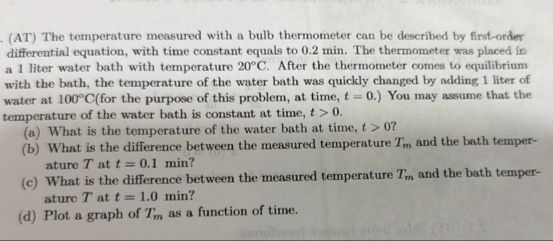 (AT) The temperature measured with a bulb thermometer can be described by first-order
differential equation, with time constant equals to 0.2 min. The thermometer was placed fn
a 1 liter water bath with temperature 20°C. After the thermometer comes to equilibrium
with the bath, the temperature of the water bath was quickly changed by adding 1 liter of
water at 100°C{(for the purpose of this problem, at time, ¢ = 0.) You may assure that the
perature of the water bath i constant at time, t > 0.
This is AI generated Response.
Asked by: singaluri krishna kumari
Created at: 2026-01-21 14:47:50
Asked by: singaluri krishna kumari
Created at: 2026-01-21 14:47:50
Final Answer:
Rendered
Raw Text
Did you like this answer?
Let's solve the problem **step-by-step** as requested.
## Step 1: Understanding the System
- **Thermometer Response**: First-order differential equation with time constant τ = .2 min.
- **Initial Temperature**: Both water bath and thermometer are at 20°C.
- **At t = **: Water bath temperature is suddenly increased (by mixing with hot water) and remains constant for t > .
## Step 2: Temperature of Water Bath After Mixing (Part a)
At t > , the new temperature of the water bath is found by mixing equal volumes of water at 20°C and 100°C:
\[
T_{\text{bath}} = \frac{1 \text{ L} \times 20^\circ\text{C} + 1 \text{ L} \times 100^\circ\text{C}}{2 \text{ L}} = \frac{20 + 100}{2} = 60^\circ\text{C}
\]
**Answer (a):** The temperature of the water bath at time \( t > \) is **60°C**.
---
## Step 3: Thermometer Response Equation
The first-order response of the thermometer is:
\[
\tau \frac{dT_m}{dt} + T_m = T
\]
where:
- \( \tau = .2 \) min
- \( T_m \) = thermometer reading
- \( T \) = water bath temperature (step change from 20°C to 60°C at t = )
Initially, \( T_m() = 20^\circ\text{C} \).
The solution for a step change is:
\[
T_m(t) = T_{\text{final}} + (T_{\text{initial}} - T_{\text{final}}) e^{-t/\tau}
\]
Substitute the values:
\[
T_m(t) = 60 + (20 - 60) e^{-t / .2}
\]
\[
T_m(t) = 60 - 40 e^{-5t}
\]
---
## Step 4: Find Differences at Specific Times
**For (b):** At \( t = .1 \) min
\[
T_m(.1) = 60 - 40 e^{-5 \times .1} = 60 - 40 e^{-.5}
\]
\[
e^{-.5} \approx .6065
\]
\[
T_m(.1) = 60 - 40 \times .6065 = 60 - 24.26 = 35.74^\circ\text{C}
\]
Difference:
\[
\Delta T = T - T_m(.1) = 60 - 35.74 = 24.26^\circ\text{C}
\]
---
**For (c):** At \( t = 1. \) min
\[
T_m(1.) = 60 - 40 e^{-5 \times 1.} = 60 - 40 e^{-5}
\]
\[
e^{-5} \approx .00674
\]
\[
T_m(1.) = 60 - 40 \times .00674 = 60 - .2696 = 59.73^\circ\text{C}
\]
Difference:
\[
\Delta T = 60 - 59.73 = .27^\circ\text{C}
\]
---
## Step 5: Plot \( T_m \) as a Function of Time (Part d)
The function is:
\[
T_m(t) = 60 - 40 e^{-5t}
\]
This is an exponential rise from 20°C at \( t = \) to 60°C as \( t \to \infty \).
You can sketch this by plotting \( T_m(t) \) for \( t \) from to 1. min.
- At \( t = \): \( T_m = 20^\circ\text{C} \)
- At \( t = .1 \): \( T_m \approx 35.74^\circ\text{C} \)
- At \( t = .2 \): \( T_m \approx 43.87^\circ\text{C} \)
- At \( t = .5 \): \( T_m \approx 56.79^\circ\text{C} \)
- At \( t = 1. \): \( T_m \approx 59.73^\circ\text{C} \)
The curve approaches 60°C asymptotically.
---
## Final Answers (Summary)
(a) The temperature of the water bath at time \( t > \) is **60°C**.
(b) The difference between the measured temperature and the bath temperature at \( t = .1 \) min is **24.26°C**.
(c) The difference at \( t = 1. \) min is **.27°C**.
(d) The measured temperature as a function of time is \( T_m(t) = 60 - 40 e^{-5t} \), which rises exponentially from 20°C to 60°C.
📢 Instructions:
- Ask anything relatd to above question only.
- For new Question goto :